Importing children’s clothing into the United States is not just about finding a supplier with a low price. It means coordinating product development, U.S. children’s apparel safety requirements, customs clearance, and the final landed cost. For brands sourcing kidswear from China or other countries, the first step is to define the product specifications, identify the responsible importer, and establish who will handle samples, testing, and import documentation.
This guide follows a children’s clothing order from design and manufacturer selection through delivery to a U.S. warehouse. You’ll learn how to choose suppliers, estimate duties and shipping expenses, prepare Children’s Product Certificates (CPCs) and garment labels, and reduce rework and compliance risks before bulk production.
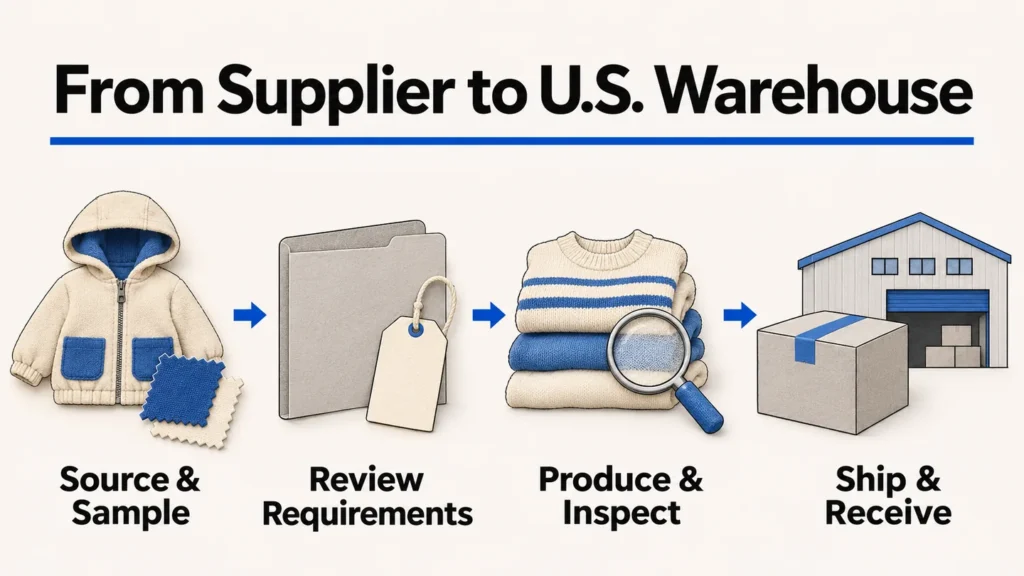
8 Steps to Import Children’s Clothing into the USA
| Step | Key Task | Main Responsible Party |
|---|---|---|
| 1. Define the products | Confirm styles, age ranges, sizes, materials, and quantities | Brand |
| 2. Select a manufacturer | Check the factory, development capabilities, MOQ, and quotation scope | Brand and supplier |
| 3. Review U.S. requirements | Identify applicable safety standards, labeling rules, and certification responsibilities | Importer and testing laboratory |
| 4. Approve samples | Review fit, fabrics, construction, packaging, and revisions | Brand and factory |
| 5. Calculate landed cost | Confirm product costs, testing, freight, duties, and destination charges | Brand, customs broker, and freight forwarder |
| 6. Produce and inspect | Manufacture against the approved sample and document corrections | Factory and brand |
| 7. Ship and clear customs | Prepare shipment documents, CPCs, and applicable eFiling data | Importer, customs broker, and freight forwarder |
| 8. Receive and inspect inventory | Check quantities, sizes, packaging, and product issues | Brand and receiving warehouse |
These eight steps establish the overall process, but some tasks can overlap. For example, while the factory develops samples, your customs broker can review the proposed tariff classification and the testing laboratory can assess applicable safety requirements. This helps prevent a finished garment from needing new labels or a different testing scope.
Define Your First U.S. Kidswear Order
Start by deciding which garments you want to sell and who will be responsible for bringing them into the United States. A clear product brief helps suppliers quote accurately, while defined responsibilities prevent important import tasks from being missed.
Start With a Clear Product Brief
Give suppliers enough detail to quote the same product. Include garment types, intended age ranges, fabric composition, garment measurements, colors, quantities by style, decoration methods, packaging requirements, and delivery destination. Reference images help communicate appearance, but measurements and construction notes are what make the brief actionable.
Explain how the clothing will be worn and marketed. An everyday outfit and a pajama set may look similar while requiring different safety assessments. Likewise, a size labeled “4 years” does not tell the factory the chest measurement or fit you expect.
For your first collection, consider limiting the number of styles while you learn how your supplier manages sample approvals and revisions. This reduces the specifications and changes you need to track, although the applicable requirements for each style still need to be checked individually.
When an overseas kidswear brand first contacts us at HAPA, we usually review its sketches or reference images, sales market, age and size range, preferred fabrics, expected quantity per style and color, and target delivery date. Once those details are clear, we can determine whether an existing pattern can be adapted or a new style needs to be developed from scratch. This also helps keep sampling, material sourcing, and quotations aligned. For customers sourcing children’s clothing from China for sale in the U.S., we also recommend identifying label, decoration, and other design details that may affect product testing early in development.
Decide Who Will Handle the Import
Assign responsibilities before paying for bulk production. A supplier manufactures the clothes, a freight forwarder can arrange transportation, and a customs broker can prepare customs declarations. Providing any of those services does not automatically make a company the importer of record (IOR).
Use the following table to discuss responsibilities, then confirm the arrangement in writing:
| Party | Main Responsibility to Confirm | Information or Documents Needed |
|---|---|---|
| Brand and responsible importer | Product decisions and applicable import obligations | Named contacts, approval authority, and access to records |
| Clothing supplier | Product development, manufacturing, and production records | Approved specifications, factory information, and shipment records |
| Testing laboratory | Testing within its relevant accepted scope | Applicable test plan and reports clearly linked to the products |
| Customs broker | Entry preparation and customs guidance | Classification review, filing instructions, and required authorizations |
| Freight forwarder or carrier | Transportation and delivery coordination | Routing, costs, milestones, and destination arrangements |
A single business may perform several of these roles. Rather than relying on job titles, confirm exactly which services and responsibilities are included.
What Do You Need to Import Children’s Clothing into the USA?
In addition to understanding your product requirements, you need an identified importer and a workable customs-entry arrangement. An import license, an importer identification number, and a product certificate are different things and should not be confused.
Understand Importer Registration and Identification
The United States does not require an import license for most goods, although individual government agencies may impose additional requirements for certain products. According to USAGov, import entry documentation requires an importer identification number, which may be the company’s IRS registration number or another accepted identifier, including a number assigned by U.S. Customs and Border Protection (CBP). Choose an arrangement that suits your business rather than assuming that importing apparel always requires forming a new U.S. company. The U.S. government’s import-license and identification guidance explains these options.
If your business already imports other products, confirm that its existing information is accurate and can be used for this shipment. Putting a new brand name on a garment does not necessarily require a new legal importing entity.
Arrange Customs Support Before Placing Your Order
Contact a licensed customs broker early enough to review the proposed goods. Formal customs entries generally require a customs bond. Ask your broker which entry procedure and bond arrangement apply rather than relying on a generic dollar threshold found online.
Before proceeding with the order, confirm:
- The legal name and identification details of the importer.
- Who will file the customs entry and any required product-certificate data.
- Which authorizations and bond arrangements must be completed.
- Who will receive customs questions and retrieve supporting documents promptly.
These preparations can also uncover expenses missing from a supplier’s quote before you commit to a retail price.
Where Can You Source Children’s Clothing for Your Brand?
You can source directly from manufacturers or find suppliers through B2B platforms, trade shows, and sourcing service providers. Choose a route that fits your products and the amount of development work your team can manage.
Four common sourcing channels are:
- Direct manufacturers: A good option when you want to discuss fabrics, fit, construction, and repeat orders with the company handling production. Confirm which operations it performs itself and which it subcontracts.
- B2B marketplaces: Alibaba.com and Made-in-China.com offer starting points for supplier discovery and product comparisons. Treat listings as leads to verify, not evidence that a product meets U.S. requirements.
- Trade shows: Useful for examining samples and discussing factory capabilities face to face. Before ordering, follow up with written specifications and business verification.
- Sourcing agents or trading partners: Useful when you need help coordinating suppliers or communicating across languages. Clarify fees, contractual responsibilities, and whether you can access the actual factory’s information.
Next, distinguish ready-stock wholesale, private-label production, and fully custom development. Stock products may reduce development work but still require checks of sizes, labels, and documentation. Custom manufacturing provides more control but adds sampling and approval steps.
If you’re developing your own kidswear brand, you can discuss design review, materials, labels, and production with HAPA through our private-label kidswear manufacturing services. We support OEM/ODM development, with standard custom orders starting at 100 pieces per style per color, with mixed sizes allowed. Special fabrics, trims, and processes may have separate minimum requirements, which must be confirmed for the project. Tell the supplier whether you plan to modify an existing style or develop a completely new one so it can prepare a relevant quotation.
How Do You Verify a Children’s Clothing Supplier?
Check the legal business, the actual production arrangement, and the evidence available for your planned products. A supplier saying “we export to the U.S.” may be useful background, but it does not prove that the company can meet the requirements of your order.
Confirm Who Will Actually Manufacture Your Order
Request the contracting company’s legal name and the name and address of the production factory. Ask whether any manufacturing will be subcontracted and how you will be notified if the production location changes. If the payment beneficiary differs from the contracting entity, resolve the discrepancy before transferring funds.
Factory identity also matters for customs. CBP requires manufacturer identification information for commercial textile and apparel imports. The Manufacturer Identification Code (MID) should be based on the business performing the relevant origin-conferring production operations. A trading company’s information cannot simply be substituted for that of the producing factory. Have your customs broker verify the correct details and code against CBP’s manufacturer identification requirements.
Ask for Evidence That Matches Your Products
Read the product descriptions and component details in the supplier’s test reports. Where required, check whether the laboratory is accepted for the relevant testing scope. Whether an older report can support your order depends on what it covers and whether its evidence remains applicable. CPSC’s third-party testing guidance emphasizes the need for due care when relying on testing performed for another party.
Also ask what records the supplier can provide about fabric and other material origins. CBP’s forced-labor enforcement guidance emphasizes supplier due diligence and supply-chain documentation. Buying clothing from a particular country does not establish that every raw material originated there.
Pause the order if essential factory information or product evidence cannot be obtained. A lower unit price cannot make up for missing records once the goods have shipped.
How Much Does It Cost to Import Children’s Clothing into the USA?
Build your budget around inventory that actually reaches your warehouse and is ready for sale, rather than the factory quotation alone. Compare suppliers on equivalent terms, then confirm import charges to see whether the total delivered cost supports your target margin.
Compare Supplier Quotes on the Same Basis
Ask suppliers to quote against the same quantities, specifications, and delivery scope. Confirm whether the minimum order quantity (MOQ) applies per style, per color, or across the entire order, and whether the size breakdown changes the price.
List each cost item separately until you have a reliable quotation:
| Cost Category | What to Include | Who Can Clarify It |
|---|---|---|
| Garments | Agreed fabrics, trims, decoration, and quantities | Supplier |
| Development | Patterns, samples, and revisions | Supplier |
| Product checks | Applicable testing, inspection, and label review | Laboratory and service provider |
| Packaging | Garment bags, labels, cartons, and special packing | Supplier and receiving warehouse |
| International shipping | Freight, origin handling, and insurance if purchased | Forwarder or carrier |
| Import costs | Applicable duties, fees, brokerage, and bond charges | Customs broker |
| Destination costs | Handling, storage if incurred, and final delivery | Logistics provider and warehouse |
You can estimate the cost per saleable garment using this formula:
Landed cost per saleable garment = (product cost + development and testing + packaging + international freight + applicable duties and customs clearance + destination costs) ÷ number of saleable units
Testing and ocean freight, for example, do not always increase proportionally with the number of garments ordered. With a smaller order, fixed charges may account for more of the cost per piece. When comparing low-MOQ manufacturers, include those costs instead of looking only at the quoted factory unit price. This landed-cost calculation does not include advertising, marketplace commissions, fulfillment, returns, or other selling expenses; assess those separately when calculating retail margins.
Confirm Import Duties Before Setting Retail Prices
There is no single duty rate for every children’s clothing product. Classification can depend on the garment type, fiber content, knitted or woven construction, and other characteristics. Country of origin and trade measures in effect when the goods enter the United States also affect the charges.
Give your customs broker an accurate product description and the relevant specifications, and have them confirm the Harmonized Tariff Schedule (HTS) classification, customs value, and applicable charges. The U.S. International Trade Commission’s official HTS database can help you explore possible classifications, but your broker should confirm the classification and duties for the actual goods and rules in force at importation. Do not assume that a small parcel, sample shipment, or an item described as a “free sample” automatically avoids duty or entry requirements.
Are Children’s Clothing Packages Under $800 Still Duty-Free?
Do not assume that a package qualifies for the U.S. de minimis duty-free treatment simply because its value is $800 or less. CBP states that, beginning August 29, 2025, this treatment was suspended for relevant low-value imports from countries worldwide, including goods moving through international postal channels. Subsequent policy in February 2026 continued that suspension. Other statutory exemptions, special treatments, or filing conditions may still apply in particular circumstances, so the correct treatment depends on the goods and shipping method. See the CBP de minimis policy source in the references below.
This change is especially important for small kidswear brands. If you plan to source a limited quantity of children’s clothing from China and send it by courier to a U.S. warehouse or fulfillment center, calculate applicable duties and customs costs before ordering, and confirm the appropriate entry process with your broker.
What U.S. Children’s Clothing Requirements Should You Check Before Production?
Review compliance while the garment design and label artwork can still be changed. Start with the actual product and intended age range, then identify the necessary testing, documentation, and any additional requirements from your sales channels.
Determine Which Product Safety Rules Apply
Under CPSC’s children’s product certification guidance, a children’s product generally means one designed or intended primarily for children aged 12 or younger. Intended use and marketing matter, not just the age printed on the size label.
Use the garment type to guide your initial review:
| Product Type | Questions to Resolve Before Approval |
|---|---|
| Everyday tops, dresses, and pants | Which clothing flammability standards and material rules apply? |
| Children’s sleepwear | Is the garment covered by children’s sleepwear regulations, or does it qualify for an applicable exception? |
| Children’s jackets and other upper outerwear | Are cords or drawstrings restricted for this style and size? |
| Garments with prints or attached decorations | Which components, coatings, and attachment hazards need assessment? |
This table helps distinguish requirements early in development. General clothing flammability standards and children’s sleepwear standards have different scopes. Certain infant garments and qualifying tight-fitting sleepwear receive specific treatment. Calling a product “loungewear” does not, by itself, determine its legal classification. CPSC’s clothing safety guidance explains the distinctions.
Have a qualified testing laboratory or product-safety adviser review the actual garment design. Avoid buying a generic “kidswear testing package” without knowing which requirements it covers.
Lead-content rules also need to be assessed by component. CPSC has determinations exempting certain textile materials from third-party lead-content testing, but hardware, coatings, and other additions may still require separate evaluation. A determination that applies to one fabric does not cover every component in the finished garment. Ask the laboratory which materials qualify and what supporting evidence is still needed. CPSC’s total lead content FAQ provides additional context.
Understand Testing and Children’s Product Certificates (CPCs)
For children’s products covered by the relevant rules, the responsible manufacturer or importer must issue a Children’s Product Certificate (CPC) based on the required supporting evidence. Where third-party testing is required, it generally must be performed by a CPSC-accepted laboratory, subject to applicable exceptions and material determinations. For children’s products manufactured abroad and imported into the United States, the importer is responsible for issuing the CPC. A certificate issued by the overseas factory cannot simply replace the importer’s certification responsibility. See the official CPSC Children’s Product Certificate guidance in the references below.
A laboratory test report and a CPC are two different documents. For imported products, forwarding a certificate from an overseas manufacturer does not fulfill the importer’s own certification responsibility. Applicable supplier test results may support certification when the importer has exercised the required due care.
Confirm who will prepare the CPC and how the product identification on the certificate will correspond to your order. Keep certificate issuance separate from the laboratory’s testing service.
Prepare Garment Labels Before Bulk Production
For products covered by the textile-labeling rules, labels generally need to disclose fiber content, country of origin, and the responsible business’s name or an eligible Registered Identification Number (RN). An RN is an alternative way to identify the responsible business; not every apparel brand is required to obtain one. The FTC’s textile-labeling guidance explains the applicable details.
Care instructions must have a reasonable basis and comply with the relevant FTC Care Labeling Rule. Children’s product tracking information serves a separate purpose: identifying the source and production batch. CPSC requires permanent, distinguishing marks on the product and packaging to the extent practicable. A retail barcode alone may not include the required information. Refer to CPSC’s tracking-label guidance for details.
Approve the label artwork, wording, and placement before ordering labels. A photograph of a finished label is easier to review than a verbal promise that the factory will “use the standard label.”
Check Your Retailer’s and Sales Platform’s Requirements
Retailers and e-commerce platforms may impose requirements beyond the baseline federal rules. Obtain the current vendor instructions and documentation checklist for your intended sales channel, and check whether relevant state requirements apply where you plan to sell.
Include warehouse packaging instructions in the same approval process. Garments may have compliant care and fiber labels but still fail to meet a warehouse’s receiving requirements if carton marks or SKU details are incorrect.
Approve Samples Before Bulk Production
Use sampling to resolve open design questions, then record exactly what has been approved. The factory needs a clear production reference, and your team needs a standard against which to check the finished order.
Check Fit and Everyday Wear
Measure the sample against the specification sheet, then assess how it performs when worn. Check the neck opening, ease of fastening, arm movement, lining, and seams. Decide which sizes require physical samples rather than assuming the smallest and largest sizes will behave exactly like the first approved sample.
Wash evaluations can reveal shrinkage, twisting, color transfer, or damage to decorations. Agree on the testing method and acceptance criteria in advance, and distinguish these quality checks from any laboratory testing required by law.
When we develop children’s clothing samples at HAPA, we compare the garment against the approved measurements, fabric, color, and decoration specifications. For styles with sequins, beading, embroidery, or snap fasteners, we check more than the finished appearance. We also look at the reverse side of decorations, areas where the lining touches the skin, and the security of attached components. If washing produces noticeable changes in dimensions or appearance, the materials and construction need another review. Resolving issues during sampling is generally easier than making changes after the entire bulk order has been manufactured. You can share your reference images or specifications through our children’s clothing sample-development service to discuss what needs to be checked in the sample.
Record Approved Details in Writing
Give the approved sample a version identifier and link it to the purchase order. Your approval record should cover:
- Final measurements and agreed tolerances for every size being produced.
- Fabric, lining, trims, colors, and decoration specifications.
- Approved garment labels and packaging artwork.
- Inspection plans, defect handling, and responsibility for approving changes.
- Payment milestones, production terms, and the agreed delivery basis.
Also record any unresolved issues. If you have approved the fit but not the zipper, state that explicitly. A partial approval must not be treated as permission to reproduce every part of the sample in bulk.
Keep Bulk Production Consistent With the Approved Sample
Before production starts, ask the supplier to reconfirm that the planned fabrics, trims, and labels match the approved version. Agree on checks during production and before packing. Inspection results should relate to the actual order, rather than consist only of generic factory photos.
HAPA’s OEM children’s clothing manufacturing services cover development, production, and quality checks. When discussing your order, identify the measurements and construction details that deserve particular attention, along with how the factory should report any problems.
A returning customer once contacted HAPA when one of their children’s jacket styles sold faster than expected and stock began running low. Because we had manufactured the jacket before, we had retained the approved pattern, size specifications, and construction details. We therefore did not need to repeat the complete sampling process required for a new design. After receiving the reorder request, we checked fabric and trim availability, coordinated the production schedule, and asked the customer which sizes needed to be replenished first. That project reinforced the value of keeping accurate production records: the clearer the original pattern, components, and construction notes, the easier it is to keep a replenishment order consistent with the previously approved style.
Inspections can identify visible and measurable defects, but they do not replace applicable regulatory testing. Document corrective work, arrange an appropriate reinspection before authorizing shipment, and make sure corrected garments are returned to the correct size and color cartons.
How Long Does It Take to Import Children’s Clothing into the USA?
For a typical HAPA order, allow an estimated 8–10 weeks from the start of bulk production until the ocean shipment reaches a U.S. port. Bulk manufacturing generally takes about 4 weeks, followed by approximately 4–6 weeks of ocean transit. This estimate does not include the earlier sample-development and order-confirmation stages, customs clearance after arrival, or inland delivery within the United States. It should not be treated as the final warehouse receiving or retail launch date.
| Stage | HAPA’s Estimated Time | Important Considerations |
|---|---|---|
| Sample development and approval | Depends on style complexity and revisions | Finalize the sample, fabrics, trims, and order specifications |
| Bulk production | About 4 weeks | Count from the agreed production start date; confirm materials and scheduling |
| Ocean shipping to a U.S. port | Usually 4–6 weeks | Varies with the route, sailing schedule, destination port, and shipping arrangements |
| U.S. customs clearance and warehouse delivery | Depends on the shipment | Allow for inspections, delivery appointments, and domestic transportation |
At HAPA, we generally coordinate bulk production once the customer has approved the sample, fabrics, trims, and order requirements. For U.S. customers choosing ocean freight, we plan factory production and international transportation as separate milestones, working with our freight forwarder to confirm the expected sailing schedule. If you need inventory to be received at a U.S. warehouse by a particular date, add time for sampling, customs clearance, and last-mile delivery on top of the 8–10 weeks for production and ocean transit.
Your purchasing schedule should distinguish the sample approval date, production completion date, expected shipping date, expected port arrival date, and date when saleable inventory reaches the warehouse. Different parties are responsible for these milestones, so they should not be treated as a single delivery promise. Final dates must be confirmed against your order, factory schedule, and logistics provider’s latest plan.
Arrange Shipping to Your U.S. Delivery Address
Choose transportation based on shipment size, delivery deadline, and receiving location. Before booking, establish which charges and customs tasks are included in the logistics provider’s services so you can arrange anything left outside the quotation.
Choose the Right Shipping Method
International courier services are often suitable for samples or small shipments. Air freight can be worth comparing when the deadline is tight and the budget allows. Ocean freight may make more sense for larger orders with more time available. Compare the full delivered quotation, including destination handling charges, rather than only the basic freight rate.
Give logistics providers the carton dimensions, gross weight, number of cartons, origin address, and full delivery address. Jackets can occupy considerable space relative to their weight, so a quote based only on the number of garments may not reflect the actual shipping cost.
Confirm cargo insurance separately, including what is covered, who can make a claim, and what evidence must be retained if cartons arrive damaged.
Confirm What the Freight Quote Includes
Ask the provider to clarify who handles pickup, export procedures, import customs clearance, payment of duties, and final delivery. If the shipment uses DDP (Delivered Duty Paid) terms, also confirm who will be named as the importer and how you will obtain the entry records. A delivery term should not leave the legally responsible importing entity unclear.
For covered ocean shipments, arrange the Importer Security Filing (ISF), often called “10+2,” before the applicable deadline. CBP requires certain key information to be filed before loading, so coordinate this with your broker or freight forwarder rather than waiting until the vessel has sailed. This requirement applies to the relevant ocean shipments, not generally to air freight or courier services. CBP’s ISF timing guidance explains the requirements.
Also tell the provider whether delivery is going to a commercial warehouse, third-party fulfillment center, or another address. Delivery appointments and unloading conditions can affect the service you need.
Prepare the Documents for Your U.S. Children’s Clothing Import
Begin preparing the records while production is underway, then compare them against the goods actually being shipped. Give your customs broker enough time to spot inconsistent information and establish how any required product-certificate data will reach the person filing the entry.
Make Sure the Commercial Invoice Matches the Shipment
Ask your broker to review draft documents before dispatch. Check that quantities, values, descriptions, country of origin, and manufacturer information agree across the documents. If you know the garment type and material details, avoid descriptions as vague as “kids items.”
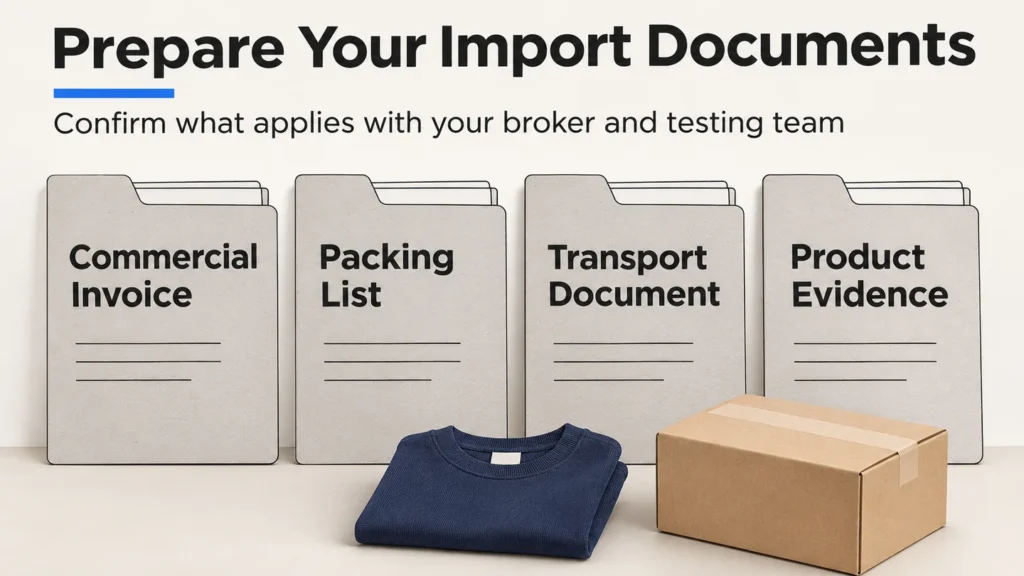
Use the following document handoff checklist:
| Document or Information | Who Usually Prepares the Initial Details | What to Verify |
|---|---|---|
| Commercial invoice | Seller, reviewed by importer | Accurate product descriptions, parties, quantities, and values |
| Packing list | Supplier | Carton contents, weights, and quantities match the shipment |
| Transport documents | Carrier or logistics provider | Correct consignee, routing, and shipment details |
| Manufacturer details and MID inputs | Actual factory and supplier | Identity corresponds to the relevant producing entity |
| Applicable CPC and supporting evidence | Responsible importer, using supplier and laboratory records | Product identifiers and applicable requirements match |
| Origin or supply-chain records, when required | Relevant suppliers and importer | Records support the actual goods and claims made |
Additional information may be required for a specific entry. Do not assume that every shipment needs a separate certificate of origin in the same format. Ask your broker what is required for the goods, origin, and any preferential treatment being claimed.
Coordinate Electronic Certificate Data Before Arrival
Beginning July 8, 2026, CPSC’s certificate eFiling requirement took effect for most imported consumer products subject to product certification requirements. Confirm whether your particular garments and entry procedures are covered, and agree with the entry filer on how to provide the necessary product identifiers, testing information, and certificate data. CPSC has a different implementation schedule for certain covered goods entered for consumption or warehousing from a foreign trade zone (FTZ). Refer to the official CPSC eFiling guidance in the sources below for current operational details rather than relying on an old shipping checklist.
Sending a PDF to your supplier is not the same as confirming that the required data has reached the actual entry filer. Before the goods ship, check the product identifiers, responsible party, and supporting test evidence.
Clear Customs and Inspect the Delivered Order
Stay reachable while your broker handles customs entry. If a government agency requests clarification, obtain authentic supporting records from your supplier or laboratory and respond through the appropriate contact. Never alter a product description or declared value merely to make the shipment appear easier to clear.
Keep inspection, storage, and other unexpected charges visible in your budget. Determine why they were incurred and retain the records so the next order can be planned more accurately.
When the shipment is delivered, compare carton counts and contents against the packing list and inspect the products received. Photograph damage before disposing of packaging. Separate ordinary commercial-quality issues from potential product-safety concerns when deciding what happens next:
- Quantity or size discrepancies: Document the affected cartons and reconcile them against the order.
- Product defects: Retain representative garments and agree on a corrective or compensation plan with the supplier.
- Missing safety evidence or a potential hazard: Hold affected inventory from sale until qualified advice is obtained and any necessary action is identified.
Customs release does not mean that all product-safety obligations have been fulfilled, nor does it replace warehouse receiving inspections. Store customs-entry records, approved specifications, and product evidence together so they can be retrieved by order or product. Certain safety-related information may trigger a legal duty to report to CPSC. Seek prompt professional guidance rather than waiting for a supplier dispute to be resolved. CPSC’s business reporting guidance explains these obligations.
Conclusion
Importing children’s clothing into the United States is easier to manage when every stage has a clearly identified owner and approval point. Before paying for bulk production, define your products, verify the supplier, establish the applicable requirements, and assess the full cost of getting saleable goods to your warehouse.
If you’re planning to source private-label children’s clothing from China for sale in the U.S., contact HAPA through our OEM/ODM kidswear manufacturing services. Share your desired garment styles or reference images, target age range, expected quantities, and planned U.S. arrival date. We can discuss fabrics, sampling, labels, and production arrangements with you. At the same time, coordinate importer identity, tariff classification, CPC responsibilities, and customs entry with a U.S. customs broker and qualified product-safety professionals so your manufacturing and import plans fit together from the outset.
Frequently Asked Questions
Can a Brand Based Outside the United States Import Kidswear for U.S. Sales?
Yes. Nonresident businesses may be able to import goods, provided they meet the applicable customs conditions. For nonresident corporations, U.S. regulation 19 CFR §141.18 addresses requirements involving a U.S. resident agent and customs bond. Confirm the appropriate arrangement with a licensed broker before shipping. Having a U.S. fulfillment warehouse address does not, by itself, establish an import arrangement.
Can a Small Brand Import a Small Quantity of Kidswear?
Yes, provided the supplier accepts the quantity and the actual landed cost fits your business plan. A small order does not automatically remove product-compliance obligations. Compare ready-stock and custom options, and allocate testing, development, and logistics expenses across the actual number of units you expect to sell.
Are Children’s Clothing Samples Exempt From U.S. Import Requirements?
Some goods genuinely imported only as samples may qualify for different treatment. CPSC’s online sellers’ safety guidance describes specific conditions for samples that will not be distributed through U.S. commercial channels or made available for consumer use, and importers must be able to demonstrate that purpose. This is not a blanket exemption from customs declarations or duties. Confirm the proper entry treatment with your broker, and do not sell noncompliant goods imported only for sample purposes.
Can I Ship Imported Kidswear Directly to a U.S. Fulfillment Center?
Yes, provided the receiving business accepts the shipment and the import arrangements have been settled. Obtain its packing, labeling, appointment, and delivery instructions in advance. Confirm who will answer customs questions and pay applicable charges. Do not assume the warehouse is the importer simply because its address is printed on the cartons.
Can I Use the Same Clothing Labels for Canada and the United States?
Possibly, but review the labels against each country’s requirements before production. Artwork already used in Canada does not prove that the U.S. requirements for fiber content, country of origin, responsible-business identification, care instructions, and tracking information are satisfied. If you intend to sell the same inventory in both countries, arrange a label review covering both markets.