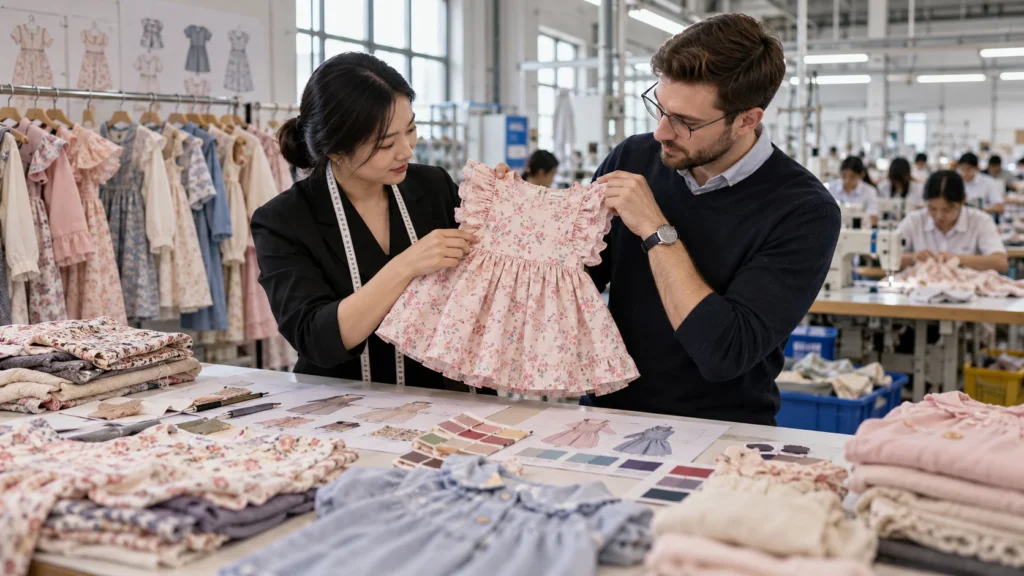
International buyer and Chinese production manager reviewing kidswear samples in a garment factory.
Kids clothing manufacturers with real experience exporting to the US and Europe are usually easier to work with than factories that have only produced for their domestic market. The difference is not simply that they know how to book an international shipment. Experienced exporters tend to understand tech packs, buyer approvals, product testing, labeling, carton requirements, inspections, documentation, and the very different expectations that US and European buyers place on children’s apparel.
When I review a factory for an overseas project, I rarely begin with the question, “Can you export?” Almost any established supplier can arrange freight. I want to know whether the team understands what has to happen before the goods are allowed to leave the factory—and what the buyer will expect when the shipment reaches the destination market.
A factory can make a beautiful sample and still be the wrong partner. I have seen sourcing conversations where the sample looked promising, yet the supplier struggled when asked about repeat-order measurements, product-specific testing, packing marks, or how an in-line defect would be documented. Those details are often where international manufacturing succeeds or fails.
In this guide, I will look at several manufacturers that publicly describe US and/or European market experience, explain what those claims should mean in practice, and show you how I would verify them before placing a meaningful order. The manufacturer descriptions below are based on information the companies publish about themselves; you should still complete your own sampling, compliance review, factory verification, and inspection.
Why Export Experience Matters More in Children’s Clothing
Children’s apparel is one of those categories where the garment, the production system, and the destination-market requirements are tightly connected. A manufacturer may be technically capable of sewing a dress, romper, sweatshirt, or two-piece set, but that does not automatically mean the company is ready to manage an international children’s wear program.
Experienced exporters are more likely to be familiar with:
- detailed buyer tech packs and graded measurement charts;
- pre-production and approval samples;
- fabric, trim, artwork, and color approvals;
- buyer-specific quality standards and AQL inspections;
- care labels, fiber labels, tracking information, and carton marks;
- third-party testing and certificate coordination;
- repeat-order records and lot traceability;
- commercial invoices, packing lists, and export documentation;
- FOB, EXW, and other agreed Incoterms;
- third-party factory or shipment inspections.
If you are still building your supplier shortlist, our guide to finding a kids clothing manufacturer covers the basic due-diligence questions I would use before comparing quotations.
The Compliance Conversation Is Different in the US and Europe
One reason export experience matters is that the United States and Europe do not share one harmonized children’s apparel rulebook. The same style may need a different testing, labeling, documentation, or traceability plan depending on where you intend to sell it.
For the United States
For covered children’s products, the U.S. Consumer Product Safety Commission’s Children’s Product Certificate guidance explains that applicable children’s products must be supported by third-party testing from a CPSC-accepted laboratory and certified through a CPC by the responsible domestic manufacturer or importer. As of July 8, 2026, importers of most regulated consumer products also face CPSC certificate eFiling requirements through U.S. Customs and Border Protection.
That is a good example of why I would never accept a vague statement such as “We are CPSIA certified” as sufficient evidence. The right question is: What rules apply to this specific product, who will arrange the testing, which lab will be used, and who is responsible for issuing or filing the required certificate data?
For the European Union
For EU sales, the General Product Safety Regulation (EU) 2023/988 establishes the general product-safety framework and traceability responsibilities for consumer products placed on the EU market.
Textile products also need appropriate fiber-composition information. The European Commission’s official textile-labeling guidance explains that textile composition must be clearly and legibly labeled and, when products are sold in multiple EU countries, translated into the required official national languages.
A manufacturer does not need to act as your legal adviser, but an experienced exporter should recognize these conversations and know when product-specific testing, labeling, or documentation needs to be clarified before bulk production begins.
A Practical Shortlist of Manufacturers to Research
I would not call any supplier “the best” based only on a website. The right factory depends on your category, quantities, target price, construction, compliance needs, delivery schedule, and the amount of product development you expect from the manufacturing team.
The companies below are useful starting points because they publicly describe experience with US and/or European buyers. Treat these as research leads, not endorsements.
| Manufacturer | Base | Publicly Stated Market Experience | Typical Fit |
| HAPA | Guangzhou, China | International OEM/ODM positioning with US/EU compliance support | Custom kidswear, private label, OEM/ODM |
| QH Apparel | China | Publicly states European and U.S. brand-side experience | Kidswear, babywear, maternity |
| Muhong Apparel | Dongguan, China | Publicly states exports to 30+ countries including US, UK, Germany | Babywear, kidswear, OEM/ODM |
| K&B Textile | Izmir, Türkiye | Publicly states exports primarily to Europe and the United States | Babywear, kidswear, organic/private label |
| Inde Artisans | India | Publicly lists US, UK, Germany, France, Italy and other export markets | Sustainable/custom children’s apparel |
1. HAPA — Guangzhou, China
HAPA is a Guangzhou-based children’s apparel manufacturer focused on OEM, ODM, and private-label production. Its public materials position the company around custom development, sampling, fabric sourcing, bulk production, QC, packaging, and export preparation for overseas buyers.
From a sourcing perspective, HAPA may be relevant if you need a manufacturer that can work from a tech pack, reference sample, or design direction rather than only selling stock styles.
Typical categories include:
- girls’ dresses and skirts;
- children’s sets;
- T-shirts, hoodies, and tops;
- bottoms and outerwear;
- sequined or embellished kidswear;
- private-label collections.
If you are comparing a fully customized program with ready-made wholesale, our children’s clothing OEM manufacturing guide explains the development process from sample and pattern work through bulk production.
What I would verify before placing an order is not the marketing language but the current production evidence: a product sample similar to your design, the relevant factory and audit documents, current QC procedures, material specifications, production timing, and product-specific compliance support for your destination market.
2. QH Apparel — China
QH Apparel publicly describes itself as an OEM and ODM manufacturer specializing in kidswear, babywear, and maternity clothing, with more than 15 years of apparel experience and brand-side experience in European and U.S. markets.
What interests me about that positioning is the emphasis on merchandising and structured production follow-up. International buyers often need more than sewing capacity. They need someone who can follow sample comments, approvals, production milestones, and delivery dates without losing information between departments.
If I were assessing QH Apparel, I would ask for recent examples in the same product category as my collection. A supplier may have broad kidswear experience, but category-level experience still matters. A baby romper, activewear set, and heavily embellished party dress are three very different production jobs.
3. Muhong Apparel — Dongguan, China
Muhong Apparel publicly states that it has 19 years of kidswear experience and exports to more than 30 countries, including the United States, the United Kingdom, and Germany. Its published services cover ODM/OEM development, fabric sourcing, sampling, bulk production, private-label packaging, QC, and export coordination.
The company also publicly describes product categories ranging from baby rompers and kids’ dresses to sportswear, school uniforms, matching sets, organic cotton, and bamboo-viscose styles.
That breadth can be useful if your collection spans several categories, but I would still ask which lines are truly routine factory work. When I qualify a supplier, I would rather see three recent production examples of my exact category than twenty unrelated catalog pages.
4. K&B Textile — Izmir, Türkiye
K&B Textile states that it has manufactured in Izmir since 1997 and exports to global brands primarily across Europe and the United States. The company describes integrated production covering design, pattern development, sampling, cutting, sewing, quality control, packaging, and global logistics.
For European buyers, Türkiye can be particularly interesting because geography affects the entire replenishment model. A nearer production base may make shorter transit times and smaller repeat drops more practical, depending on your route and commercial terms.
That does not mean Türkiye will automatically give you the lowest factory price. Your landed economics still depend on fabric, construction, quantity, duty treatment, freight, and delivery timing. But for a brand that values quick replenishment, proximity can be commercially important.
5. Inde Artisans — India
Inde Artisans publicly positions itself around sustainable and custom apparel manufacturing and lists international markets including the United States, United Kingdom, Germany, France, Italy, Spain, the Netherlands, Scandinavia, and others.
India can be particularly attractive when the product direction relies on cotton, prints, embroidery, natural fibers, or artisan-influenced details. Those capabilities may be more important than choosing a factory purely on country or unit price.
If I were evaluating this type of supplier for a boutique or sustainable label, I would verify the exact fabric certifications, the production facility actually making my order, how subcontracted processes are controlled, and whether the supplier has recent children’s apparel examples that match my intended construction.
What Does ‘Export Experience’ Actually Mean?
This is where I would push beyond the sales pitch. Many kids clothing manufacturers can say, “We export worldwide.” That statement is too broad to help you make a sourcing decision.
Real international experience should show up in the way the team works. When I send a technical file, I expect the merchandiser to identify missing information rather than rush to quote. When I ask about a destination market, I expect the discussion to move toward product-specific testing and labeling—not a generic folder of unrelated certificates.
Ask which countries they actually ship to
Europe is not one customer profile. Germany, France, Italy, Spain, the Netherlands, Scandinavia, and the UK can involve different retailer requirements, languages, logistics arrangements, and commercial expectations.
For the US, I would ask which channels the supplier knows: independent boutiques, Amazon, DTC brands, wholesalers, large retailers, or licensed programs. The production discipline required by each customer type can be very different.
Ask what type of orders they repeat
A one-time sample sent to New York is not the same thing as managing repeat bulk orders for a US brand. I would ask whether the supplier has customers placing second, third, and fourth orders of the same style. Repeat orders are a powerful test of fabric, measurement, trim, and color consistency.
Tech-Pack Discipline Is One of the Best Tests
One of the easiest ways to assess an export-oriented manufacturer is to send a real tech pack and watch how the team responds.
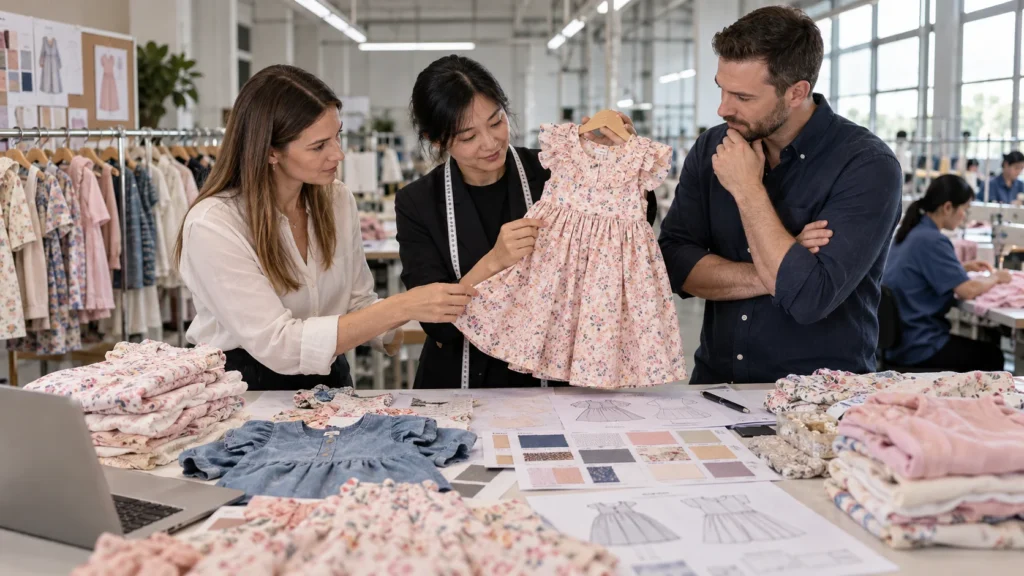
Technical sample review for an international children’s clothing order.
A strong merchandiser may ask questions such as:
- Is this dimension a full measurement or half measurement?
- What tolerance should we use at the chest, body length, and sleeve?
- What fabric weight or GSM do you require?
- Is the artwork placement fixed or approximate?
- Are the buttons, zippers, or snaps custom?
- What care label and fiber information will be required?
- Which market is the style being developed for?
- What packaging and carton assortment do you need?
Those questions slow down the quotation slightly, but I consider them a positive sign. The supplier is thinking about making the garment, not just winning the inquiry.
How I Would Compare Kids Clothing Manufacturers
When I compare kids clothing manufacturers, I prefer a weighted scorecard instead of a simple cheapest-to-most-expensive list.
| Criteria | Suggested Weight |
| Product-category experience | 20% |
| Sample quality | 20% |
| Compliance knowledge | 15% |
| QC system | 15% |
| Communication | 10% |
| MOQ and flexibility | 5% |
| Price | 5% |
| Lead time | 5% |
| Repeat-order capability | 5% |
Price is deliberately not the largest factor. A supplier that saves you $0.30 per garment but causes a missed launch, expensive air freight, inconsistent sizing, or high defect rates can easily become the most expensive factory on your list.
US Export Experience: What I Would Expect
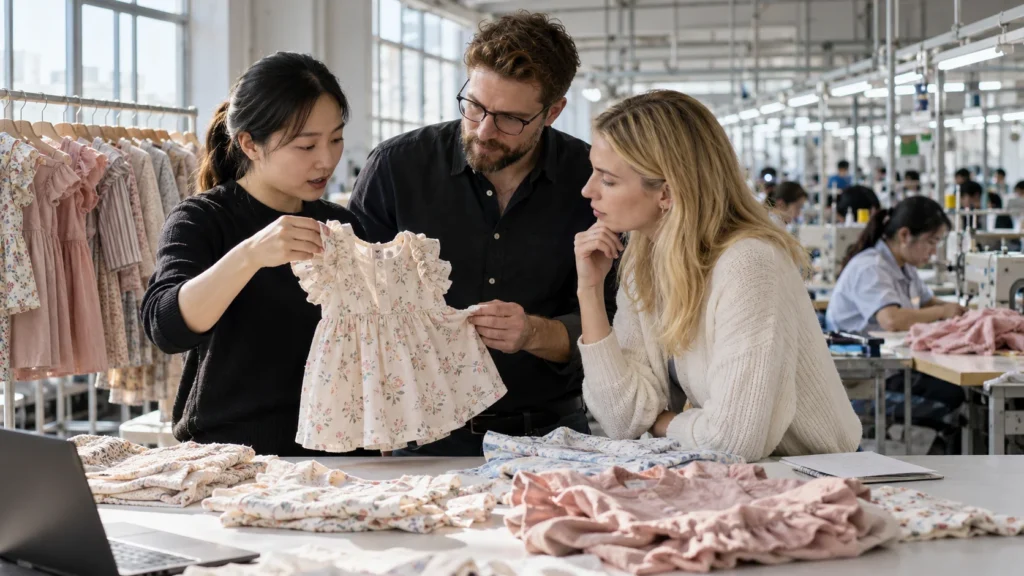
Quality and compliance preparation for a US-bound children’s garment order.
For kids clothing manufacturers serving US buyers, I would expect the team to understand that compliance is product-specific. They should not treat one old test report as universal proof for every garment.
Depending on the product, the conversation may include:
- applicable CPSC rules;
- third-party testing by a CPSC-accepted laboratory;
- Children’s Product Certificate support and importer responsibilities;
- tracking labels and production identification;
- flammability requirements where applicable;
- fiber, care, and country-of-origin labeling;
- retailer-specific packaging and barcode requirements;
- 2026 CPSC certificate eFiling preparation for applicable imports.
For a sourcing-oriented explanation of this process, HAPA’s CPC certification guide can help you organize the questions to discuss with your testing partner and importer.
European Export Experience: What I Would Expect
For European business, I would expect the factory to ask which country or countries the goods will enter and where they will ultimately be offered for sale.
The planning discussion may involve:
- GPSR-related product-safety and traceability information;
- fiber-composition labeling;
- language requirements for consumer information;
- REACH-related restricted substances where applicable;
- buyer-specific RSL requirements;
- drawstring and construction standards where relevant;
- market-specific labels and packaging;
- responsible-person or economic-operator information supplied by the buyer where applicable.
The factory does not need to replace your EU compliance specialist. What matters is whether the supplier understands that a US production file cannot automatically be copied into an EU order without reviewing the market-specific requirements.
Ask for Evidence, Not Just Claims
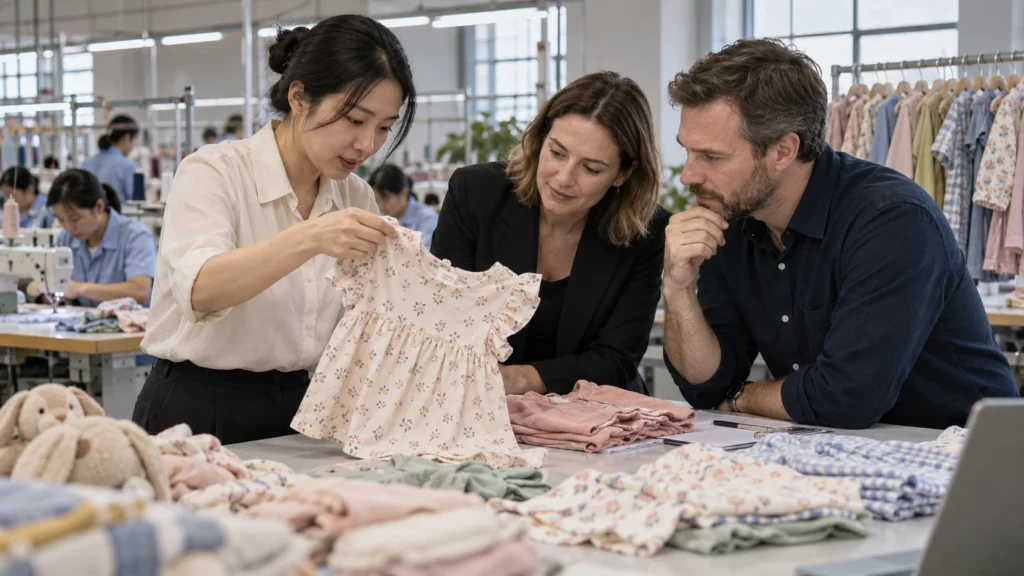
Factory capability and product quality review during supplier due diligence.
When a shortlist of kids clothing manufacturers starts to look promising, I move from marketing claims to documents and production evidence.
Recent product examples
Ask for products similar to yours. If you are producing a lined occasion dress, reviewing basic T-shirts tells you very little about the factory’s ability to handle your construction.
Factory audit documents
Check that the legal company and facility names match the site that will actually produce your order. Also check the date and scope of the audit rather than looking only at the logo on the first page.
Relevant test reports
A report should relate to the product, material, component, or requirement you are trying to verify. An unrelated historic report may prove that the factory has worked with a lab before, but it does not prove your new style complies.
Packing and shipping examples
You can often review redacted packing lists, carton photos, or commercial-document formats without asking the supplier to expose another customer’s confidential information.
Third-party inspection acceptance
I would ask whether an independent inspection company can visit before shipment. A professional factory may need notice and scheduling coordination, but a blanket refusal deserves a closer look.
The Trial Order Is Often More Valuable Than the Supplier Presentation
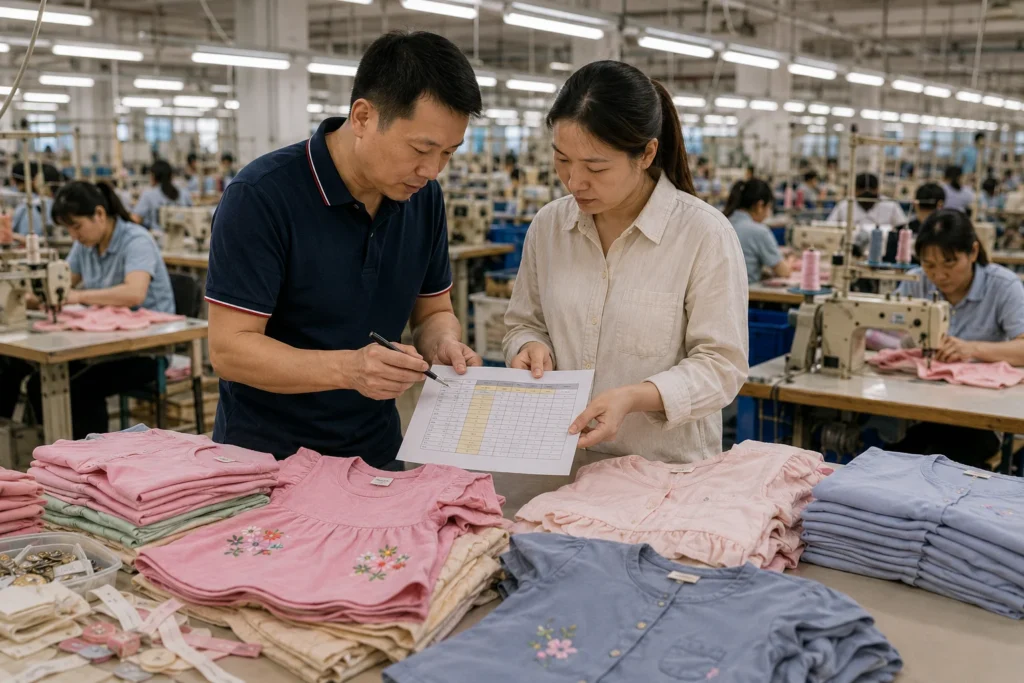
Trial-order production control inside a children’s garment factory.
Websites, certifications, and video calls are useful. A real production order is more revealing.
If practical, I would rather discover a factory’s strengths and weaknesses on a controlled first order than on a major seasonal launch. Use the first bulk run to evaluate fabric shade, measurement stability, sewing consistency, communication, inspection, packing, documentation, and shipment timing.
One of the most useful things you will learn is how the supplier reacts when a problem appears. Manufacturing is not a world where nothing ever goes wrong. The real difference is whether the factory hides the issue until the final inspection or tells you early, shows you evidence, proposes a correction, and updates the plan.
Red Flags I Would Not Ignore
“We can make everything”
Most factories have stronger and weaker categories. I become cautious when a supplier claims equal expertise in babywear, down jackets, swimwear, formal dresses, seamless sportswear, denim, and every other garment type without showing specialist production evidence.
Certificates do not match the producing factory
Always compare the legal name and facility details. If a supplier presents an audit or certificate belonging to another company, ask exactly how that facility relates to your order.
They cannot explain the testing plan
An experienced exporter does not need to memorize every regulation, but the team should understand that testing depends on the product and target market and know how to coordinate with an appropriate lab.
They refuse to document approvals
Bulk production should be based on an approved sample, measurement chart, material specification, artwork, trims, labels, and packing instructions. If the supplier prefers to keep everything informal, repeatability becomes much harder.
Repeat orders are inconsistent
For me, this is one of the biggest long-term problems. A manufacturer can make one attractive shipment and still be a weak partner if the second batch arrives in a different shade, fabric quality, measurement range, or trim specification.
Which Manufacturing Country Is Best?
There is no universal answer. Country is one factor in the sourcing equation, not the strategy itself.
China
China remains attractive when you need broad access to fabrics, trims, specialist processes, OEM/ODM development, and scalable production. It can be particularly useful for collections with several materials or custom components.
Türkiye
Türkiye can be attractive for European brands that value proximity, knitwear expertise, organic cotton programs, and shorter logistics routes. For the right collection, nearshoring can support faster repeat orders and lower inventory exposure.
India
India can be compelling for cotton, prints, embroidery, handcrafted details, and sustainable or natural-fiber collections.
I would choose the country after defining the garment, quantity, quality standard, lead time, and landed-cost target—not before.
Questions I Would Ask Before Choosing a Factory
If I were interviewing kids clothing manufacturers for a US or European program, these are the questions I would take into the meeting:
- Which US and European countries do you currently ship to?
- What percentage of your business is children’s clothing?
- Which kidswear categories are your strongest?
- Do you manufacture directly at this facility?
- Which processes are subcontracted?
- Can you show recent products similar to my collection?
- Can you provide current factory audit documentation?
- How do you determine which US product tests are required?
- How do you prepare EU-bound orders for labeling and traceability?
- Can you work from detailed tech packs and graded specifications?
- How are first-piece and in-line measurements controlled?
- What inspections are completed before shipment?
- Can I arrange an independent third-party inspection?
- What is the MOQ per style and per color?
- How are repeat-order fabrics and shades controlled?
- What is your normal sampling timeline?
- What is your normal bulk-production timeline?
- How do you handle defective or non-conforming goods?
- Which private-label services do you provide?
- Which Incoterms do you normally quote?
The quality of the supplier’s questions back to you is also important. A good manufacturer will want to understand your product, market, quantity, quality expectations, and delivery date before promising a price and timeline.
How We Approach US and European Projects at HAPA
From our side of the factory table, the destination market should be discussed during development, not after the garments have already been produced.
Why? Because the market can influence trims, fabric selection, testing plans, care and fiber labels, tracking information, packaging, and documentation. If we know at the beginning that a style is intended for a US children’s brand, an EU retailer, or both, we can flag those requirements before the sample is treated as final.
The same principle applies to quality. The approved sample should not be a one-off display piece. It should become part of the production standard together with the measurement chart, material specification, artwork, trim references, label files, and packing requirements.
That process is especially important when you are developing your own brand rather than buying open-stock merchandise. Our private-label clothing manufacturer guide explains how branding, product development, labels, and packaging fit into a factory program.
Can One Factory Serve Both the US and Europe?
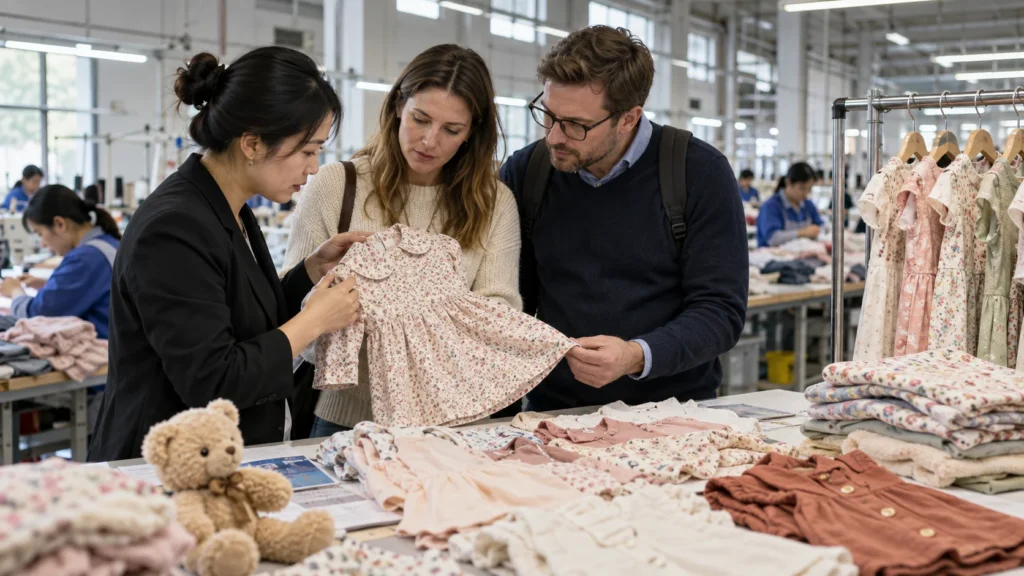
Factory team reviewing a kidswear program for US and European markets.
Yes, and in many cases it simplifies the supply chain. You may be able to share the same core pattern, fabric, construction, and production run while separating market-specific labels, testing, documentation, or packaging.
However, do not assume that one finished compliance file automatically covers both destinations. Build the US and EU requirements into the order plan separately and identify which elements can legitimately be shared.
A capable group of kids clothing manufacturers will be comfortable with that distinction. They will not tell you that one generic “international certificate” solves every market.
How I Would Build a Final Supplier Shortlist
After reviewing websites, samples, calls, documents, and quotations, I would narrow the field to two or three factories and compare them using the exact same product specification.
For each finalist, I would confirm:
- the same fabric composition and weight;
- the same construction and workmanship standard;
- the same trims and labels;
- the same testing assumptions;
- the same packaging requirements;
- the same delivery term;
- the same inspection standard;
- the same color and size breakdown.
Only then does the price comparison become meaningful. Otherwise, a cheaper quotation may simply be a different product.
Final Thoughts
There are many kids clothing manufacturers with experience serving overseas markets, but the phrase “export experience” is only useful when you can see it in the factory’s systems.
I would look for a manufacturer that can move confidently through the whole sequence: tech pack, material sourcing, sampling, approval, production planning, first-piece review, in-line QC, final inspection, market-specific labeling, packing, documentation, and shipment.
If I were choosing between two factories and one was slightly cheaper while the other showed stronger kidswear specialization, clearer compliance understanding, more disciplined QC, and better repeat-order control, I would usually choose the second one.
A small unit-price saving can disappear after one late shipment, one failed inspection, or one inconsistent reorder. Reliability is not an abstract benefit; it has a measurable commercial value.
The best kids clothing manufacturers for US and European buyers are not simply factories that have shipped cartons overseas. They are manufacturing partners that understand how to reproduce the approved garment, document what was made, communicate problems early, and prepare the order for the market where it will actually be sold.
That is the distinction I would use when moving from a long list of suppliers to one production partner.