The T-shirt may seem like the simplest staple in any wardrobe. While many assume the only marker of quality is 100% cotton, the journey from a sketch on paper to a finished product in your customer’s hands is far more complex.
From yarn spinning and fabric pre-shrinking to cutting precision, stitch density, and neckline binding techniques — a minor discrepancy in any single step can create a night-and-day difference in the final garment.
As a manufacturer with over 16 years of deep expertise in the apparel industry, we know exactly how critical every detail is to your brand. In this guide, we walk you through the 7 key stages of the T-shirt manufacturing process, giving you a behind-the-scenes look at factory floor operations to help you efficiently vet and select the right manufacturing partner.
Why Custom T-Shirts Are Popular
The enduring popularity of custom T-shirts boils down to one core truth: they are far more than just garments — they are a highly versatile cultural currency. They turn a basic staple into a medium for expressing individuality, transforming a sense of belonging into tangible reality.
In a market saturated with generic styles, forward-thinking retailers are turning to custom T-shirt production to build a powerful brand moat. By taking control of the design process — especially through private label T-shirt manufacturing — brands can curate everything from fabrics to customized graphics. These garments not only stand out with one-of-a-kind style but also deliver superior comfort, driving a significant boost in repeat purchase rates.
The Development of Different T-Shirt Styles
If there is one “universal global language” in fashion, it is undoubtedly the T-shirt. Despite its seemingly simple construction, it underpins a massive global market. As the single best-selling product category in apparel, T-shirt production is the true backbone of the fashion industry.
Before diving into the manufacturing process, it is critical to understand the mainstream styles, as each dictates specific cutting and sewing techniques:
- Crew Neck: The most classic and top-selling style. Suitable for nearly all occasions, it is a non-negotiable staple in any brand line.
- V-Neck: Visually elongates the neckline, commonly used for slim-fit silhouettes or smart-casual styles.
- Henley Neck: A crew neck with a button placket (typically 2–5 buttons), featuring a vintage American workwear aesthetic.
- Polo Neck: A hybrid between a T-shirt and a shirt, delivering a smart-casual feel through knit fabrics like pique mesh.
- Scoop Neck (U-Neck): A deep, wide neckline, most commonly found in women’s apparel or fashion-forward men’s styles with a draped fit.
- Mock Neck: A hugely popular style in recent high-street streetwear trends, featuring a close-fitting, raised neckline for a sleek, polished look.
Pre-Production: The Blueprint for Success
A common mistake many emerging brands make is rushing straight into the cutting and sewing phase in pursuit of quick results. Yet, in professional apparel manufacturing, success or failure is often determined before the very first yard of fabric is unrolled.
Finalizing the Tech Pack and Bill of Materials (BOM)
The tech pack serves as the binding contract between the designer and the manufacturer. It includes detailed flat technical drawings, size grading rules, and dimensional tolerances to ensure precise, standardized production.
Within the tech pack, the Bill of Materials (BOM) itemizes every single component of the garment—from main fabric to thread and buttons—while dimensional tolerances define clear pass/fail standards for the finished pieces.
Fabric Sourcing and Inspection
Based on each client’s unique requirements, we source premium fabrics globally to meet the most exacting standards for high-quality T-shirts.
Our dedicated quality control inspectors conduct a 100% inspection of every single fabric roll, checking for weaving defects, color shading, texture inconsistencies, and other imperfections.
Any flawed fabric is rejected outright before production begins, guaranteeing that only top-tier textiles enter the manufacturing line. This is our core promise: quality first, with a client-centric approach in everything we do.
Once inspection is successfully completed, the official production process can begin.
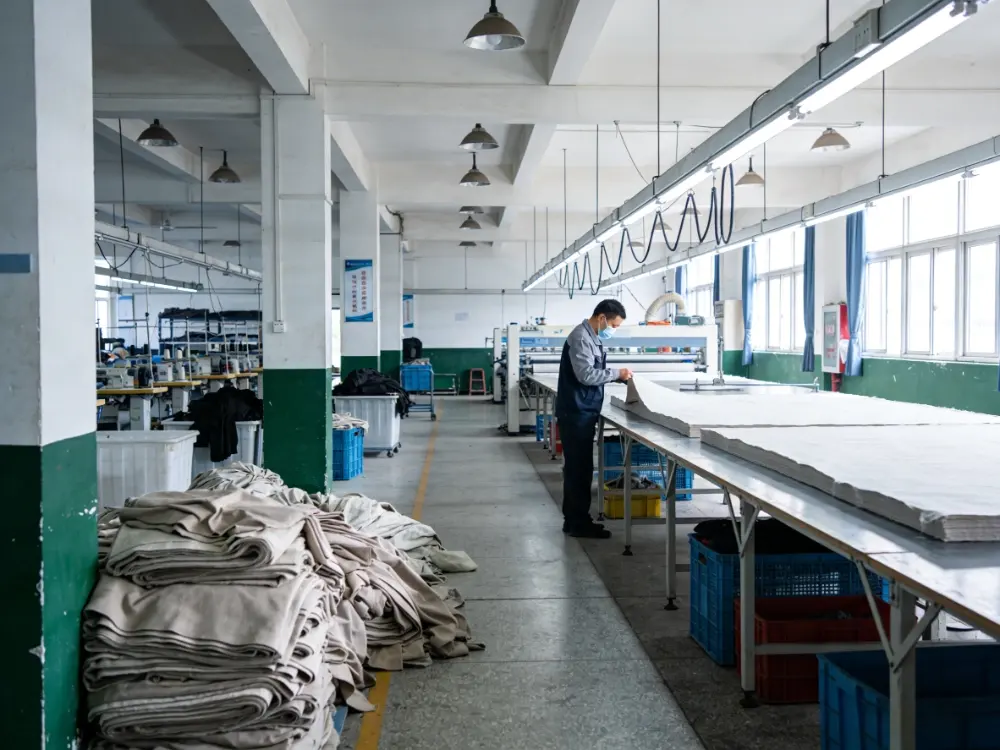
Step-by-Step T-Shirt Manufacturing Guide
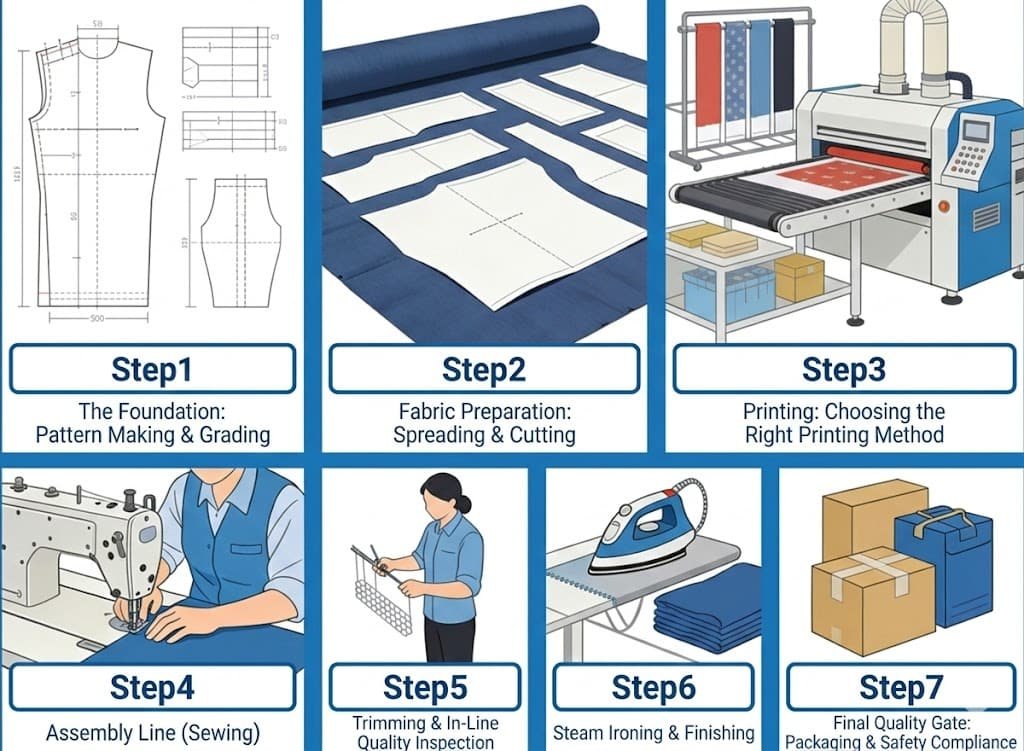
Turning an initial design concept into shelf-ready, retail-ready garments is a journey defined by uncompromising attention to detail. Below, we break down exactly how professional factories execute the step-by-step T-shirt manufacturing workflow to transform rolls of raw fabric into products beloved by customers.
Step1. The Foundation: Pattern Making & Grading
Everything starts with your design drawings. Before a single yard of fabric is cut, our expert pattern makers translate your tech pack into a precise digital model. We use advanced CAD (Computer-Aided Design) systems to create a master pattern that defines the exact silhouette and fit of the garment.
Once the sample pattern is approved, we move to the grading phase. Grading is the perfect blend of science and art: we use precise mathematical calculations to scale the master pattern up or down, creating every size you require (e.g., S, M, L, XL). A professional grading process ensures the neckline and shoulder width of an XL T-shirt maintain the exact same proportional fit as the original S size.
Step2. Fabric Preparation: Spreading & Cutting
For bulk production, we do not cut garments one by one. Instead, we use a specialized process called spreading, where fabric is smoothly unrolled and stacked in uniform, even layers across long cutting tables.
Critical Detail: For knit fabrics such as jersey knit, we allow the fabric to “relax” for 12 to 24 hours prior to cutting. This releases internal tension built up during the knitting process and is a critical step to prevent twisting, warping, or shrinkage in the finished garment.
After the relaxation period, the stacked fabric is ready for cutting. While vertical electric cutters are the industry standard for large bulk orders, we routinely use laser cutting for complex designs or high-precision requirements, ensuring perfectly sealed, clean edges with zero fraying.
Step3. Printing: Choosing the Right Printing Method
Unlike print-on-demand services, we print on the cut fabric panels before the sewing process begins. This enables full edge-to-edge printing and ensures that if a printing defect occurs, we only discard a single fabric panel, not an entire completed garment.
Selecting the optimal printing method depends on the complexity of your design and your order volume. Below are the most commonly used printing methods in our factory, for your reference:
| Decoration Method | Best Used For | Key Advantages |
| Screen Printing | High-volume orders & simple logos | Extremely durable; cost-effective for bulk; vibrant colors. |
| DTG (Direct-to-Garment) | Complex, multi-color designs & photos | Soft hand feel; no setup fees; captures fine details perfectly. |
| Embroidery | Logos on heavy fabrics & branding | Premium look; high perceived value; long-lasting texture. |
| Heat Transfer | Neck labels & small details | Clean finish; great for tagless labels to improve comfort. |
Step4. Assembly Line (Sewing)
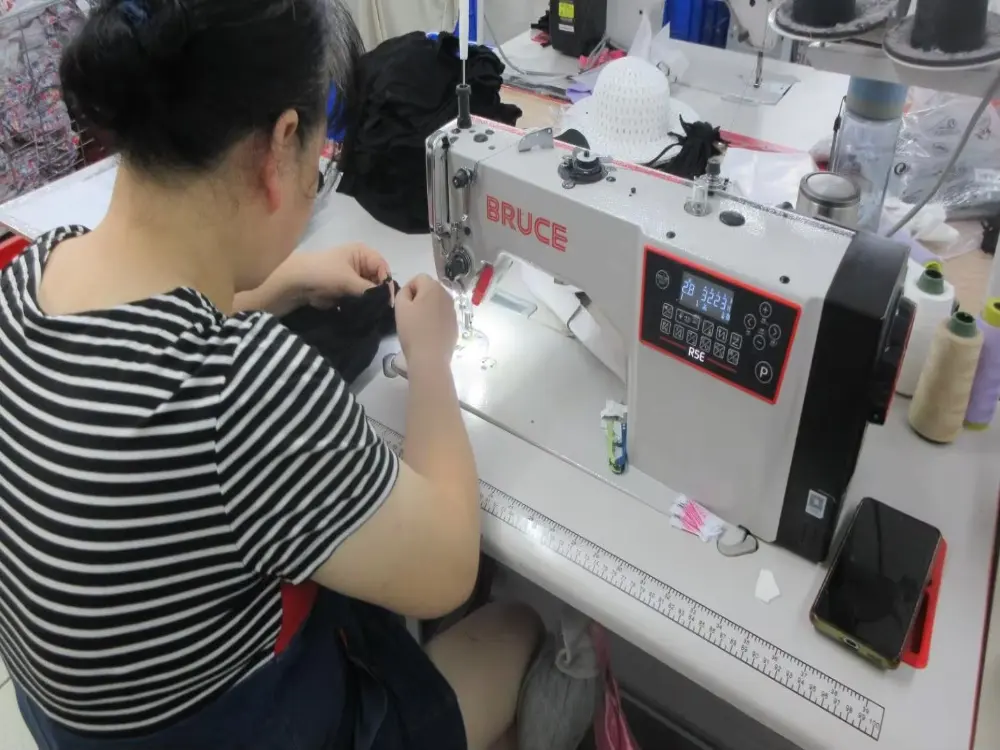
This is the lifeblood of the factory. Cut fabric panels are sent to the sewing workshop, where two-dimensional fabric is transformed into a three-dimensional finished garment. To ensure structural integrity, the assembly process follows a strict, sequential logic:
- Shoulder Reinforcement: First, shoulder seams are sewn and reinforced with clear elastic tape. This hidden detail prevents the shoulders from sagging or stretching out over time—a hallmark of high-quality construction.
- Neckline Attachment: Next comes the most critical step: attaching the neck rib. Skilled operators must maintain precise tension control. Too tight, and the head won’t fit; too loose, and the neckline warps into an unsightly “bacon neck.”
- Final Assembly: Finally, sleeves are set in, side seams are closed, and the hem is finished with a double-needle coverstitch machine to create a classic stretch hem that retains its shape wash after wash.
Step5. Trimming & In-Line Quality Inspection
A sewn shirt is not yet a finished garment. As soon as it comes off the line, it enters the first critical quality checkpoint.
- Thread Trimming: A dedicated team removes every single loose thread left by the sewing machines to ensure a clean, flawless finish.
- In-Line Inspection: Simultaneously, inspectors check for seam slippage (holes), skipped stitches, or machine oil stains. Any non-compliant garments are tagged and reworked immediately, preventing defective goods from reaching the finishing stage.
Step6. Steam Ironing & Finishing
Presentation is everything. Garments are processed through an industrial steam tunnel or individually pressed on a vacuum ironing table.
This step is about far more than just removing wrinkles. The heat and moisture relax the fabric fibers, eliminate creases built up during production, and stabilize the final dimensions of the garment. This ensures that when your customer opens the package, the shirt has a crisp, professional, retail-ready appearance—not one that looks like it just came out of a laundry basket.
Step7. Final Quality Gate: Packaging & Safety Compliance
Before T-shirts are folded and bagged, they must pass a final, non-negotiable series of tests — a step especially critical for children’s apparel.
Safety Standard: Needle Detection
Every single garment passes through a conveyor-belt needle detector. This machine ensures no broken needle fragments from the sewing process are left trapped within the fabric. This is a mandatory compliance step for selling in the U.S. (per CPSIA regulations) and the European Union market.
Once cleared through inspection, your T-shirts are fitted with your custom branded hang tags, neatly folded, sealed in protective polybags, and prepared for shipment to your warehouse.
Quality Control: Ensuring Unwavering Product Consistency
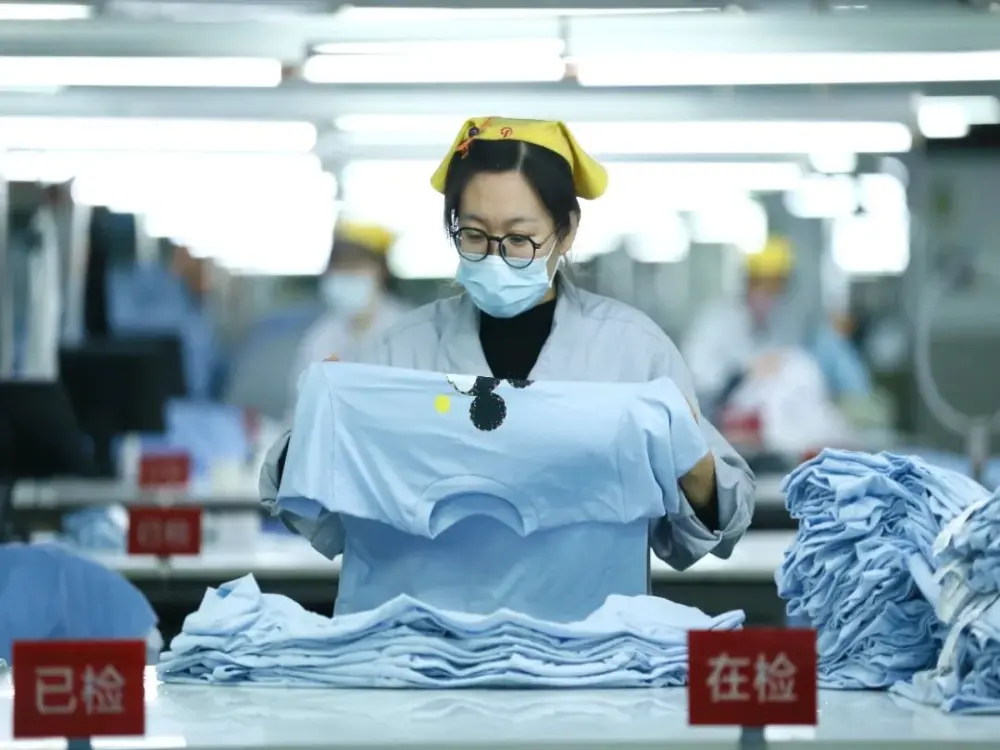
In the apparel industry, quality control is far more than just a department — it is a core operating philosophy. Implementing rigorous quality control in T-shirt manufacturing is the only way to prevent customers from receiving garments with twisted side seams or peeling logos.
In our professional manufacturing facility, we go beyond inspecting finished garments — we implement a Total Quality Management (TQM) system that monitors every single stage of production, from yarn spinning to final packaging. This guarantees that the 1,000th T-shirt off the production line is identical in quality, fit, and finish to the very first.
Common T-Shirt Defects
Identifying defects is straightforward — the true mark of expertise lies in understanding the root cause of each imperfection. We categorize defects into three industry-standard grades (aligned with AQL standards):
- Critical Defects: Unsafe, non-compliant garments that fail mandatory safety regulations (e.g., sharp objects, hazardous chemicals).
- Major Defects: Garments that are unsellable due to functional or aesthetic flaws (e.g., holes, open seams, wrong size).
- Minor Defects: Imperfections that are acceptable only within strict, pre-defined tolerance limits (e.g., loose threads, slight color shading).
Below are the specific technical issues we monitor and mitigate throughout our production process:
| Defect Name | What It Looks Like | The Root Cause (How We Prevent It) |
| Spirality (Torque) | The side seams twist around the body after washing. | Cause: The fabric wasn’t relaxed properly before cutting. Fix: We ensure 24-hour relaxation for all knit fabrics. |
| Pilling | Small fuzzballs forming on the fabric surface. | Cause: Short staple cotton fibers or low-twist yarn. Fix: We verify fiber length during yarn sourcing or use enzyme washes. |
| Skipped Stitches | A break in the seam line where the thread didn’t catch. | Cause: Worn-out needles or incorrect machine tension. Fix: Machines are calibrated daily, and needles are changed regularly. |
| Shading (Color Variance) | Slight color differences between the sleeves and the body. | Cause: Cutting parts from different dye lots (rolls of fabric). Fix: We use a rigid numbering system to ensure all panels of one shirt come from the same layer of fabric. |
Pro Tip: The “Snap-Back” Test
When inspecting pre-production samples, always perform a stretch test on the neck ribbing. Pull it firmly and check if it snaps back to its original shape immediately. If it remains stretched out or looks wavy (“bacon neck”), it typically indicates insufficient spandex content or poor-quality rib construction — a red flag for long-term durability.
The Critical Role of Third-Party Inspections
While our in-house quality control team upholds rigorous standards at every stage of production, many global brands choose to add an extra layer of security: third-party inspections.
You can think of this as insurance for your entire production run. Independent, internationally accredited bodies (such as SGS, Intertek, or QIMA) visit the factory to conduct an unbiased audit against global industry standards — most commonly AQL 2.5 (Acceptable Quality Limit).
These inspections fall into two key phases:
- During Production Inspection (DUPRO): Conducted when 20% to 50% of the order is completed. This allows us to catch systemic errors early (for example, care labels sewn on backwards) and correct them promptly, with no impact on your shipment timeline.
- Final Random Inspection (FRI): Performed after 100% of the goods are fully finished and packaged. Inspectors randomly select sample cartons to check folding accuracy, packaging consistency, and overall workmanship. If the defect rate exceeds the AQL threshold, the entire batch must be 100% re-inspected and re-packaged.
For emerging brands, partnering with a manufacturer that understands and welcomes these inspections is the safest way to scale your business without compromising on quality.
Best Fabrics for T-Shirt Manufacturing
The fabric you select defines the drape, print performance, and overall value of your final product. In the T-shirt industry, we typically categorize fabrics into three core families: 100% cotton, synthetic fibers, and blends.
- Combed Ring-Spun Cotton: Exceptionally soft, smooth, and durable, with a premium surface finish that makes it the ideal choice for high-quality printing.
- Polyester: Hard-wearing, wrinkle-resistant, and moisture-wicking, making it the perfect option for high-performance active-wear.
- CVC (Chief Value Cotton) Blends: Combines the breathability of cotton with the strength and durability of polyester, creating garments that resist wrinkling and hold up to repeated wear and washing.
- Tri-Blends: An ultra-soft blend of cotton, polyester, and rayon, delivering a vintage heathered finish and exceptional drape.
- Bamboo Fiber: An eco-friendly, hypoallergenic option renowned for its silky-smooth hand feel and natural cooling properties.
- Pima/Supima Cotton: Made with extra-long staple fibers that resist pilling, this luxury fabric is purpose-built for premium, elevated wardrobe staples.
The Bulk T-Shirt Production Timeline
Understanding the lead time is critical for inventory management. Below is the industry-standard bulk T-shirt production timeline, covering every key stage from initial design concept to final delivery:
| Stage | Estimated Timeline | Key Influencing Factors |
|---|---|---|
| Sampling | 7–14 business days | Accuracy and completeness of the provided Tech Pack |
| Fabric Sourcing & Preparation | 15–30 business days | Whether using in-stock ready-made fabric, or requiring custom dyeing and finishing |
| Bulk Production | 30–45 business days | The factory’s production schedule and order backlog, including demand fluctuations between peak season and off-season |
| Shipping & Logistics | 3–35 business days | Shipping method: air freight (fast, premium cost) vs. ocean freight (cost-effective, longer lead time) |
How to Choose the Right T-Shirt Manufacturer
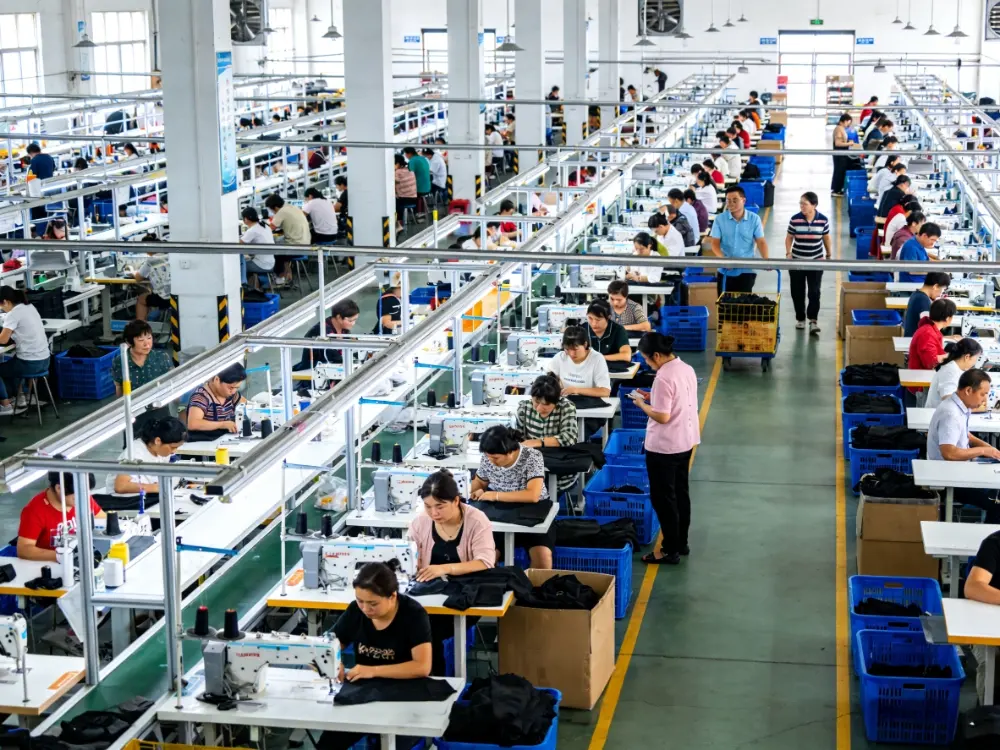
Finding the right manufacturing partner is critical to the long-term growth of your brand. It is about far more than just securing the lowest price — it hinges on reliability, consistent quality, and scalable production capacity. Below are the four non-negotiable key factors to evaluate during your selection process:
- Communication Efficiency
Look for a partner with fluent English proficiency and a response time of within 24 hours. A factory that proactively communicates potential risks is far more valuable than one that blindly agrees to every request you make. - Flexible Minimum Order Quantities (MOQs) & Scalability
Your manufacturer should be equipped to support your brand at every stage of growth. Whether you need a small 50-piece run for a test launch or a large 10,000-piece bulk production order, ensure they have the capacity to grow alongside your brand. - Specialization
Avoid “jack-of-all-trades” factories. If you sell children’s apparel, partner with a manufacturer (like HAPA) that has deep, specialized expertise in CPSIA safety regulations, soft fabrics such as bamboo fiber, and intricate craftsmanship like sequin embroidery. - Sample Validation
Never skip the sampling process. Placing a sample order before committing to a large bulk run is the most effective way to audit the factory’s sewing quality, fabric hand feel, and garment fit.
Stricter Standards for Children’s T-Shirt Production
For the manufacturing of children’s T-shirts, safety and compliance requirements are exceptionally stringent, with mandatory adherence to international regulations including CPSIA (U.S.) and REACH (EU).
1.Physical Safety: A Non-Negotiable Priority
Physical safety is our baseline standard. All small components, such as buttons and sequins, must pass a 90-Newton pull test to prevent detachment and accidental ingestion. Furthermore, drawstrings are strictly prohibited in the neck area to eliminate the risk of strangulation.
2.Chemical Safety & Process Control
- Fabric & Dyes: Must be certified free of formaldehyde, azo dyes, and heavy metals.
- Printing & Hardware: We use only phthalate-free inks, and all metal hardware is strictly lead-free.
- Needle Detection: Every finished garment must pass through a conveyor-belt needle detector to remove any residual broken needle fragments.
- Flammability: Specific product categories also meet strict flammability standards, delivering comprehensive protection for children’s safety.
As a professional children’s apparel manufacturer, HAPA stands out in this highly competitive market with superior craftsmanship. Whether you require ultra-comfortable basic T-shirts or special designs that demand exquisite workmanship, HAPA leverages its 16 years of specialized expertise to deliver an ironclad quality guarantee for your products.
Conclusion
The T-shirt manufacturing process requires a masterful balance between creative vision and technical precision. From initial design to final delivery, every stage is layered with nuance.The T-shirt manufacturing process requires a masterful balance between creative vision and technical precision. From initial design to final delivery, every stage is layered with nuance.
For brands operating in the highly competitive children’s apparel market, the stakes are even higher. High-quality manufacturing is about far more than just sewing; it is about protecting and upholding your brand reputation through uncompromising safety, sustainable practices, and superior craftsmanship.
Ready to turn your design vision into a market-leading collection? Let’s work together to create something exceptional.
FAQ
What is the best type of material for t-shirts?
For premium fashion brands, 100% combed ring-spun cotton is the gold standard because it is incredibly soft, smooth, and holds prints well. However, for athletic wear or uniforms that need to be durable and wrinkle-resistant, a polyester-cotton blend (such as 60/40 or 50/50) is often the superior choice.
What is the minimum order quantity (MOQ) for t-shirt manufacturing?
For fully custom cut-and-sew production (where you choose the specific fabric weight and fit), the MOQ is typically 500 to 1,000 pieces per color. If you are willing to use “stock blanks” (pre-made t-shirts) and only add custom printing or embroidery, many factories will accept orders as low as 50 to 100 pieces.
How long does it take to manufacture a T-shirt?
Once your sample is approved, the bulk T-shirt production timeline generally takes 25 to 35 days. If your design requires custom fabric knitting, plan for 45 to 60 days.
What is the first step in the garment manufacturing process?
The process begins with Product Design and Development, where you create a comprehensive “Tech Pack” that includes technical sketches, size charts, and fabric specifications. This document serves as the factory’s blueprint, ensuring they understand exactly how to construct your garment before any fabric is cut.
How to find a reliable T-shirt manufacturer?
Focus your search on factories that specialize specifically in knitwear and jersey fabrics, using platforms like Alibaba or attending trade shows like the Canton Fair. To verify reliability, always inspect their Business License and request samples of previous work to evaluate the quality of their seams, neck ribbing, and print durability.