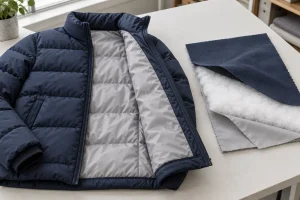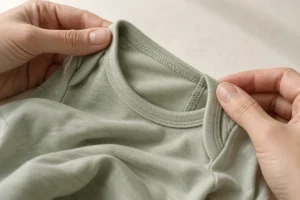
Everyday Fabric Comparison
Modal vs Polyester: Which Is Better for Everyday Clothing?
Modal vs polyester has no universal winner. Modal often suits soft, fluid, absorbent clothing worn close to the skin. Polyester usually leads when durability, quick drying, crease resistance, and easy care come first. The final choice still depends on fabric construction, finish, garment design, and test results.
Modal Strength
Soft hand, fluid drape, and absorbent comfort for underwear, loungewear, and other next-to-skin styles.
Polyester Strength
Durable, fast-drying, crease-resistant performance for travel basics, uniforms, and frequently washed garments.
Main Trade-Off
Modal favors softness and moisture uptake. Polyester favors shape retention, quick drying, and easy care.
Brand Decision
Compare construction, GSM, recovery, pilling, shrinkage, wash appearance, care needs, and supplier evidence.
What Is the Difference Between Modal and Polyester?
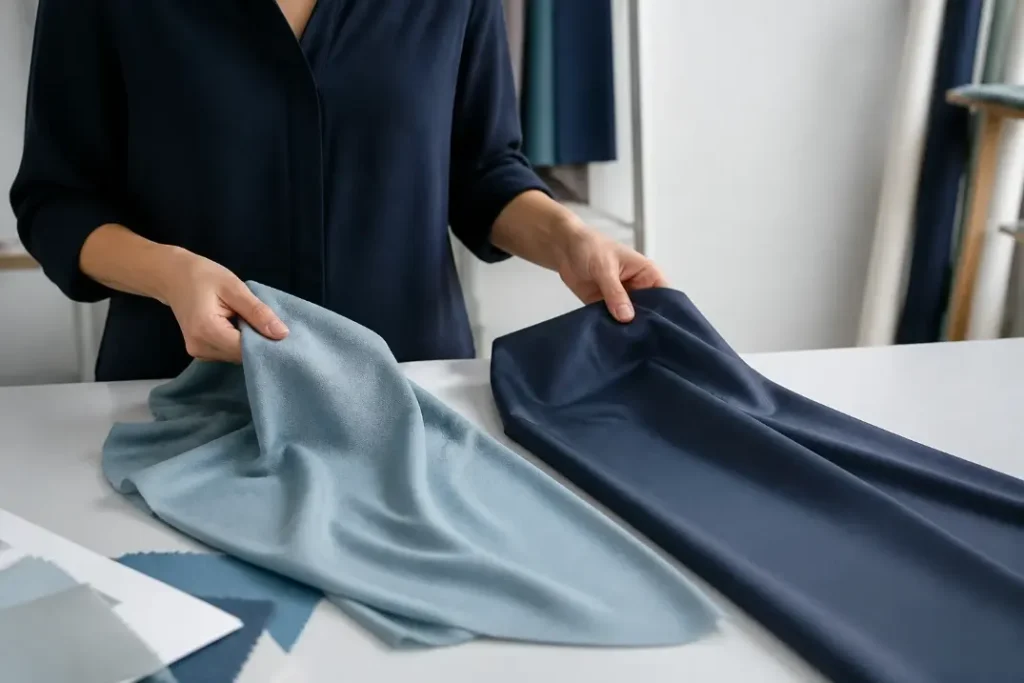
The essential difference: Modal is a regenerated cellulosic fiber, while polyester is a synthetic fiber. Their different material systems influence how they absorb moisture, dry, drape, crease, and withstand wear, but fiber content alone does not determine the finished garment.
The European Union’s official list of textile fiber names defines Modal as a regenerated cellulose fiber produced through a modified viscose process, with specified strength and wet-modulus characteristics. Polyester is defined by its polymer chemistry. In plain language, Modal starts with cellulose, commonly obtained from wood pulp, which is dissolved and regenerated into fiber. Conventional polyester is commonly made from fossil-derived inputs and formed into synthetic filaments or staple fibers.
How Is Modal Made?
Wood-derived cellulose is converted into a spinning solution, extruded, regenerated, washed, and processed into fiber. Modal belongs to the manmade cellulosic family, alongside fibers such as viscose and lyocell, although their production specifications and performance are not identical.
If you want the manufacturing process, terminology, advantages, and limitations before comparing materials, start with this guide to how Modal fabric is made.
How Is Polyester Made?
Polyester is made by creating a polymer, melting it, and spinning the molten material into fine fibers. These fibers can then be engineered in different ways—they may be fine or coarse, smooth or textured, continuous filaments or cut into staple fibers.
This flexibility is why polyester fabrics can vary so much in feel and performance. One fabric may feel crisp and structured, while another can be soft, brushed, lightweight, or mesh-like. If you want a closer look at how polyester is produced, its properties, types, and common uses, read our complete guide to polyester fabric.
This fiber-level difference is useful, but it is only the first layer of a fabric decision. Yarn size, knit or weave, fabric weight, brushing, compacting, dyeing, and finishing can all change the result. A lightweight open polyester knit may allow more air to pass than a dense Modal knit. A well-developed Modal blend may hold its dimensions better than a poorly specified polyester jersey. Compare actual fabrics, not stereotypes.
How Do Modal and Polyester Feel in Everyday Clothing?

For next-to-skin softness, Modal is usually the stronger starting point. For a broader range of textures, structure, and engineered surfaces, polyester gives product developers more options. The actual swatch still matters more than the generic fiber name.
Which Fabric Feels Softer Against the Skin?
Modal is widely selected for a smooth, soft hand and a fluid feel against the body. Those qualities make it a natural candidate for underwear, pajamas, relaxed T-shirts, base layers, and loungewear. It also tends to take up moisture more readily than polyester, which can reduce the dry, slick sensation associated with some basic synthetic fabrics.
Polyester has no single hand feel. Standard filament fabrics may feel smooth or slightly slick. Textured yarns can create a drier, more cotton-like surface. Microfibers can feel soft and fine, while brushed polyester can feel warm and plush. Finishes can further alter softness, static, moisture transport, and surface friction. A brand that rejects or approves polyester based on one old sample may overlook a large technical range.
How Do Drape and Appearance Differ?
Modal often produces a soft, fluid drape that follows the body rather than holding a crisp silhouette. This can work beautifully for relaxed tops, soft dresses, pajamas, and garments intended to move gently. The same fluidity can be a drawback when the product needs a firm collar, tailored structure, or strong shape retention.
Polyester can be engineered for either fluidity or structure. Filament polyester is common in drapey blouses and dresses, while heavier woven or knitted versions can provide a firmer profile. Before shortlisting a fabric, examine these five variables together:
- Surface:smooth, brushed, peached, matte, lustrous, or textured
- Construction:jersey, rib, interlock, mesh, twill, satin, or another knit or weave
- Weight:light enough to drape or heavy enough to hold shape
- Recovery:the ability to return to its original dimensions after stretch
- Finish:any treatment used to adjust softness, static, moisture behavior, or appearance
Decision factor | Modal | Polyester | What a brand should verify |
Typical hand feel | Soft, smooth, fluid | Ranges from slick or crisp to soft and brushed | Approved swatch and finished sample |
Moisture uptake | Usually more absorbent | Usually absorbs less into the fiber | Fabric-level moisture behavior |
Drying tendency | May stay wet longer after absorbing moisture | Often dries faster | Drying test in the intended construction |
Drape | Often fluid and body-following | Can be fluid or structured | GSM, yarn, knit or weave, and finish |
Durability | Depends strongly on construction and care | Usually stronger for abrasion and repeated use | Pilling, abrasion, wash, and seam tests |
Easy care | May need lower heat and gentler handling | Usually quick-drying and crease-resistant | Finished-garment care validation |
Environmental decision | Check pulp source and production system | Check feedstock, recycled claim, shedding, and durability | Product-specific documents, not generic claims |
Is Modal or Polyester More Durable?
Polyester usually has the durability advantage when abrasion, repeated use, dimensional stability, and low-maintenance care lead the brief. Modal can still perform well, but its success depends on fabric engineering and appropriate garment care.
“Durable” is too broad to use as a single pass-or-fail description. A school top may fail because the surface pills. A fluid dress may fail because it grows in length. A printed pajama may retain its dimensions while the graphic cracks. A uniform may keep its color yet show abrasion at the elbows. The right comparison starts with the likely failure mode.
What Happens After Repeated Washing?
Polyester is commonly valued for strength, shape retention, crease resistance, and quick drying. It often works well for products that face frequent washing or cannot demand delicate care from the wearer. Still, heat can damage polyester, and poor construction can distort, pill, or develop an unattractive surface.
Modal’s regulated fiber definition includes high wet-modulus characteristics, but this does not guarantee that every Modal jersey resists shrinkage, twisting, stretching, or pilling. Yarn quality, knitting tension, compacting, dyeing, finishing, garment pattern, and laundering all influence the outcome.
Which Durability Tests Matter?
Build the test plan around the product’s use and customer promise. Common checkpoints include:
- Dimensional stability:Measure length and width before and after the agreed wash cycles.
- Appearance after laundering:Review twisting, wrinkling, fuzzing, surface change, and overall presentation.
- Pilling and abrasion:Match the method and severity to expected wear.
- Color performance:Check fading, staining, rubbing, and print behavior where applicable.
- Garment integrity:Inspect seams, elastics, trims, labels, and recovery, not just the main fabric.
Odor is another concern often attached to polyester. Fiber chemistry, finishes, sweat composition, laundering, and fabric construction can all affect odor retention. If odor control is a product promise, treat it as a testable requirement rather than a generic fiber claim.
Which Fabric Is Easier to Care For?
Polyester is typically easier to dry and less prone to creasing. Modal remains practical for everyday clothing, but it may need lower heat and more careful handling. Always set care instructions from the finished garment test.
A polyester garment often dries quickly, holds its shape, and needs little ironing. Its main caution is heat. High dryer or iron temperatures can create shine, distortion, or permanent damage. Modal garments may benefit from a gentler wash and lower drying heat, particularly when the fabric is lightweight, fluid, or blended with elastane.
There is no responsible universal care label for either fiber. Dyeing, printing, elastane, interfacing, elastic, decorations, and trims can set the limiting instruction. A 100 percent polyester shell with a heat-sensitive print may need gentler care than a plain fabric. A Modal blend may perform reliably in normal machine washing after suitable development. Test the whole garment using the proposed consumer care process, then write the label.
Does Modal Shrink More Than Polyester?
Yes, and this is the single most useful thing to understand about the pair. Nearly every comparison states the fact. Almost none explains it — which is a shame, because the explanation is what tells you how to wash the garment.
Modal: a fibre that keeps responding to water
Cellulosic fibres swell when they absorb water and relax as they dry. A modal garment stays dimensionally responsive for its entire life. Tension introduced during spinning, knitting and finishing can release when heat and moisture are applied together — and a hot dryer supplies both at once. A modal shirt can still move two years after purchase.
This is a property of the fibre, not a defect in the garment.
Polyester: heat-set at the mill, thermoplastic for life
Polyester fabric is heat-set during finishing — held at a controlled temperature that locks the fibre into its final dimensions. Once set, ordinary washing and drying do not move it. That is why polyester comes out of the dryer the size it went in.
The same thermoplasticity creates a different vulnerability: excessive heat deforms rather than shrinks. Fibres distort, the surface glazes, creases set permanently. Polyester is not heat-proof — it is heat-set, which is a narrower thing.
How to Wash Modal and Polyester Properly
The care rules follow directly from the mechanism, which means you can reason about them rather than memorise them.
| Care step | Modal | Polyester |
|---|---|---|
| Wash | Cold to warm, gentle cycle | Cold to warm; hot is unnecessary and risky |
| Dry | Low heat or air dry — this is where shrinkage happens | Low to medium; high heat sets creases permanently |
| Iron | Low to medium, damp | Low only, or steam from a distance |
| Main risk | Dimensional change from heat plus moisture | Heat damage, glazing, set creases |
| Practical note | Most shrinkage occurs in the dryer, not the wash | Wash inside out to reduce surface pilling |
The most useful line in that table is the one about the dryer. People who report that modal shrank badly have usually tumble-dried it hot. Cold wash and low-heat drying prevent the large majority of the problem.
Why “Pre-Shrunk” Modal Isn’t Shrink-Proof
Pre-shrinking and compacting are real finishing processes that relax tension out of the fabric before it is cut. They remove most residual shrinkage — under the specific conditions used at the mill.
They cannot remove shrinkage under conditions the wearer chooses. A pre-shrunk modal garment put through a hot wash and a hot dryer will still move, because the finishing process was calibrated for a gentler cycle than the one you just used. “Pre-shrunk” means most of the shrinkage has been taken out in advance. It does not mean the fabric has stopped being cellulose.
Polyester does not carry this asterisk, because heat setting works on a different principle entirely — it changes the fibre’s physical state rather than releasing accumulated tension.
Is Modal More Sustainable Than Polyester?

The fiber name alone cannot establish a sustainability winner. Modal and polyester begin with different feedstocks and present different risks. A defensible choice requires supplier-specific evidence, product design context, and clarity about which impact is being compared.
Modal commonly begins with wood-derived cellulose, so feedstock origin, forest management, pulp production, chemical management, energy, and fiber-producer practices all matter. Textile Exchange describes manmade cellulosic fibers as an important category whose outcomes depend in part on responsible feedstock sourcing and production.
Conventional polyester is commonly fossil-derived. It is durable and can support longer use when the garment is well designed, but fossil inputs and end-of-life limitations remain relevant. Recycled polyester can reduce reliance on virgin feedstock, yet recycled content does not answer every question about energy, chemical use, shedding, garment longevity, future recyclability, or collection infrastructure.
The European Environment Agency identifies the wearing and washing of synthetic textiles as a source of unintentional microplastic release. The amount released varies with material and product factors, so avoid using one dramatic number as if it applies to every polyester garment.
What Environmental Evidence Should a Brand Request?
Instead of accepting “eco-friendly Modal” or “sustainable recycled polyester” as complete answers, request documentation that supports the exact claim:
- Fiber identity and supplier:Know what material is being offered and who produced it.
- Feedstock evidence:Review pulp or recycled-content documentation and relevant chain-of-custody records.
- Process information:Ask what evidence supports chemical-management, energy, water, or recovery claims.
- Product durability:Confirm that the fabric and garment can meet the intended service life and care routine.
- Claim wording:Match every marketing statement to the scope of the evidence and the rules in the target market.
Be equally cautious with biodegradability and recyclability. A fiber-level possibility does not automatically apply to a dyed, finished, blended garment with sewing thread, elastane, labels, prints, and trims. Recycling also depends on accessible sorting and processing systems. If a claim cannot be substantiated for the product being sold, use narrower factual language.
Which Fabric Is Better for Different Everyday Garments?

Choose Modal when soft, absorbent, fluid comfort leads. Choose polyester when durability, fast drying, crease resistance, or structure leads. Consider a blend when the product genuinely needs both sets of properties and the finished sample confirms the balance.
Garment brief | Likely starting option | Why | Test before approval |
Underwear and soft base layers | Modal or a Modal blend | Soft hand, fluid fit, and moisture uptake | Wash stability, pilling, recovery, seams, and care |
Pajamas and loungewear | Modal for softness, polyester for low-maintenance fleece or plush styles | The best choice changes with season and surface | Thermal comfort, wash appearance, pilling, and drying |
Fluid dresses and relaxed tops | Modal or soft filament polyester | Both can drape, but the hand and care profile differ | Growth, static, opacity, snagging, and crease recovery |
Travel basics | Polyester or a performance blend | Quick drying, shape retention, and crease resistance | Odor behavior, comfort, drying, and wash appearance |
Uniforms and repeated-wash garments | Polyester or a polyester-rich blend | Abrasion resistance and easy care often lead | Colorfastness, pilling, seams, and repeated laundering |
Casual T-shirts | Modal, polyester, or a blend | Choice depends on softness, structure, price, and drying needs | Spirality, shrinkage, recovery, pilling, and hand feel |
Children’s everyday clothing | Decide by garment, age, use, and care promise | Comfort is important, but construction and safety details also matter | Physical and chemical requirements, wash durability, trims, and fit |
When Is Modal the Better Starting Point?
Start with Modal when the product brief prioritizes softness against the skin, a fluid silhouette, and absorbent comfort. This often suits relaxed sleepwear, underwear, loungewear, and premium-feeling casual pieces. Make sure the fabric has enough stability and recovery for the garment shape, especially in long, fitted, or elastane-containing styles.
When Is Polyester the Better Starting Point?
Start with polyester when the garment will face frequent use, friction, travel, repeated washing, or a strong easy-care expectation. Polyester can also support structured or technical surfaces that Modal alone may not provide. For warm-weather or next-to-skin products, pay closer attention to construction, moisture transport, static, and odor behavior.
When Does a Blend Make More Sense?
A Modal-polyester blend can combine a softer, more absorbent hand with improved dimensional stability, drying, crease resistance, or cost control. The ratio does not tell the whole story. Spinning method, yarn, construction, finishing, and the addition of elastane can influence the result as much as a percentage on a specification sheet.
Compare the nearest alternatives before finalizing the brief.
If your brand is choosing between regenerated cellulosic options, this guide explains how Modal differs from viscose. If natural-fiber positioning, structure, and familiar care are part of the decision, use the Modal and cotton comparison as the next step.
How Should Brands Choose Between Modal and Polyester?

Choose through a product-development process, not a fiber preference. Define the garment’s priorities, compare like-for-like fabrics, review supplier evidence, and approve a washed garment sample against agreed criteria.
1. Define the Garment’s Non-Negotiable Requirements
Begin with the wearer and use case. Is the garment worn directly against the skin? Will it be packed for travel, worn in heat, washed every week, used for school, or expected to hold a tailored line? Rank comfort, moisture behavior, drying, durability, care, appearance, price, and environmental evidence. If everything is labeled “high priority,” the supplier cannot see where trade-offs are acceptable.
2. Build a Comparable Fabric Shortlist
Ask for options that are close enough to support a fair comparison. A 140 gsm Modal jersey should not be judged against a 260 gsm brushed polyester knit as if fiber content caused every difference. Record fiber percentages, yarn details, construction, weight, width, stretch and recovery, finish, color process, minimum quantity, price basis, and availability. Treat commercial figures as quotation-specific, not permanent properties of the fiber.
3. Review the Documents Behind the Claims
Match documentation to your market and product claims. Fiber composition, recycled content, feedstock sourcing, chemical-management statements, and environmental marketing language require different forms of evidence. In the United States, the FTC provides guidance on textile fiber content, responsible-party identity, and country-of-origin labeling. Other markets have their own rules, so confirm the intended sales region before the label is finalized.
4. Develop and Wash the Garment Sample
A fabric can look excellent on a hanger and fail after laundering. Make the sample in the intended pattern with the actual seam types, elastics, prints, labels, and trims where possible. Measure it before and after the agreed wash sequence. Wear or fit-test it under realistic conditions, then inspect recovery, twisting, pilling, surface change, opacity, static, drying, and overall comfort.
5. Approve Against Written Criteria
Do not approve with comments such as “soft enough” or “looks fine.” Record what was tested, the method or wash process, the result, the acceptable limit, the approved sample, and who signed off. The bulk standard should be clear enough that the sourcing, factory, quality, and brand teams are evaluating the same outcome.
Washed Garment Sample Approval Card
- Confirm identity:composition, supplier, fabric code, color, weight, construction, and finish.
- Measure change:garment dimensions, twisting, stretch, and recovery before and after care.
- Inspect appearance:pilling, fuzzing, fading, staining, print, trims, seams, and shape.
- Check the wearer experience:hand feel, heat, moisture, static, opacity, movement, and fit.
- Close the record: test evidence, care label, approved reference sample, tolerances, and sign-off owner.
Conclusion
Modal vs polyester comes down to the job the garment must do. Modal is often the stronger starting point for a soft, fluid, absorbent feel close to the skin. Polyester usually leads when durability, quick drying, crease resistance, or easy care matters more. Neither result is automatic.
Define the wearer and use case, compare the actual fabrics, and validate the finished garment after washing. If you are developing children’s everyday clothing, share your design brief, fabric priorities, target market, quantity range, and care expectations with HAPA so the discussion can begin with suitable material directions and a clear sample-approval plan.
Frequently Asked Questions About Modal and Viscose
Is Modal usually more expensive than polyester?
Modal is often priced above standard commodity polyester, but there is no reliable fixed premium. Fiber producer, yarn, fabric construction, finish, color, certification, order quantity, and market conditions all affect the quotation. High-performance or recycled polyester may also cost more than a basic Modal option. Compare current quotes for fabrics that meet the same brief.
Can Modal and polyester be blended together?
Yes. A Modal-polyester blend can balance softness and moisture uptake with faster drying, shape retention, crease resistance, or cost control. The blend percentage alone cannot predict performance. Ask for the complete specification, then test the fabric and finished garment using the intended wash and wear conditions.
Does fiber content alone tell me how a garment should be washed?
No. The safest care process depends on the complete garment, including dyes, finishes, elastane, interfacing, elastic, prints, decorations, labels, and seams. Test the proposed consumer care method on the finished sample and base the care label on the limiting component and target-market requirements.
How can a brand verify Modal or recycled polyester content?
Start with the fabric specification, supplier declaration, invoice trail, and relevant chain-of-custody or transaction records. The required evidence depends on the exact claim and market. Independent fiber-composition testing can add assurance when commercial or compliance risk justifies it, but testing does not replace all supply-chain documentation.
Is a Modal-polyester blend recyclable?
Do not assume it is recyclable simply because both fibers can be discussed in recycling systems. Technical separation, dyes, finishes, elastane, trims, garment construction, collection, sorting, and available local infrastructure all affect the real pathway. Only make a recyclability claim when a relevant, accessible system supports the finished product.