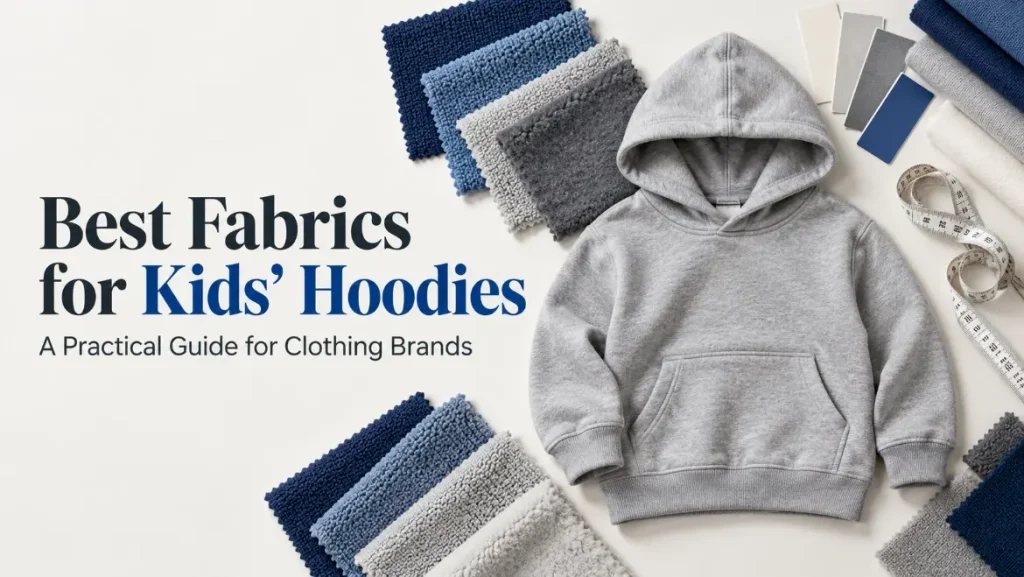
The best fabrics for kids’ hoodies include cotton-polyester blends for everyday collections, 100% cotton for cotton-focused casualwear, and organic cotton when verified sourcing matters. French terry, brushed sweatshirt fleece, lightweight jersey, and polar fleece give you different choices for the fabric’s structure and feel.
You can combine these choices: a hoodie can be both organic cotton and French terry. I’d start with the product you want to sell, then compare how two or three suitable fabrics handle the fit, decoration, and washing your customers expect.
What Are the Best Fabrics for Kids’ Hoodies?
For an everyday kids’ hoodie range, I’d start by sampling cotton and cotton-polyester versions of French terry or brushed sweatshirt fleece. Add lightweight jersey for hooded T-shirts, or polar fleece for a fleece-layer collection. Choose organic cotton when its verified sourcing supports a specific promise your brand wants to make.
Composition and construction are two parts of the same choice. The first three options below concern fiber content or sourcing. The remaining four describe constructions or surfaces. Use them together when writing your specification, rather than treating them as seven mutually exclusive fabrics.
This shortlist connects each option to a product brief:
| Option | Where I’d start using it | What to settle before approval |
|---|---|---|
| Cotton-polyester blend | Everyday school and casual collections | Composition, face yarn, wash behavior, and decoration |
| 100% cotton | Casualwear built around a cotton composition | Shrinkage, surface feel, and the planned care routine |
| Organic cotton | Collections with a documented organic sourcing requirement | Claim scope, traceability, and finished-fabric performance |
| French terry | Everyday layers with an unbrushed loopback interior | Loop texture, drape, and hood shape |
| Brushed sweatshirt fleece | Warmer casual styles with a plush interior | Loft, loose fibers, and bulk at seams |
| Lightweight jersey | Hooded T-shirts and light layering pieces | Coverage, pocket support, and neckline stability |
| Polar fleece | Fleece layering products | Pile finish, assembly, and logo application |
1. Cotton-Polyester Blends for Everyday Collections
Cotton-polyester blends belong on the shortlist when you want to balance a cotton-based feel with specific wash, drying, or shape-retention requirements. For a school or everyday casual range, I’d compare a blend with a pure-cotton candidate in a similar construction. That gives you a useful choice between finished fabrics, rather than an argument about which fiber is always better.
An 80/20 or 60/40 cotton-polyester ratio describes composition, not a performance grade. Ask which fiber percentage comes first and whether the face and reverse use different yarns. Then compare the washed samples and your proposed decoration. A blend is worth choosing when it meets the brief at a workable cost, not simply because its label contains polyester.
2. 100% Cotton for Cotton-Focused Casualwear
Pure cotton is a sensible starting point when you want cotton throughout the main body fabric and a composition customers recognize. Its absorbency can suit an everyday casual brief, although absorbing moisture and moving it away from the body are different properties. You still have several design options: a cotton hoodie can have a light jersey body, an unbrushed loopback interior, or a brushed reverse.
For cotton hoodie fabric, compare the new and washed hand feel before choosing the finish. A soft swatch is appealing, but you also need the garment to keep its intended dimensions. CottonWorks’ guidance on shrinkage explains how construction, processing, finishing, and care affect dimensional change. Ask what “pre-shrunk” means for the offered fabric and what remaining change the supplier expects under your agreed wash procedure.
3. Organic Cotton for Brands with Verified Sourcing Requirements
Choose organic cotton when you want a documented organic material requirement in the collection. It can fit a cotton-focused range without forcing you into one hoodie shape or weight. For example, you could request an organic cotton French terry for an everyday layer or an organic cotton brushed fabric for a warmer style, then compare the samples against the same design brief.
You’re paying for cotton with a documented organic origin. That description alone doesn’t establish extra softness, better wash performance, or suitability for sensitive skin. Ask which certification and order documents support your intended claim, including whether it applies to the material or the finished garment. I’d settle that before paying a premium or writing the product page.
4. French Terry for Everyday Layering
French terry has a relatively smooth face and visible, unbrushed loops on the reverse. I’d consider it for a hoodie that children can wear over a T-shirt and keep on indoors, where a fluffy interior isn’t part of the brief. You can select different weights and compositions while keeping that recognizable loopback surface.
Turn the sample over, handle the loops, and look at how it hangs. For a relaxed fit, compare the side profile with your reference garment; for a lined hood, check the assembled bulk behind the neck. French terry is a useful direction, but the actual loop texture and finish need to suit your product. Request a clearly identified swatch rather than approving the construction name alone.
5. Brushed Sweatshirt Fleece for Warmer Styles
Brushed sweatshirt fleece is a good candidate when a soft, raised interior is part of the product’s appeal. Brushing lifts fibers on the reverse, while the face can retain the familiar smooth sweatshirt appearance. I’d shortlist it for warmer casual collections and compare its thickness with the room available in the intended fit.
Feel the inside again after the agreed wash process and check for loose fluff on an underlayer. Then examine pocket edges and the hood attachment, where several layers meet. Those checks help you decide whether the plushness is worth the added bulk in your design. Ask the supplier for the actual composition too: a brushed interior doesn’t tell you whether the fabric is cotton, a blend, or synthetic.
6. Lightweight Jersey for T-Shirt-Weight Hoodies
Lightweight jersey suits a product that should feel closer to a hooded T-shirt than a traditional sweatshirt. Consider it for light layers, indoor use, or a collection where a substantial fleece hoodie would be out of place. Make that distinction clear in the product description so customers know which kind of garment they’re buying.
Review coverage and construction together. Hold the fabric against the intended underlayer, then inspect it in the actual garment rather than relying on a small swatch. A heavy double-layer hood, large pocket, or dense chest decoration may need a different fabric or assembly. Decide how much structure you want at the neckline and hem before choosing the lightest candidate.
7. Polar Fleece for Fleece-Layer Collections
Polar fleece is worth considering when you want a layering garment with a soft pile surface rather than the smooth-faced sweatshirt look. Its texture gives the collection a different appearance, so assess it as a separate product option. Ask for a sample showing both surfaces, the proposed seams, and the actual logo application.
Try the finished sample beneath the outerwear it is intended to accompany. Check the sleeve and underarm bulk, then review how the hood sits. Your preferred pile appearance should remain acceptable after the planned care process. If you want to market wind resistance or a specific thermal performance, request supporting evidence for that fabric and construction rather than relying on the word “fleece.”
Which Hoodie Fabrics Suit Different Seasons?
Choose by likely wearing conditions rather than the collection’s month on a calendar. A winter range sold into a mild climate may need a removable layer more than a thick pullover. Explain whether children will wear the hoodie indoors, outdoors, or under a coat.
Lightweight Fabrics for Warm-Weather Layering
For a lighter kids’ hoodie, I’d compare jersey with a relatively light French terry before requesting a brushed interior. Decide how much coverage and body you want: a hooded T-shirt and a lightweight sweatshirt can occupy quite different places in your range.
Include the intended T-shirt underneath when reviewing the sample. Look at the underarms, sleeve openings, and hood attachment. A light body fabric paired with a bulky hood can produce an unbalanced garment, even when the fabric itself feels pleasant. If you plan to advertise quick drying or moisture management, request evidence for the selected material rather than assuming a fiber name proves it.
Warmer Fabrics for Cold-Weather Collections
Brushed sweatshirt fleece is worth sampling when your brief calls for a warmer, plush interior. Review the whole garment with its intended layers, including whether the hoodie must fit beneath an outer jacket. Extra thickness at cuffs and underarms can make that combination awkward.
I wouldn’t approve a heavier fabric simply because it feels more expensive. For younger sizes especially, compare the finished garment’s weight and ease of movement. A warm-feeling swatch also doesn’t establish wind or rain protection, so keep those separate from your everyday hoodie claims.
French Terry vs. Fleece for Kids’ Hoodies
Start with French terry when you want an unbrushed loopback interior; start with brushed sweatshirt fleece when a plush inner surface is part of the brief. If your design calls for the pile appearance of polar fleece, name that separately so the supplier doesn’t quote a different product.
For a useful comparison, request candidates in a similar color and show the factory the same fit reference. Review the neck area, underarms, and hood with the intended underlayer. A fabric that feels pleasant loose on the table may become too bulky once those parts are assembled.
I’d also give each sample a fabric code. Write “loopback French terry” or “brushed sweatshirt fleece” beside it and photograph both sides. That small step makes later discussions about weight, color, and substitutions much clearer than a message asking for “the soft gray fleece.”
Is Cotton Better Than Polyester for Kids’ Hoodies?
Choose cotton when cotton composition and the selected fabric’s feel support your product brief. Compare a polyester-containing option when you have particular drying, wash, or shape-retention targets. The better choice is the finished fabric that meets those targets, including the care routine your customer is likely to use.
Keep the comparison fair. If one sample is lighter, brushed differently, and made with different yarns, you can still choose between the products, but you can’t attribute every difference to the polyester percentage. Ask the supplier which specifications changed and whether a closer comparison is available.
Before deciding, try the same decoration on both candidates and review the washed garments. If either needs a pattern adjustment or a care instruction that doesn’t suit your customer, include that in the decision. A familiar fiber label shouldn’t outweigh an obvious problem in the finished hoodie.
What GSM Should You Choose for Kids’ Hoodies?
Choose GSM after defining the construction and intended use. GSM means grams per square meter, so it measures fabric mass per area. It doesn’t directly measure thickness, softness, or warmth. There isn’t one number that makes every children’s hoodie comfortable or premium.
For an illustrative comparison, imagine two fabrics both specified at 300 GSM. One is a compact loopback knit; the other has a raised, loftier reverse. They have the same nominal mass per square meter, but you still need to compare their thickness, drape, and behavior in your pattern. The number hasn’t answered those questions.
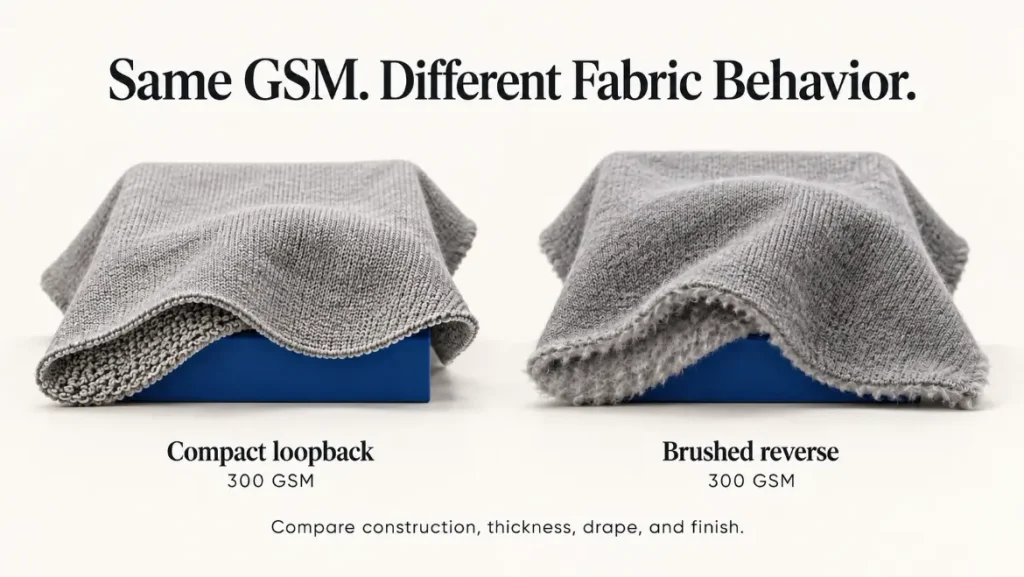
Keep these points beside your weight specification:
- Record the finished fabric’s weight, not an unclear value from an earlier processing stage.
- Agree how variation will be assessed; don’t leave “around 300 GSM” as the entire acceptance requirement.
- Compare usable width and consumption as well as mass per area when reviewing cost.
- Weigh the finished sample if total garment weight matters, especially with a lined hood or large pockets.
A higher GSM shouldn’t be your shortcut to a higher quality claim. I’d choose the weight that helps the product work, then explain its value through the garment’s construction and verified performance. A lighter, well-specified layer can be the right product for your range.
How Does Fabric Affect Hoodie Fit and Movement?
Fabric changes how a pattern hangs and responds when the wearer moves. Review drape, stretch, and recovery separately: a fabric can stretch easily but recover poorly, or hold a neat shape while feeling restrictive in the chosen cut.
Match Drape to the Intended Shape
Start with where you want the volume to sit. A broad body with a shorter hem needs a different visual result from a long, relaxed layer. If the names are getting blurred in the brief, distinguish the different hoodie styles and fits before approving the material.
In a hypothetical same-pattern comparison, a softer candidate might fall closer to the body while a firmer one holds the side profile away from it. Neither result is inherently better. Review the front, side, and back against your design reference, then decide whether to adjust the fabric or the pattern.
Check Stretch and Recovery During Movement
Try the sample with the intended underlayer and ask the wearer to reach forward, bend their elbows, and put the garment on and take it off. Observe where it pulls and whether the cuffs or body remain stretched afterward. Record the size and fit conditions so the feedback is useful.
Don’t use extra stretch to compensate for a neckline or armhole that needs pattern work. Likewise, a roomy silhouette doesn’t eliminate the need to check cuff openings. For a size range, agree which additional sizes need evaluation rather than assuming the first development sample represents them all.
Why the Whole Hoodie Needs a Fabric Review
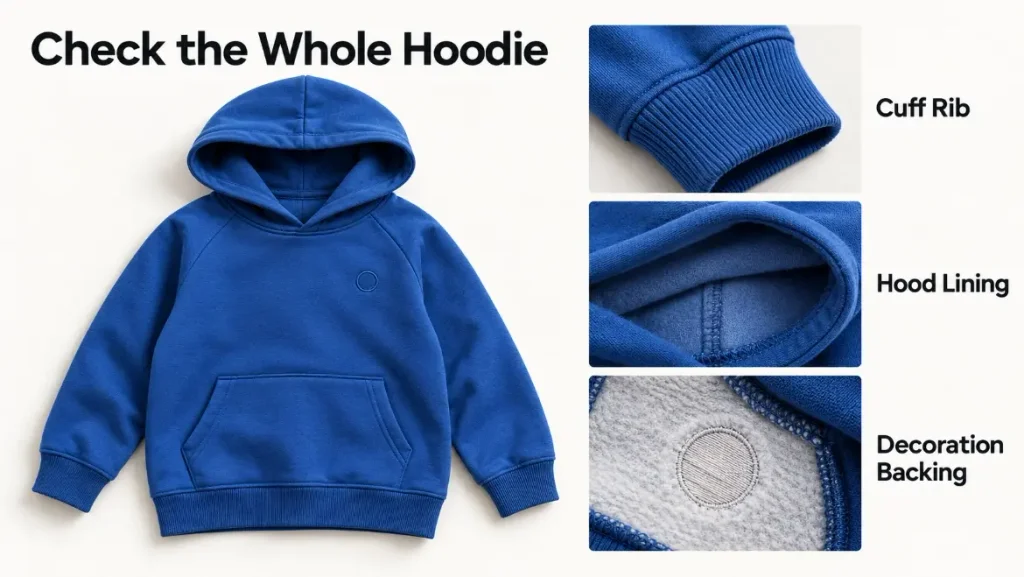
The body fabric shares the garment with ribbing, hood layers, seams, and decoration. These parts need to work together in the finished sample. A good body swatch can’t tell you whether the neckline feels bulky or the hem hangs as intended.
Match Ribbing to the Body Fabric
Ask for the proposed cuff and hem rib alongside the body material. Compare their color and feel, then review them sewn together. Rib that looks acceptable loose can behave differently once its attachment dimensions are fixed.
Use a short assembly check:
- Does the cuff opening allow the intended hand to pass through comfortably?
- Does the cuff recover after the agreed handling check?
- Does the hem sit as designed rather than pulling the body into unwanted folds?
- Do the body and rib still look coordinated after washing?
Keep the approved rib code with the body-fabric record. If the supplier substitutes a different rib later, review the assembly again instead of treating it as a minor color-matching decision.
Review Hood Layers and Decoration
A double-layer hood deserves its own handling check. Fold it behind the neck, wear it up, and inspect the join where the hood meets the body. Also examine pocket edges and zipper areas, where several layers meet. Decide whether a lighter lining is needed before approving bulk materials.
Decoration belongs in this review too. Use the actual fabric color and finish for the trial, and look at both sides of the decorated area. Our comparison of embroidery and printing for custom kids’ hoodies covers the method choice; here, the priority is confirming that the chosen application works on your selected fabric without unwanted stiffness or distortion.
What Should You Check After Washing?
Check dimensions, shape, surface appearance, and the joins between materials under a recorded procedure. Agree the acceptance criteria before testing, so you’re not deciding what counts as acceptable after seeing the result.
Measure Shrinkage and Shape Changes
Measure the same defined points before and after the agreed wash and drying process. Record the sample version and conditions. A phone photograph can show a twisted side seam, but it can’t replace a repeatable measurement of body length or sleeve length.
For formal work, distinguish fabric testing from garment testing. The AATCC methods directory lists TM135 for fabric dimensional changes after home laundering and TM150 for garments. Ask the laboratory which method and conditions fit your purpose; this record sheet is a development aid, not a substitute for the method.
Keep a record for each candidate:
| Record field | What to enter |
|---|---|
| Sample identification | Style, size, color, fabric code, and sample version |
| Wash conditions | Agreed procedure, drying method, and number of cycles |
| Measurements | Defined points and before-and-after values |
| Shape observations | Side seams, hem, cuffs, neckline, and zipper alignment |
| Appearance observations | Surface texture, loose fibers, color, and decoration |
| Decision | Approved, rejected, or revised, with the reason and reviewer |
Check the Surface and Color
Inspect the body and rib next to each other under consistent viewing conditions. Look for changes that would affect the product you plan to sell. An attractive new sample may be less convincing once a dark body and lighter rib no longer look coordinated.
Separate the questions you need answered:
- Has the inner surface changed noticeably in feel or appearance?
- Is loose fiber collecting on other parts of the garment?
- Are there visible pills, and is further pilling testing needed?
- Has the color changed or transferred to another component?
- Has the decoration changed, stiffened, or distorted its surrounding area?
One wash doesn’t establish abrasion resistance, colorfastness under every exposure, or lifetime durability. Define any additional tests with the supplier or laboratory. During sample evaluation, identify the approved version clearly and keep its records together, so later fabric or trim substitutions are visible.
Are Organic or Recycled Fabrics Worth Choosing?
They’re worth considering when verified material sourcing is part of your brand’s brief and the available fabric also meets your product requirements. Keep the sourcing decision separate from the performance decision: an organic or recycled description doesn’t demonstrate better drape, lower shrinkage, or greater comfort.
Decide Which Sourcing Claim Your Collection Needs
An organic cotton requirement and a recycled-content requirement answer different sourcing questions. Decide which belongs in your collection before asking suppliers for alternatives. A general request for “eco fabric” can produce quotes for materials that support quite different product claims.
Check whether the documented option is available in the color, finish, and quantity you need. If the supplier proposes a substitution to meet your delivery date, ask whether it changes the intended claim as well as the garment. Keep the material documentation with the approved sample so the sourcing decision remains connected to what you buy.
Check What Fabric Certifications Actually Cover
OEKO-TEX STANDARD 100 concerns testing textiles for harmful substances. It doesn’t establish that cotton is organically grown or that a hoodie won’t pill. Textile Exchange’s RCS and GRS address recycled materials and chain of custody; their purpose is different from a wash-performance report.
Check the certificate’s validity, product scope, and relevance to the material being purchased. Ask what documentation is needed for your order and any label claim you intend to make. A supplier’s certification doesn’t mean every fabric it offers, or every finished garment made from it, carries the same claim.
How Fabric Choices Affect Your Production Budget
Compare the material cost for the intended garment and order, not just the price printed beside a swatch. Usable width, consumption, color choices, and matching trims can change which option is affordable once you start production.
Compare Fabric Cost per Finished Hoodie
Ask for a comparison based on the same style and size mix. A price per kilogram and a price per meter can’t be compared directly without the fabric specifications and consumption assumptions. In cut-and-sew development, decisions about the hood, pockets, and silhouette also affect the material needed.
Request these inputs with the quote:
- The price unit, finished weight, and usable width of each candidate.
- Estimated consumption for your actual size mix and design.
- Allowances included for cutting loss or other agreed production needs.
- The cost and availability of matching rib and hood lining.
- Any separate development, finishing, or material-testing charges.
In an illustrative comparison, a cheaper fabric could need more purchased material because its usable width gives a less efficient cutting layout. Ask the factory to show that difference. You don’t need to become a marker planner, but you do need to know why the cheaper swatch produces the higher garment quote.
Weigh Stock Fabrics Against Custom Dyeing
Stock fabric can be worth considering if its colors and specifications already fit your range. Confirm what quantity is available and whether the supplier expects to replenish it. A suitable fabric for one launch may be a poor basis for a repeat core product if future supply is uncertain.
Custom dyeing gives you a different set of questions about minimum quantities, color approval, scheduling, and repeat orders. Ask which requirements apply per color and which apply to the total fabric order. Keep an approved reference and agree how later batches will be compared for shade, finish, and performance.
Turn Your Fabric Choice into a Sampling Brief
Once you have a shortlist, give the sample team enough detail to understand both the material and the product it must become. “Soft cotton hoodie for kids” leaves too many choices open. A clear brief helps the supplier explain trade-offs before making a sample you didn’t intend.
Put these fields into your clothing tech pack or accompanying material brief:
- Target age range, market, season, and expected wearing conditions.
- Style reference, intended fit, size range, and normal underlayer.
- Candidate fabric codes, construction, composition, and finished GSM.
- Required face and reverse appearance, with physical references where possible.
- Rib, lining, pocket, and zipper-area requirements.
- Decoration method, placement, and the actual trial needed.
- Planned care instructions and the wash or performance checks to agree.
- Quantities by color, budget assumptions, and sourcing claims that need documentation.
Mark what is fixed and what the supplier can propose changing. For example, you might require a loopback interior but be willing to compare two weights, or keep a particular color while considering different compositions. That distinction makes supplier recommendations easier to evaluate.
Before approving production, confirm which material, finish, trims, and sample version the approval covers. If a later substitution changes any of those, request the relevant review again. Your brief should make it possible to identify an unapproved change without relying on someone’s memory of a swatch.
Conclusion
For everyday kids’ hoodies, I’d begin with cotton and cotton-polyester candidates in French terry or brushed sweatshirt fleece. Use organic cotton for a substantiated sourcing requirement, lightweight jersey for a hooded T-shirt, and polar fleece for a different layering product. Narrow that list to the fabrics that suit your fit, care instructions, and budget.
For a HAPA project involving custom boys’ hoodies, send your target ages, style reference, quantities, and fabric priorities together. That gives the development conversation a useful starting point. I’d settle those choices before adding more colors or decorative details to the range.
Frequently Asked Questions
Can One Fabric Work for Both Hoodies and Joggers?
Yes, the same fabric can be a candidate for a coordinated set. Review both garments separately, including the jogger knees, seat, waistband, and pocket areas. A material that makes the hoodie you want still needs to meet the demands of the matching bottoms. Approve the set’s color and appearance together.
Can I Use Adult Hoodie Fabric for a Kids’ Collection?
You can consider it, but reassess it in the children’s pattern and intended age range. Check finished weight, bulky joins, openings, and movement rather than simply scaling down the adult garment. Also confirm the applicable product and market requirements separately; the fabric name alone doesn’t establish suitability.
Should I Approve Every Color Before Production?
Each production color needs a defined approval route. Agree with your supplier which shades, combinations, and decorations need additional testing based on the product’s risks. Don’t assume that the appearance or performance of one approved shade proves the same result for every other color in the order.
What If My Preferred Fabric Has a High Minimum Order?
Ask whether the constraint comes from knitting, dyeing, finishing, or the garment order. Then compare options such as an available stock color, fewer colors, or another suitable fabric. Request revised terms for each alternative; changing the design doesn’t automatically reduce every supplier minimum.
Does a Softer Swatch Always Make a Better Hoodie?
No. Softness can win the first comparison while another issue rules the fabric out later. Check its behavior in the hood, cuffs, seams, and decorated areas, then review it after the planned wash process. Keep softness in your criteria, but decide what other requirements the product must meet before approving it.
References & Sources
- CottonWorks: Single & Double Knits explains jersey, French terry, sweatshirt fleece, and rib constructions.
- AATCC: Standard Test Methods and Procedures identifies methods for evaluating fabrics and finished garments.
- OEKO-TEX STANDARD 100 explains the scope of harmful-substance testing and certificate checks.
- Textile Exchange: RCS and GRS explains recycled-content certification and chain of custody.