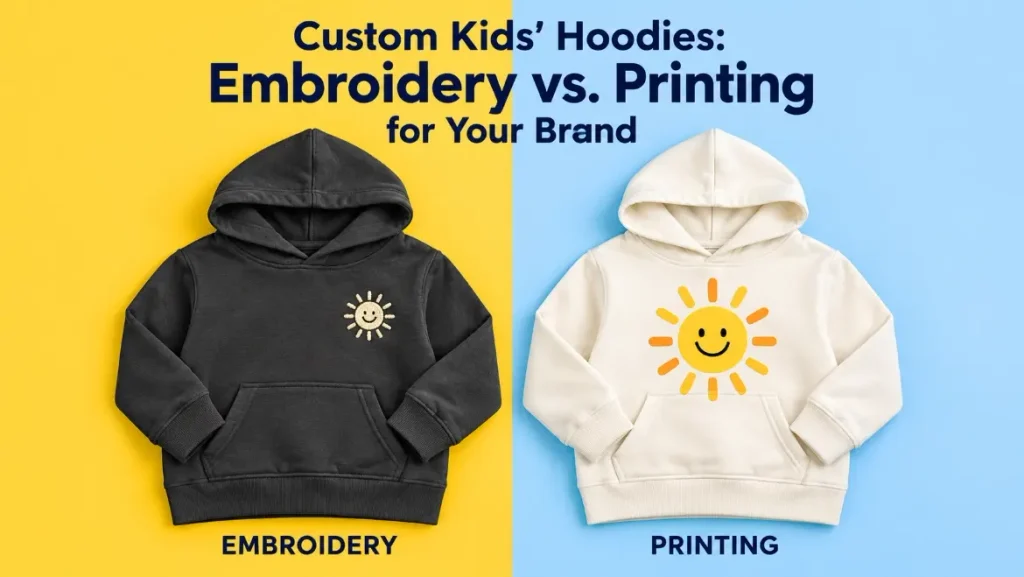
For custom kids’ hoodies, I’d start with embroidery for a compact logo with a raised finish, and printing for a large illustration or detailed, colorful design. Neither wins every time. When comparing embroidery vs. printing for kids’ hoodies, the fabric, artwork size, and feel of the finished garment should guide your choice.
A design that looks balanced on an adult hoodie can overwhelm a smaller size. Before committing to bulk production, check the decoration inside and out, compare equivalent quotes, and approve a sample made with your intended materials.
Embroidery vs. Printing for Kids’ Hoodies at a Glance
Embroidery builds a design with stitches. Printing reproduces it through an ink or transfer process, with different results depending on the method. Start by choosing which finish suits your design, then check whether the proposed process works on your hoodie. “Printed” alone isn’t a useful production specification.
| Method | Worth considering for | Fabric and feel to check | Quote and sample priorities |
|---|---|---|---|
| Embroidery | Small logos, initials, simple lettering | Whether the fabric supports the stitches; thickness and reverse-side finish | Digitizing, stitch count, placement, backing, readable details |
| Screen printing | Repeated graphics, especially where setup can be shared across an order | Ink system, coverage, flexibility, and compatibility with the fabric | Screens and setup, colors, locations, curing, final feel |
| Direct-to-garment printing (DTG) | Illustrations and detailed multicolor artwork | Suitable fabric surface, pretreatment, color reproduction | Actual print size, garment color, detail, washing results |
| Direct-to-film printing (DTF) | Multicolor artwork applied through a transfer | Heat compatibility, adhesive layer, coverage, and flexibility | Transfer dimensions, application, edges, fabric marking |
Treat these as starting points for sampling. A light outline and a filled rectangle can feel very different even when both use the same printing method. Likewise, a small stitched emblem tells you little about how a large embroidered panel will behave.
I’d compare two samples on the same hoodie body, with the same artwork dimensions wherever feasible. Otherwise, you may end up choosing between different garments rather than different decoration methods.
When Does Embroidery Work Well on Kids’ Hoodies?
Embroidery is worth considering when you want a distinct texture and the design remains readable at a compact size. It works less comfortably as a default answer for every graphic. Decide which details matter before asking a supplier to turn the artwork into stitches.
Small Logos and Simple Lettering
A simple chest emblem can make a basic hoodie recognizable without covering much fabric. Short lettering can work too, provided the letters and the spaces between them remain clear in the stitched version. Zooming in on your laptop won’t show you whether the actual embroidery is readable.
Ask to see the design at its actual size. If the supplier proposes thicker lines, wider spacing, or fewer details, review those changes before sampling. For a small logo, I’d preserve the recognizable shape before trying to keep every tiny feature of the original drawing.
When exploring custom embroidery options, send the intended hoodie fabric and logo dimensions together. “Can you embroider this?” leaves too much open; the useful question is whether that design works at that size on that garment.
Dense Designs and Large Embroidered Areas
A large stitched design needs a different review because its coverage, density, and supporting materials affect how the decorated area bends. Adding more stitches isn’t automatically an improvement. Check whether the cloth puckers around the design or feels noticeably heavier where the child moves.
Suppose your design features a cartoon animal. You could compare a simplified embroidered outline with a printed version that retains the filled colors. Approve the change in appearance as well as the construction; the factory shouldn’t remove part of the character without checking with you.
Which Printing Method Fits Your Kids’ Hoodie Design?
Screen printing, DTG, and DTF deserve separate quotes when more than one could suit your design. They use different preparation and application steps, so their costs and results won’t follow one simple rule. Ask the supplier to name the proposed method before you compare prices.
Screen Printing for Repeat Graphics
Screen printing pushes ink through a prepared screen onto the fabric. For repeated artwork, the setup can be spread across the order. Colors and locations affect that setup, which is why a simple front design and a multicolor front-and-back design need separate evaluation.
Don’t assume a screen print will feel either thick or barely noticeable. Ask which ink system the supplier proposes and inspect the printed area when the hoodie is folded and gently moved. The design’s coverage matters alongside the ink and application.
Screen printing can reproduce more than basic solid shapes, but the workable detail depends on the artwork and production setup. Have the printer review fine lines and shading instead of ruling the method in or out from a generic description.
DTG for Detailed Artwork
DTG prints ink directly onto the garment and is an option for illustrations with many colors or fine visual detail. Fabric suitability still matters. Ask whether the chosen hoodie surface works with the supplier’s equipment, ink, and pretreatment rather than relying only on its overall cotton percentage.
Check the intended garment color, too. A sample on a white hoodie doesn’t approve the same image on navy. I’d look closely at pale details, the edges of the illustration, and how the finished area feels beside the unprinted fabric.
DTF for Transfer-Based Designs
DTF prints the design onto film, uses an adhesive system, and transfers it to the garment with heat. It can be useful for multicolor graphics, but the chosen transfer must suit the fabric and its response to heat. A supplier’s material approval is more useful than a claim that DTF works on everything.
Check broad filled areas as well as small details. Bend the decorated panel, inspect the edges, and look for unwanted marks around it. If the hoodie has awkward seams or limited access, discuss the decoration sequence during cut-and-sew development; a flat panel and a finished garment don’t offer the same working access.
How Should You Prepare Artwork for Embroidered or Printed Kids’ Hoodies?
Provide the original design, the intended output size, and a clear color reference before sampling. Embroidery requires a stitch file, often called a digitized file, while printing has its own output requirements. The same original artwork can begin both conversations, but it isn’t automatically ready for both production processes.
Use this checklist to keep the design brief specific:
- Supply the best original file you have, with the intended background clearly identified. Ask the decorator which format and color settings their process needs; a screenshot of a logo is a poor substitute for the original artwork.
- State the finished width and height. Review small lettering, thin lines, and open spaces at that size. If details need changing, keep the original and proposed versions together so everyone can see what changed.
- Separate thread-color approval from printed-color approval. Request available thread references and an appropriate printed sample for important brand colors. Don’t assume two different materials will look identical because they share a color name.
- Give the approved artwork a version identifier and connect it to the physical sample. Record any changes in size or color before placing the production order.
Printful’s print-file preparation guidance explains why actual dimensions, product-specific requirements, and screen-to-print color differences need attention. Its upload settings belong to its service; your manufacturer may require different files. Use the physical sample as your color reference, not a phone photo.
How Does Decoration Affect Comfort on Kids’ Hoodies?
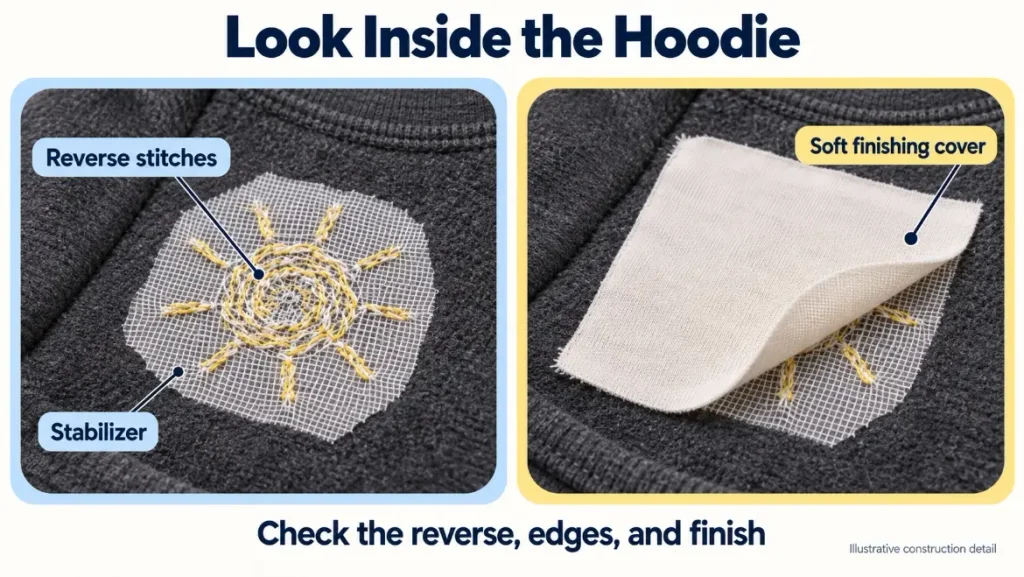
Decoration can change the softness and flexibility of a hoodie, even when the undecorated garment feels comfortable. Inspect the inside as carefully as the front, then handle the garment as a whole. You want to know whether the decorated area feels appropriate for the intended use and layers.
Check the Inside of the Garment
Embroidery backing helps support the fabric during stitching. A soft finishing layer can cover the back of the embroidery afterward. Those are different jobs. Madeira’s backing guidance connects backing selection with factors including fabric stability, stitch density, design size, and laundering; it also describes finishing materials for covering embroidery.
Run your hand across the reverse and check the edges, thread ends, and any covering. Repeat that inspection after washing according to the proposed care instructions. A neat front doesn’t tell you whether the reverse will feel rough against a thin layer or whether a finishing edge will lift.
I’d avoid approving a children’s chest logo from front-only photographs. Ask for a reverse view and, before production, handle the sample yourself. This is a practical comfort check, not proof that a material cannot irritate any child’s skin.
Match Decoration to the Fabric Surface
Look at the actual surface being decorated. A smooth outer face, a textured surface, and a stretchy lightweight knit present different conditions. The fiber percentage on the label doesn’t describe all those differences. If your girls’ hoodie collection includes both lightweight and fleece styles, approve the decoration on each selected fabric rather than carrying one approval across the range.
Polyester-containing fabrics also deserve attention during heat-based processes. STAHLS documents how heat can cause dye from polyester garments to migrate into certain decorations. Ask for compatibility checks on the intended fabric and color; that risk doesn’t mean every polyester hoodie will bleed.
Where Should You Place Logos and Graphics on Kids’ Hoodies?
Choose a position that remains visible and workable across the size range. A pocket, zipper, narrow sleeve, or hanging hood can change both the appearance and the available decoration area. Approve placement on representative small and large sizes before applying one layout across the collection.
Check each location with the garment laid flat and in its normal wearing position:
- For chest artwork, review the space between the neckline and pocket. On a zip-up hoodie, confirm whether the design stays on one panel or requires an approved approach across the opening.
- For back graphics, lower the hood and see how much artwork it covers. A layout that looks centered on a flat drawing may leave an important word hidden during wear.
- For sleeves, ask the supplier to confirm working access and the usable area. Review the graphic around the sleeve rather than treating it like a flat rectangular panel.
- Across youth sizes, compare the artwork’s proportion to the body. Agree on size groups if one decoration size doesn’t work throughout; you don’t necessarily need a new design for every garment size.
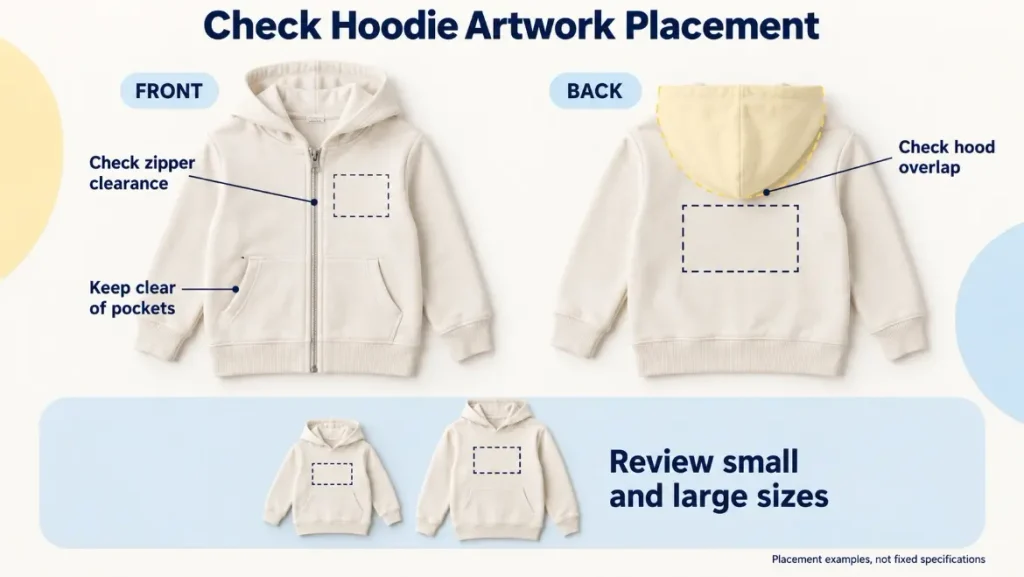
Keep placement measurements tied to named garment reference points. That makes feedback clearer than asking for a logo to move “slightly higher.” For a boys’ hoodie range spanning several age groups, retain the measurements and approved layout for each size group so the factory knows which version to use.
Is Embroidery More Expensive Than Printing in Bulk?
Embroidery isn’t always more expensive. The result depends on the artwork, stitch or print requirements, number of locations, quantity, and setup. A compact stitched logo and a large multicolor print are different jobs. Compare the same garment and intended design before deciding which quote offers better value.
For custom kids’ hoodies in bulk, ask each supplier to separate these items:
- The hoodie body, including the selected fabric, sizes, colors, and quantity breakdown. Keep this specification unchanged between the decoration options.
- Artwork preparation, digitizing, screen setup, or other initial charges. Ask what happens to those charges if you change the artwork or reorder later.
- Decoration per garment and per location, including the actual design dimensions. Confirm whether backings, finishing covers, or other required materials are included.
- Samples, revisions, and any extra checking you request. Agree on what happens if a sample doesn’t match the approved brief.
- Packing and delivery costs, plus any exclusions that prevent the quotes from being directly comparable.
I would rather simplify a design deliberately than accept a cheaper quote with an undefined finish. If the price changes because a supplier removes a covering, reduces the artwork, or substitutes another hoodie, review that as a product change. The lower price alone doesn’t tell you whether it suits the collection.
What Should Brands Know About Small-Batch Hoodie Orders and Reorders?
Small-batch feasibility depends on the complete order, including the hoodie body and materials. A decorator using stocked garments may have different constraints from a manufacturer developing your own fabric, fit, and colors. Confirm the minimums and schedule for your particular order instead of treating either method as inherently low-MOQ.
Before setting a launch date, clarify four things:
- Ask how the quantity is counted: per style, body color, artwork, or decoration position. A total order spread across several combinations may not meet each individual requirement.
- Confirm when the production clock starts. Artwork approval, material availability, sample approval, and payment can be separate milestones. Get the relevant starting point in writing.
- Allow time for sample changes and transport. A quoted production period doesn’t necessarily include development, international delivery, or the time you need to review a revised sample.
- For reorders, retain the approved garment, file versions, color references, and placement record. Ask whether the same body fabric and decoration materials remain available, and how substitutions would be approved.
My preference would be to keep the first order’s decoration manageable if the main goal is testing a new hoodie fit. Adding several placements at once makes it harder to separate a fit decision from a decoration decision. Once you know what you want to repeat, discuss the next order against that approved version, not just its product name.
Which Lasts Longer After Washing: Embroidery or Printing?
There isn’t a reliable universal winner. Embroidery and printing have different failure signs, and both depend on materials, application, and care. A promise that one method “lasts forever” won’t help you approve a hoodie. Compare the actual samples under recorded conditions that match their intended care instructions.
Photograph and inspect the samples before washing, then check the following afterward:
- On embroidery, look for loose or broken stitches, changes in shape, puckering around the design, and problems with the backing or finishing cover. Check the reverse again rather than judging only the front.
- On printed areas, inspect color changes, cracking, lifted edges, or peeling where relevant to the method. Also check the surrounding fabric for changes in feel or appearance.
- On both garments, review the body dimensions and how the decoration sits after washing and drying. Record the wash setting, drying method, and other conditions so you can discuss a specific result with the supplier.
A home wash check is useful feedback, but it isn’t a standardized laboratory test. If your retailer or product specification requires defined durability testing, agree on the method and acceptance criteria with the supplier and testing provider. Avoid turning a few satisfactory washes into an unsupported lifespan claim on your product page.
Choose a Decoration Method for Your Kidswear Collection
You don’t need one technique for every style. Choose according to the role of each garment, then keep the parts that identify the collection consistent. The following are illustrative selection scenarios, not test results or customer orders.
| Collection idea | What I’d compare first | What needs approval |
|---|---|---|
| An everyday hoodie with a compact chest emblem | Embroidery and a suitable small print | Legibility, reverse-side feel, and proportion on smaller sizes |
| A hoodie built around a colorful illustration | DTG and a compatible DTF option | Fine details, garment-color effects, and flexibility across the graphic |
| A repeated group graphic with a simple color scheme | Screen printing and a transfer quote | Setup allocation, order breakdown, feel, and washing results |
| A small brand mark plus a large back illustration | Embroidery with printing, or printing at both locations | Combined cost, processing sequence, placement, and shared care instructions |
Suppose you want the embroidered emblem to stay on future collections while the illustrated back changes seasonally. I’d ask which files and approvals can carry forward, and which need another sample. Repeating a brand mark doesn’t automatically approve it on a new fabric or in a different position.
That discussion belongs alongside private label kidswear development, where the body, labels, and decoration become one finished product. A consistent collection can use different techniques without pretending they should all feel or cost the same.
What Should You Approve Before Bulk Hoodie Production?
Approve a physical sample that represents the intended production materials and decoration. A swatch can answer an early question about a stitch or print, but it can’t show every detail of the completed hoodie. Before giving approval, record which sample and specification version the factory should follow.
Use a short approval record that covers the whole garment:
- Match the hoodie fabric and color to the order, and record any sample materials that differ from planned production.
- Confirm artwork version, finished dimensions, colors, and position using agreed measurement points. Include the size groups that need different layouts.
- Inspect the face and reverse, including backing edges, loose threads, transfer edges, and the feel of large decorated areas.
- Record washing observations and any agreed testing results, with the conditions used. Confirm that the care instructions suit both the garment and its decoration.
- Close outstanding revisions and identify who approves them. Keep the approved sample and written comments available for production and reorder discussions.
For US sales, check the CPSC’s Children’s Product Certificate guidance with the responsible compliance party. US importers and domestic manufacturers must address the rules applicable to their children’s products, with testing and certification requirements subject to relevant exceptions. Match the documents to the product being sold; a thread or ink claim alone doesn’t establish the finished hoodie’s compliance.
If you’re developing the collection with HAPA, send your artwork, size range, fabric preference, quantities, sales market, and required arrival date when requesting and reviewing hoodie samples. That gives the team a concrete brief for discussing feasible decoration options and revisions before you commit to the bulk order.
Conclusion
For custom kids’ hoodies, embroidery is a useful starting point for compact, textured branding. Printing gives you other ways to handle larger graphics and detailed color. The choice becomes clearer when you compare the actual fabric, design size, reverse-side feel, and complete quote.
I’d spend the most attention on the sample that represents your smallest sizes and intended materials. Approve the appearance and the construction together, retain that version, and use it when discussing production or reorders. That gives your brand something specific to buy against.
Frequently Asked Questions
Is sublimation suitable for kids’ hoodies?
It can suit an appropriately designed polyester hoodie, usually starting with a white or light-colored fabric. Conventional sublimation isn’t a direct substitute for decorating a dark cotton hoodie. Confirm the fabric, base color, and construction route before choosing it.
Can every hoodie carry a different name or number?
Ask the supplier whether it supports item-by-item personalization and how it prices that work. Provide a checked list matching each name or number to the correct size and color, and agree on an approval process before production.
Can I use embroidery and printing on the same hoodie?
Yes, where the fabric, locations, and production sequence support both. Approve the combined garment rather than separate decorations alone, including how any heat application affects the finished item and which care instructions it needs.
Can embroidery be removed if a logo changes?
Don’t plan on removal as a guaranteed way to save stock. Have the supplier assess a sample for remaining needle marks or fabric damage before attempting a larger rework. Covering the old design also needs a separate appearance and comfort review.
Can I decorate ready-made hoodies instead of making new ones?
Yes, if the selected garments and accessible areas suit the decoration. Check material compatibility, available sizes, and any labeling or resale conditions. Using blanks can avoid developing a new body, but it doesn’t remove the need to approve the decorated sample.
References & Sources
These resources explain the technical and compliance points discussed above; product-specific decisions still require your supplier’s specifications and samples.