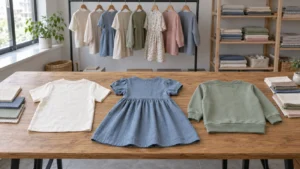
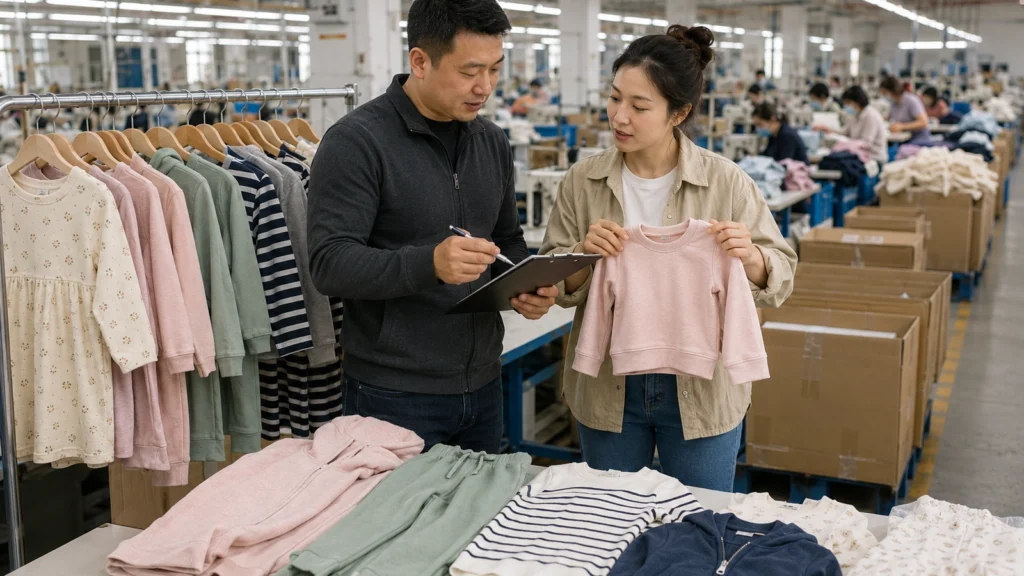
Le responsable de production et l'acheteur examinent une nouvelle commande de vêtements pour enfants dans une usine chinoise.
Délai de traitement des commandes répétées de vêtements pour enfants chinois La question devient très concrète dès lors qu'un de vos modèles de vêtements pour enfants commence à se vendre plus vite que prévu. Pour une première commande, vous êtes peut-être prêt à consacrer des semaines à peaufiner un prototype, à confirmer les couleurs, à valider les étiquettes et à finaliser l'emballage. Pour une commande suivante, votre état d'esprit change : vous savez déjà que le produit fonctionne et vous avez désormais besoin de stock avant que la dynamique des ventes ne s'essouffle.
D'après mon expérience dans la production de vêtements pour enfants, les commandes répétées les plus rapides sont rarement dues à une simple augmentation de la cadence de production. Elles surviennent parce que la plupart des incertitudes ont déjà été levées. Le patron est validé, le système de tailles est stable, les spécifications du tissu sont connues, le visuel est finalisé et l'acheteur comme l'usine savent précisément à quoi doit ressembler un produit conforme.
Dans des conditions idéales, une commande simple et répétée peut parfois être exécutée en environ 7 à 15 jours départ usine. Une plage de planification plus pratique pour de nombreuses commandes répétées de vêtements pour enfants est 15 à 30 jours, tandis que les modèles nécessitant la reproduction de tissus, une teinture personnalisée, une broderie complexe, des finitions spéciales ou une forte capacité saisonnière peuvent prendre plus de temps. 30 à 45 jours ou plus.
Ces chiffres ne constituent pas une garantie pour le secteur, et je vous recommande la prudence face à tout fournisseur qui présente un délai de livraison comme étant universel. Votre calendrier réel dépend du produit, de la quantité, de la disponibilité des matières premières, de la décoration, de l'emballage, des contrôles qualité et de la charge de production actuelle de l'usine.
Lorsque j'évalue Délai de traitement des commandes répétées de vêtements pour enfants chinois, La question la plus utile n'est pas simplement : “ De combien de jours avez-vous besoin ? ” C'est :
“ Quelles pièces de ma nouvelle commande sont déjà prêtes, et quelles pièces doivent encore être produites ? ”
C’est ainsi que vous obtenez un délai d’approvisionnement que vous pouvez réellement utiliser pour la planification des stocks.
Réponse rapide : Quel est le délai de livraison réaliste pour une nouvelle commande de vêtements pour enfants en Chine ?
À des fins de planification, j'utiliserais les fourchettes suivantes comme cadre de départ plutôt que comme une promesse.
| Situation de commande répétée | Objectif de production pratique |
| Même style, même couleur, tissu et finitions d'origine, capacité ouverte | 7 à 15 jours |
| Même style, certains matériaux nécessitent un réapprovisionnement. | 15 à 25 jours |
| Le tissu doit être tricoté, imprimé, teint ou apprêté à nouveau. | 20 à 35 jours |
| Broderie, paillettes, perles, lavage spécial ou multiples procédés sous-traités | 25 à 40 jours |
| Commande répétée en gros volume | 25 à 45 jours et plus |
| Commande de haute saison avec capacité de production limitée | Ajouter 1 à 3 semaines ou plus si nécessaire |
Ce sont production Les fenêtres ne comprennent pas automatiquement l'inspection finale, la livraison au transitaire, le transport international, le dédouanement ni la livraison à votre entrepôt.
Lorsqu'un fournisseur affirme pouvoir terminer en 15 jours, demandez-lui précisément ce que signifie cette date. S'agit-il de la fin de la confection ? De l'emballage ? De la sortie d'usine ? De la remise des marchandises ? De l'arrivée en entrepôt ? Une date butoir claire est tout aussi importante que le nombre de jours.
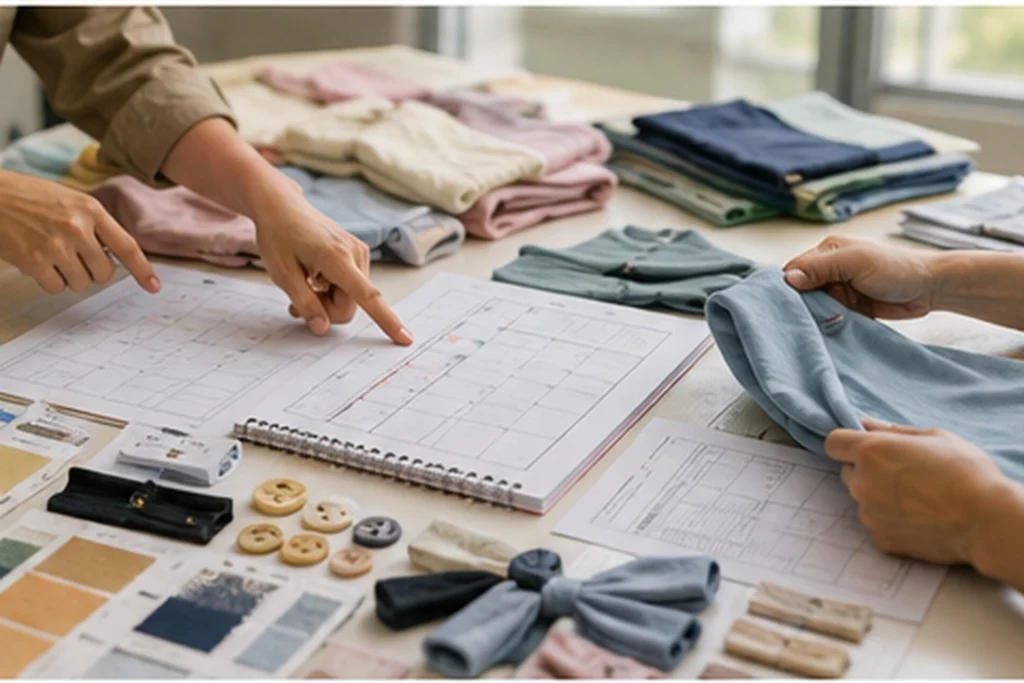
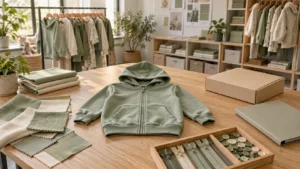
Planification d'une nouvelle commande de vêtements pour enfants avec échantillons, tissus et calendrier de livraison.
Pourquoi les commandes répétées peuvent être livrées plus rapidement que les premières commandes
La principale raison pour laquelle une nouvelle commande peut être traitée rapidement est que l'usine n'a plus besoin de redécouvrir le produit.
Repensez à votre première commande personnalisée. Selon le projet, vous avez peut-être suivi les étapes suivantes :
- Examen de la conception et de la faisabilité
- Précisions sur le dossier technique
- Création de patrons
- classement des tailles
- Approvisionnement en tissus
- Approvisionnement en garnitures
- Développement de prototypes
- Corrections d'ajustement
- Approbation des œuvres d'art
- Échantillonnage d'impression ou de broderie
- Développement d'étiquettes
- Confirmation d'emballage
- Approbation de l'échantillon de préproduction
- planification de la production en vrac
Une véritable commande répétée ne devrait pas nécessiter la majeure partie de ce développement à nouveau.
Si le vêtement reste inchangé, l'usine devrait déjà disposer du patron final, des tailles graduées, du tableau des mesures approuvé, des détails de construction, des illustrations, des spécifications de finition approuvées, des instructions d'emballage et de l'historique de production. C'est pourquoi il est préférable de conserver une version “ maître ” unique et fiable de chaque modèle approuvé plutôt que de disperser les informations de production dans des courriels et des conversations éparses.
Si vous souhaitez examiner plus en détail les éléments que l'usine doit généralement sécuriser avant une première commande en gros, consultez le guide de HAPA sur production OEM de vêtements pour enfants Ce document illustre les liens entre la revue de conception, les patrons, le classement des matériaux, l'approvisionnement en matériaux, les échantillons, la production et le contrôle qualité. Lors d'une commande répétée réussie, une grande partie de ce travail préparatoire a déjà été effectuée.
C'est ici que Délai de traitement des commandes répétées de vêtements pour enfants chinois peut s'améliorer considérablement : non pas parce que l'usine néglige les contrôles nécessaires, mais parce qu'elle évite des redéveloppements inutiles.
La commande répétée la plus rapide est une commande répétée inchangée.
Si la vitesse compte, l'ordre de répétition le plus simple est ennuyeux, dans le meilleur sens du terme.
C'est la même chose :
- Modèle
- Mesures
- Tissu
- Couleur
- Impression ou broderie
- Étiquettes
- Garnitures
- Conditionnement
- Gamme de tailles
- Norme de fabrication
Dès que vous commencez à modifier ces éléments, l'ordre passe de la “ répétition ” à la “ révision ”.”
J'entends souvent les acheteurs dire : “ C'est la même commande, avec des manches légèrement plus longues, une nouvelle couleur, un tissu plus épais et une broderie placée différemment. ” D'un point de vue commercial, il peut s'agir de modifications mineures. Mais d'un point de vue production, elles peuvent nécessiter la création de nouveaux patrons, de nouveaux contrôles de gradation, la recherche de matières premières, la validation des visuels ou l'approbation d'échantillons.
Si vous avez un best-seller urgent et que vous souhaitez également l'améliorer, je séparerais généralement les deux objectifs :
1. Répétez rapidement la version éprouvée.
2. Développer la version révisée en tant que nouvelle itération pour la prochaine série de production.
Cela protège votre calendrier de réapprovisionnement sans entraver l'amélioration des produits.
La disponibilité des tissus détermine généralement le calendrier réel.
S'il fallait choisir un seul facteur déterminant la rapidité d'une nouvelle commande, ce serait le tissu.
La couture attire beaucoup l'attention car les acheteurs peuvent la voir se dérouler directement dans l'usine. Mais une chaîne de production ne peut démarrer la découpe que lorsque le tissu adéquat est prêt.
Supposons que votre sweat-shirt pour enfants, un best-seller, soit confectionné en molleton standard de coton-polyester noir. Si le même tissu est disponible chez le fournisseur, vous pourrez passer rapidement aux étapes d'inspection et de découpe.
Comparez maintenant cela avec un sweat-shirt en utilisant :
- Molleton français 320 g/m² tricoté sur mesure
- Un mélange de coton exclusif
- Une couleur Pantone spécifique
- Lavage enzymatique
- Brossage ou finition spéciale
L'usine peut avoir besoin de tricoter, teindre, apprêter, contrôler et livrer à nouveau le tissu. Votre usine de confection peut être parfaitement prête et se retrouver malgré tout à devoir attendre deux ou trois semaines pour recevoir la matière première.
C’est pourquoi je recommande de diviser chaque délai de livraison pour une commande répétée en deux questions :
Combien de temps faut-il pour les matériaux ?
Combien de temps faut-il pour fabriquer un vêtement après la réception des matières premières ?
Vous aurez une image beaucoup plus claire du goulot d'étranglement.
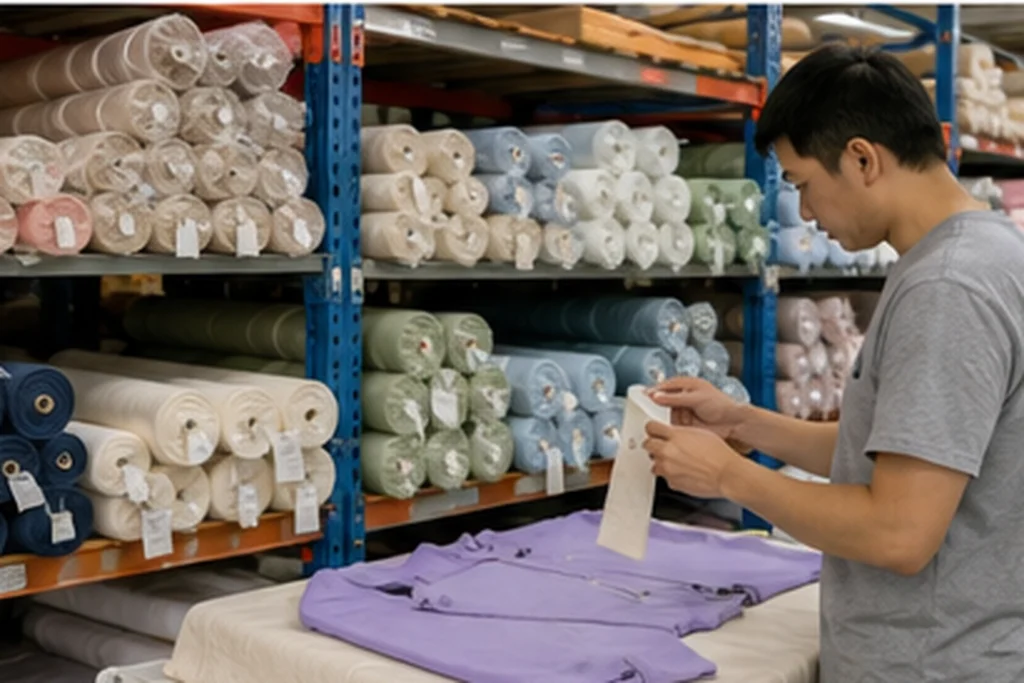
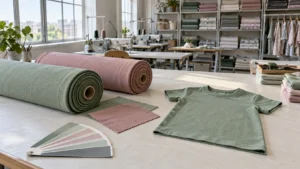
Vérification des stocks de tissus pour une production rapide des commandes répétées.
Tissus en stock ou tissus sur mesure pour un réapprovisionnement rapide
Si le réapprovisionnement rapide est essentiel à votre modèle commercial, la stratégie textile doit faire partie intégrante du développement produit dès le départ.
Tissus à stock soutenu
Ces méthodes peuvent particulièrement bien fonctionner pour les fondamentaux intemporels tels que :
- T-shirts
- Sweat-shirts
- Joggeurs
- Guêtres
- robes simples
- Pyjama basique
Les avantages sont évidents : moins d’attente pour le tricotage ou la teinture, des quantités minimales de matériaux plus faibles dans de nombreux cas et des réapprovisionnements plus faciles en petites séries.
Le compromis réside dans la continuité. L'expression “ tissu en stock ” ne signifie pas que le fabricant s'engage à conserver exactement le même tissu indéfiniment. Si un produit essentiel est important pour votre activité, renseignez-vous sur le fournisseur du tissu, sur la conformité des spécifications à une production régulière et sur les modalités de remplacement en cas de rupture de stock.
Tissus développés sur mesure
Les tissus sur mesure offrent un contrôle accru sur la composition des fibres, le grammage, le toucher, la couleur et la finition. Ils contribuent à différencier votre marque, mais rendent généralement la planification des commandes ultérieures plus dépendante du fabricant.
Aucune des deux solutions n'est intrinsèquement meilleure. L'important est de comprendre les conséquences du réapprovisionnement avant que votre produit phare n'en dépende.
La reproduction des couleurs peut prendre plus de temps que prévu par les acheteurs.
Un numéro Pantone est utile, mais il ne garantit pas comme par magie une couleur identique d'un lot de teinture à l'autre.
Un nouveau lot de production peut présenter de légères variations dues à la fibre, à l'eau, aux conditions de teinture, à la température, à la finition ou à d'autres variables de fabrication. Si les anciens et les nouveaux produits sont présentés côte à côte en magasin, même une petite différence de teinte peut être perceptible.
Pour une nouvelle commande, l'usine peut avoir besoin de comparer :
- Échantillon original approuvé
- Nouveau bain de laboratoire
- ombrage en tissu en vrac
- Couleur du vêtement existant
Si la teinte est hors de la plage acceptée, la teinture ou la correction prend du temps.
Une solution pratique pour les modèles intemporels consiste à prévoir la continuité des approvisionnements avant même que la première commande ne soit entièrement consommée. Si cela s'avère économiquement judicieux, conserver une quantité de matériel approuvé en stock facilitera grandement les réapprovisionnements ultérieurs.
L'impression, la broderie et les travaux décoratifs ont leurs propres files d'attente.
Une erreur fréquente consiste à se contenter de demander si l'usine de confection dispose de capacités de couture.
Le style des vêtements pour enfants peut dépendre de plusieurs partenaires de production différents. L'impression, la broderie, le lavage, les paillettes, les perles, la découpe laser, les smocks, les plis ou d'autres techniques peuvent être réalisés en dehors de la chaîne de couture principale.
Imaginez que l'usine de confection ouvre demain, mais que l'atelier de broderie ne puisse pas prendre votre commande avant huit jours. Votre nouvelle commande est donc toujours retardée.
Cela est particulièrement important pour les vêtements de mode enfantins. Dans notre travail sur des vêtements plus décoratifs, le planning de production n'est pas un planning unique, mais une succession de plannings interdépendants. Le délai de livraison le plus court dépend de l'étape critique la plus longue.
C’est pourquoi, lorsque vous discutez Délai de traitement des commandes répétées de vêtements pour enfants chinois, Demandez à votre fournisseur quelles étapes sont internes, lesquelles sont externalisées et laquelle contrôle actuellement le chemin critique.
Les étiquettes et l'emballage peuvent retarder la production d'un vêtement fini.
Un autre retard dans les commandes répétées est étonnamment simple : les vêtements sont prêts, mais les éléments de marquage ne le sont pas.
Votre produit peut nécessiter :
- Étiquette tissée principale
- Étiquette de taille
- Étiquette d'entretien
- étiquette volante
- Étiquette à code-barres
- sachet imprimé
- Papier de soie
- Marquages personnalisés sur les cartons
Ces articles proviennent souvent de fournisseurs différents.
Si vous savez que la même étiquette sera utilisée pour de nombreuses commandes futures, il peut être judicieux d'en produire davantage et de gérer au mieux vos relations avec l'usine. Les étiquettes sont relativement peu coûteuses comparées au coût d'une rupture de stock due à l'attente d'un nouveau tirage.
HAPA Exemple de flux de travail du produit Ceci nous rappelle utilement que l'approvisionnement en matières premières et en fournitures fait partie intégrante du développement produit, et non une simple formalité. Le même principe s'applique à la production en série : plus votre chaîne d'approvisionnement est opérationnelle pour la production en série, plus le réapprovisionnement est rapide.
La capacité de production est la variable que vous ne pouvez pas ignorer.
Même si tous les matériaux sont prêts, l'usine a encore besoin d'une chaîne de production.
C’est là que les acheteurs sont parfois frustrés, car une même usine peut annoncer des délais de livraison très différents à différents moments de l’année.
Dans un mois, votre nouvelle commande pourra peut-être être directement intégrée à un créneau disponible. Dans un autre mois, toutes les lignes compatibles seront peut-être déjà réservées.
Cela ne signifie pas nécessairement que le fournisseur est irrégulier. Les usines de confection fonctionnent selon des calendriers de production, et la disponibilité des lignes de production varie au fur et à mesure que les commandes des clients passent par les étapes de découpe, de couture, de finition et d'emballage.
Chez HAPA, par exemple, la faisabilité des commandes urgentes est vérifiée en fonction du planning de production et des spécificités de la commande, et non considérée comme un engagement ferme. C'est aussi pourquoi… FAQ HAPA souligne que le délai de livraison varie en fonction de la complexité et de la quantité du produit.
Si un fournisseur promet le même délai de livraison pour 500 pièces et 50 000 pièces sans consulter son calendrier, je souhaiterais obtenir plus de détails.
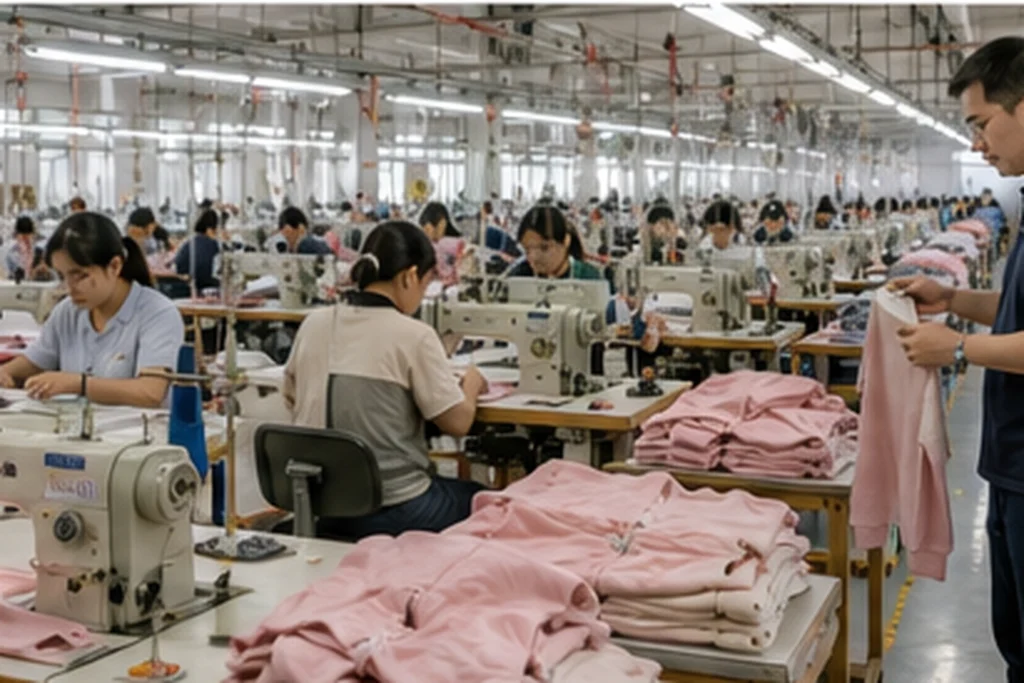
Ligne de couture produisant des vêtements pour enfants sur commande.
La prévision est le meilleur moyen de gagner du temps.
La meilleure façon de relancer une commande est généralement de la déclencher avant qu'elle ne devienne urgente.
Si vous attendez que votre entrepôt soit presque vide, l'usine aura très peu de marge de manœuvre pour vous aider. En communiquant plus tôt vos indications de demande, le fournisseur peut parfois préparer les articles les plus importants.
- Réservez une fenêtre de réservation
- Vérifier la disponibilité des tissus
- Confirmer le stock de découpe
- Alertez le moulin
- Préparer les étiquettes
- Vérifier les fichiers d'illustration
Il n'est pas toujours nécessaire d'émettre un bon de commande des mois à l'avance. Même une prévision fiable peut améliorer la planification.
Par exemple, au lieu d'écrire :
“Nous pourrions repasser commande à l'avenir.”
essayer:
“ Les ventes actuelles indiquent que nous pourrions avoir besoin de 1 500 unités supplémentaires des modèles A et B d’ici quatre semaines. Veuillez vérifier la disponibilité des matériaux et les prévisions de production afin que nous puissions prendre une décision d’ici vendredi. ”
Voilà une information sur laquelle une usine peut agir.
La quantité répétée modifie le délai de traitement.
La répétition de 300 pièces et la répétition de 30 000 pièces ne constituent pas le même problème.
Même lorsque le matériel est entièrement prêt, le volume de production détermine le nombre d'heures nécessaires pour la découpe, la couture, la finition, l'inspection et l'emballage.
Supposons qu'une ligne de production puisse fabriquer environ 700 pièces de votre modèle par jour ouvrable après équilibrage et démarrage. La différence entre 700 et 7 000 pièces n'est pas d'ordre administratif ; elle représente dix fois la charge de travail de couture, à moins d'allouer des lignes supplémentaires.
Les grands programmes de fidélisation devraient donc se poser des questions telles que :
- Combien de lignes peuvent utiliser ce style ?
- Quand chaque ligne peut-elle commencer ?
- La découpe peut-elle commencer avant la livraison de tous les matériaux ?
- Les quantités finies peuvent-elles être livrées par lots ?
- La première partie peut-elle être expédiée avant que la commande entière ne soit complète ?
Cette dernière question peut s'avérer très utile lorsque la prévention des ruptures de stock prime sur le maintien de tous les cartons ensemble.
Délai de livraison rapide par type de produit
Les différents vêtements ont des processus de production différents, je n'utiliserais donc pas une seule cible pour chaque catégorie.
T-shirts pour enfants : environ 7 à 20 jours dans des conditions favorables.
Les t-shirts font souvent partie des produits les plus faciles à reproduire car le patron est simple, les opérations de couture sont relativement standardisées et les tissus jersey courants sont généralement plus faciles à trouver.
Ce qui peut les ralentir :
- teinture personnalisée
- Imprimé intégral
- Lavages spéciaux
- Appliqué complexe
- Grande quantité
Sweat-shirts et sweats à capuche : environ 12 à 25 jours
Un sweat-shirt basique peut être fabriqué rapidement, mais il contient généralement plus de matériaux et d'opérations qu'un t-shirt. Les bords-côtes, la doublure de la capuche, les fermetures éclair, les poches, les broderies ou les cordons de serrage peuvent tous influer sur le délai de fabrication.
Si votre marque vend régulièrement ce type de produits, l'utilisation d'un tissu stable peut faire toute la différence. L'expérience de HAPA dans la fabrication de sweat-shirts pour enfants démontre pourquoi le poids du tissu, la coupe, la décoration, les étiquettes et l'emballage doivent être parfaitement maîtrisés d'une production à l'autre.
Pyjamas : environ 15 à 30 jours
Les ensembles de pyjamas peuvent nécessiter un tissu imprimé personnalisé, des côtes, plusieurs pièces de vêtements ou une vérification de conformité aux normes spécifiques du marché. Une nouvelle production est rapide si le tissu est disponible ; elle est plus longue lorsqu’il faut produire un nouveau lot d’impression.
Robes pour filles : environ 15 à 35 jours
Une simple robe en coton peut être portée plusieurs fois. Une robe à plusieurs épaisseurs, avec doublure, tulle, dentelle, volants, nœuds et broderies, peut nécessiter l'intervention de différents fournisseurs de tissus et d'accessoires de décoration.
Vêtements pour enfants brodés, à paillettes ou à perles : environ 20 à 40 jours
Ces produits nécessitent une coordination qui va au-delà de la simple couture. Si la capacité de finition est limitée, cela peut impacter l'ensemble du planning des commandes.
Vestes et vêtements d'extérieur : environ 25 à 45 jours
Les vestes comportent souvent plus de composants, nécessitent davantage d'opérations de couture et utilisent des matériaux plus spécialisés. Le tissu extérieur, la doublure, le rembourrage, les fermetures éclair, les boutons-pression, les poches et les finitions techniques peuvent tous allonger le processus de fabrication.
Il s'agit de fourchettes prévisionnelles, et non de normes industrielles garanties. Votre fournisseur devra établir un devis en fonction du style réel et des conditions de production actuelles.
Les fournisseurs chinois de vêtements pour enfants peuvent-ils vraiment réaliser un chiffre d'affaires identique en 7 jours ?
Parfois, oui. Mais je considérerais sept jours comme une exception accélérée plutôt que comme une hypothèse de fonctionnement standard.
Un délai de production de sept jours est plus crédible lorsque :
- La commande est petite.
- Le produit est simple
- Le tissu est physiquement disponible
- Les garnitures et les étiquettes sont physiquement disponibles
- Le style reste inchangé.
- Aucune nouvelle approbation n'est requise
- La chaîne de couture peut démarrer immédiatement
Si un fournisseur affirme pouvoir toujours produire des vêtements complexes pour enfants en sept jours, je demanderais à connaître le calendrier qui sous-tend cette affirmation.
À quelle date la découpe commencera-t-elle ? Quels matériaux sont déjà en stock ? Quelle ligne de production traitera la commande ? Quand aura lieu la décoration ? Quand se déroulera le contrôle final ?
Un délai de livraison rapide doit être justifié.
Pourquoi 10 à 15 jours constituent une meilleure cible pour les répétitions rapides
Pour une marque qui met intentionnellement en place un système de réapprovisionnement rapide, 10 à 15 jours départ usine est une cible optimale plus utile pour les styles appropriés.
Elle reste agressive, mais elle laisse plus de place aux véritables étapes de production :
1. Vérification des matériaux
2. Découpe
3. Préparation de la ligne
4. Couture
5. Finition
6. Contrôles des mesures et de la qualité de l'exécution
7. Emballage
8. Version finale
L’objectif devrait être de supprimer l’attente et le redéveloppement, et non de supprimer les contrôles qui assurent la cohérence du produit.
Cette distinction est importante. Une usine peut réduire ses délais de livraison en optimisant son fonctionnement, ou en négligeant certaines étapes. Le résultat n'est pas le même.
Une commande répétée nécessite tout de même un contrôle qualité
Je ne considérerais jamais une production répétée comme une autorisation de cesser d'inspecter le produit.
Chaque nouvelle production peut introduire de nouvelles variables :
- Lot de tissus neufs
- Nouveau bain de teinture
- Lot de garnitures neuves
- Différents opérateurs
- Réglages de la machine
- Différents emballeurs
La norme de référence est déjà établie, ce qui facilite le contrôle qualité, mais ne le rend pas inutile.
Pour une nouvelle commande, je m'attendrais toujours à des chèques couvrant :
- Mesures clés
- qualité du travail
- défauts de tissu
- Couleur
- Décoration
- Étiquettes
- Quantité
- Emballage
Si vous souhaitez comprendre où ces contrôles s'intègrent dans un processus de production normal, consultez le guide HAPA sur le processus de fabrication de vêtements décrit en détail le processus, du développement à l'emballage, en passant par la découpe, la couture et le contrôle qualité.
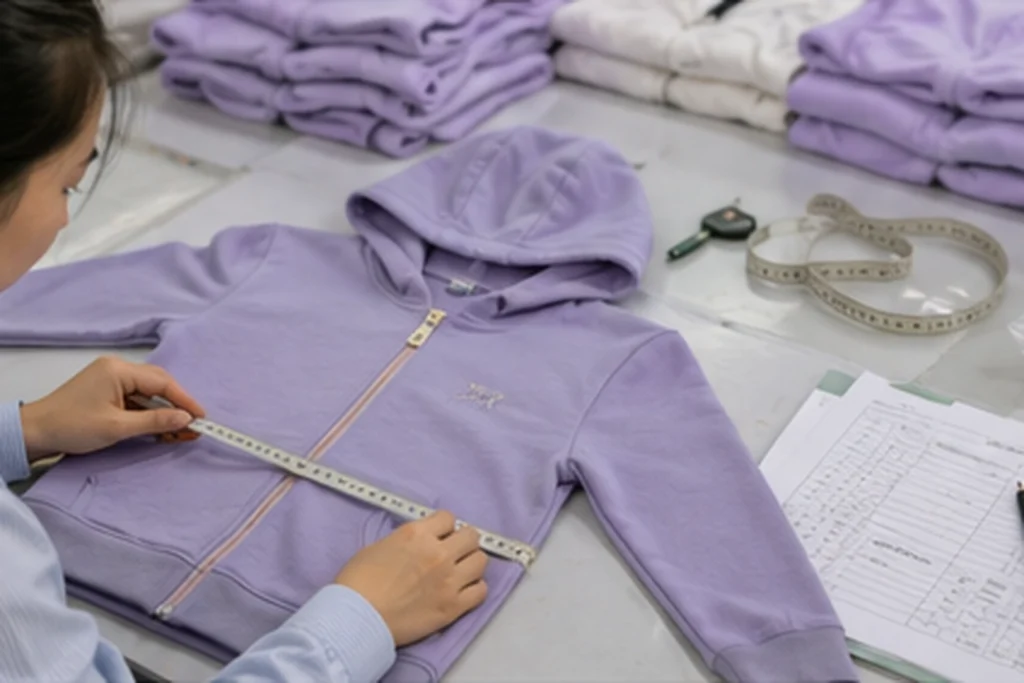
Contrôle qualité des mesures et de la confection des vêtements pour enfants portés régulièrement.
La conformité ne disparaît pas lors d'une nouvelle commande.
Cela est particulièrement important pour les produits destinés aux enfants.
Une nouvelle commande peut être commercialement identique à la précédente, mais il s'agit d'un nouveau lot de fabrication. Si vous importez aux États-Unis, vous ne devez pas supposer que la documentation de l'expédition précédente répond automatiquement à toutes les exigences pour la suivante.
La Commission américaine de la sécurité des produits de consommation Guide relatif aux certificats de produits pour enfants Ce document explique que les produits pour enfants concernés doivent être certifiés selon les exigences de test applicables et que les informations du CPC incluent la date et le lieu de fabrication. À compter du 8 juillet 2026, la CPSC indique également qu'un dépôt électronique des certificats de conformité sera requis pour la plupart des produits réglementés importés aux États-Unis.
De même, la CPSC guide d'étiquetage de suivi Il est nécessaire d'identifier le fabricant ou le sous-traitant, le lieu et la date de production, ainsi que le lot ou la série de production. Un nouveau lot répété peut donc nécessiter une traçabilité de production mise à jour, même si le modèle reste inchangé.
Pour les vêtements en textile, la Federal Trade Commission guide d'étiquetage des vêtements Les informations relatives à la composition en fibres, au pays d'origine, à l'identification du responsable et à l'entretien restent pertinentes.
La leçon commerciale est simple : ne créez pas un processus de commande répétée “ rapide ” qui considère les documents de conformité comme des formalités administratives facultatives à corriger après la production.
Conserver un maître de production approuvé
Le contrôle de version peut paraître ennuyeux jusqu'à ce qu'il permette de sauvegarder une commande entière.
Une marque peut avoir :
- Échantillon V1
- Échantillon révisé V2
- Échantillon de préproduction V3
- Commentaires finaux en masse
- Tableau de mesures mis à jour
- Nouveau fichier d'illustration
Si, lors d'une nouvelle commande, l'usine rouvre par erreur un ancien modèle ou tableau de mesures, votre “ même style ” ne sera plus le même style.
Je recommande de conserver un seul dossier de production final qui identifie clairement :
- Référence du modèle final
- Tableau des mesures finales
- Spécifications du tissu
- Référence couleur
- Œuvre d'art
- placement de la décoration
- Fichiers d'étiquettes
- Instructions d'emballage
- Date ou référence de l'échantillon approuvé
Une forte fiche technique des vêtements est utile ici car cela regroupe les informations dont l'usine a besoin pour reproduire le vêtement avec précision, plutôt que de se fier à sa mémoire.
C'est l'un des moyens les plus simples d'améliorer Délai de traitement des commandes répétées de vêtements pour enfants chinois sans exercer aucune pression sur la ligne de couture.
Quand faut-il demander un nouvel échantillon de préproduction ?
Il n'est pas nécessaire de relancer un échantillonnage complet pour chaque commande répétée inchangée. Cependant, je demanderais une nouvelle approbation lorsqu'une variable de production significative change.
Exemples :
- Fournisseur de tissus différent
- Différence majeure entre les lots de teinture
- Nouveau fournisseur d'impression ou de broderie
- Changement de construction
- Changement de mesure
- Changement de garniture
- La production a été transférée dans une autre usine.
- Long intervalle depuis la commande précédente
Quelques jours consacrés à confirmer un changement significatif peuvent éviter des semaines de travail correctif par la suite.
Le principe n'est pas “ toujours échantillonner ” ou “ ne jamais échantillonner ”. Il est échantillonner lorsque le risque a changé.
La réservation de matériel peut réduire de plusieurs semaines le délai de réapprovisionnement d'un best-seller.
Pour les produits véritablement pérennes, la réservation de matières premières est l'une des stratégies de réapprovisionnement les plus efficaces qui soient.
Supposons que votre sweat à capuche phare se vende tous les mois et soit toujours confectionné dans le même molleton bleu marine. Si vous n'achetez que la quantité de tissu nécessaire pour chaque commande, chaque réapprovisionnement implique de demander à l'usine de produire à nouveau le tissu.
Si les conditions commerciales vous permettent de réserver ou de conserver du tissu approuvé supplémentaire, la prochaine commande pourra être passée beaucoup plus près de la date de découpe.
Cela fonctionne particulièrement bien pour :
- T-shirts basiques
- Sweat-shirts
- Joggeurs
- Guêtres
- Pyjama basique
- vêtements scolaires de base
Elle convient moins à la mode éphémère, dictée par les tendances et qui ne se reproduira peut-être jamais.
Les stocks de matières premières immobilisent des capitaux ; la décision doit donc se fonder sur des données de vente plutôt que sur l’optimisme. Cependant, pour un produit à succès avéré, un petit stock de matières premières peut s’avérer moins coûteux que des ruptures de stock répétées.
Gardez également des tailles de conifères en réserve
La même logique s'applique aux composants que vous savez que vous continuerez à utiliser :
- Étiquettes principales
- Étiquettes de taille
- Étiquettes d'entretien
- Étiquettes volantes
- Boutons standard
- Couleurs de fermeture éclair courantes
- Conditionnement
Si votre marque utilise la même étiquette tissée sur tous ses produits, commander uniquement la quantité nécessaire pour la commande en cours peut engendrer des délais d'attente inutiles à l'avenir.
Demandez à l'usine comment les matériaux restants sont comptabilisés, identifiés, protégés et stockés. “ Il nous reste quelques étiquettes ” ne suffit pas. Vous avez besoin d'un stock contrôlé et vérifiable au début de la prochaine commande.
Utiliser des ressources partagées pour plusieurs best-sellers
Une collection bien conçue peut faciliter le réapprovisionnement sans donner une impression de répétition.
Par exemple, un jersey de coton de 210 g/m² peut supporter :
- T-shirt
- T-shirt à manches longues
- tenue décontractée
Un tissu éponge français de 300 g/m² peut supporter :
- Sweatshirt à capuche
- Joggeur
- Shorts
Cela permet au fournisseur de matériaux d'obtenir un volume combiné plus significatif et vous permet d'utiliser les stocks réservés pour plusieurs références.
Vous pouvez toujours créer une différenciation grâce à la silhouette, aux blocs de couleur, à la broderie, aux imprimés, aux détails des poches et aux finitions.
Il s'agit de conception de chaîne d'approvisionnement, et pas seulement de conception de vêtements.
Calculez les points de réapprovisionnement avant que le stock ne soit bas.
Une production rapide est utile, mais le moyen le plus fiable d'éviter une rupture de stock est de passer une nouvelle commande au bon moment.
Une formule de planification simple est :
Ventes hebdomadaires moyennes × délai total de réapprovisionnement + stock de sécurité
Supposer:
- Ventes moyennes = 150 pièces/semaine
- Production + inspection + transport = 5 semaines
- Stock de sécurité = 300 pièces
Votre point de réapprovisionnement de base serait :
150 × 5 + 300 = 1 050 pièces
Lorsque les stocks disponibles atteignent ce niveau, vous entamez le processus de renouvellement des commandes.
C’est beaucoup plus sûr que d’attendre que votre entrepôt vous dise : “ Il ne nous reste que deux semaines. ”
La formule exacte doit tenir compte de la variabilité de vos ventes et de votre modèle d'entreprise, mais le principe est universel : L'usine devrait avoir de vos nouvelles avant l'urgence..
Intégrez la logistique dans votre délai réel de réapprovisionnement.
Un délai de production de 12 jours ne correspond pas à un réapprovisionnement d'entrepôt de 12 jours.
Votre chronologie complète peut inclure :
- Production
- Inspection finale
- Libération de l'emballage
- Documents d'exportation
- Transport routier jusqu'au transitaire
- transport aérien ou maritime
- dédouanement
- Livraison finale à domicile
Si vous ne tenez compte que du planning de production, vous pourriez croire que vous avez plus de temps que vous n'en avez réellement.
Cela prend une importance particulière lorsqu'on compare les stratégies de transport aérien et maritime. Une commande urgente peut justifier le fret aérien pour la première quantité, tandis que le reste sera acheminé par voie maritime.
Les envois partiels peuvent préserver les ventes sans avoir à tout transporter par avion.
Imaginez que vous commandiez 5 000 exemplaires d'un best-seller, mais que vous soyez en rupture de stock avant que la commande complète n'arrive.
Une solution pratique consiste à fractionner l'envoi :
- Les 800 à 1 000 premières pièces sont emballées et expédiées par avion dès qu'elles ont passé l'inspection.
- Les plus de 4 000 pièces restantes ont été terminées et expédiées selon la méthode habituelle, moins coûteuse.
Cela permet de réduire le coût de l'urgence tout en préservant les revenus.
L'important est d'en discuter avant le début de l'emballage. L'usine pourrait avoir besoin de plans de cartonnage, de quantités, de documents et de modalités d'inspection spécifiques.
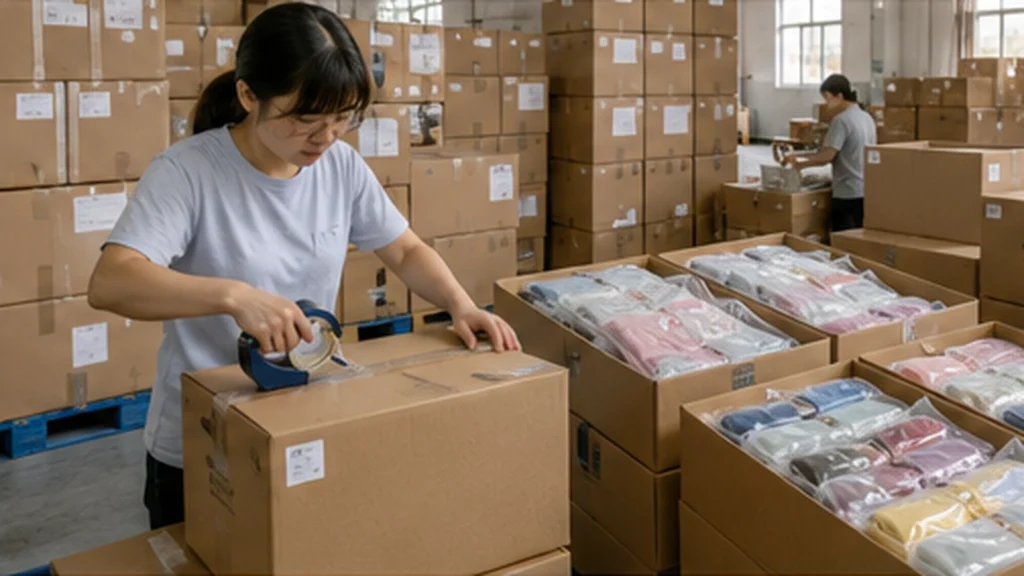
Emballage et préparation des commandes récurrentes de vêtements pour enfants en vue de leur expédition.
Votre fournisseur le plus rapide est peut-être celui que vous utilisez déjà.
Lorsqu'un produit se vend bien, les acheteurs cherchent naturellement à optimiser les coûts. Il arrive parfois qu'un autre fournisseur propose un prix unitaire inférieur.
Mais le changement d'un best-seller a un coût caché en termes de délai de préparation.
L'usine d'origine le sait déjà :
- Le modèle
- Règles de notation
- Source de tissu
- Norme de couleur
- Programme de décoration
- Méthode d'emballage
- Problèmes de contrôle qualité antérieurs
- Vos habitudes d'approbation
Une nouvelle usine devra peut-être recréer tout cela par échantillonnage et comparaison.
Si la différence de prix est faible et que la rapidité de réapprovisionnement est importante, la continuité du service peut valoir plus que les économies réalisées.
Je ne suggère pas que vous ne deviez jamais changer de fournisseurs. Je suggère que vous en incluiez temps de requalification et risque de production dans la comparaison plutôt que d'évaluer uniquement le prix unitaire.
Que peuvent faire les acheteurs pour réduire le délai de livraison des commandes répétées ?
Les fabricants contrôlent la chaîne de production, mais les acheteurs contrôlent une grande partie des retards qui l'entourent.
Geler les spécifications
En cas de répétition urgente, évitez les modifications inutiles.
Prévision plus tôt
Donnez à votre fournisseur une estimation réaliste des quantités potentielles.
Répondre rapidement
Si l'usine demande une confirmation, quatre jours de silence de l'acheteur représentent toujours quatre jours de délai de livraison.
Respectez les échéances de paiement.
Si la production ne peut démarrer tant que l'acompte convenu n'est pas reçu, tout retard de paiement retarde la commande, quelle que soit la capacité de l'usine.
Maintenir des fichiers propres
Un patron final, un tableau de mesures final, un fichier graphique final.
Gardez les matériaux réutilisables prêts à l'emploi
Pour les produits éprouvés, envisagez des matériaux et des garnitures de finition lorsque cela est commercialement judicieux.
Évitez les modifications d'emballage de dernière minute
Une nouvelle spécification pour un sac, une étiquette, un code-barres ou un carton peut retarder l'expédition d'un vêtement qui est par ailleurs prêt à être expédié.
Ces pratiques ont souvent un impact plus important sur Délai de traitement des commandes répétées de vêtements pour enfants chinois que de demander à la chaîne de couture de faire des heures supplémentaires.
Ce qu'un fournisseur doit faire pour soutenir les commandes répétées rapides
Un bon partenaire pour les commandes répétées devrait être en mesure de retrouver rapidement l'historique de production final.
Je m'attendrais à ce qu'un fabricant organisé conserve ou reproduise l'accès à :
- Modèle et qualité approuvés
- Spécifications de mesure finales
- Détails du tissu et des garnitures
- fichiers d'illustration
- placement de la décoration
- Instructions d'emballage
- Norme de qualité
- Commentaires précédents sur la production
Chez HAPA, lorsqu'un client existant demande une nouvelle production urgente, la première étape utile n'est pas de promettre une date. Il s'agit de vérifier si le design reste inchangé, quels matériaux sont encore disponibles, quels processus doivent être reprogrammés et quelle est la capacité de production actuelle.
C’est seulement à ce moment-là qu’un rendez-vous “ express ” prend tout son sens.
Un flux de travail pratique pour les commandes répétées sur 15 jours
Pour un produit adapté dont les matériaux sont déjà disponibles, une répétition rapide pourrait ressembler à ceci :
Jours 1 et 2 : PO et confirmation répétée
Confirmer la quantité, le rapport de taille, la couleur, les spécifications finales, le stock de matériaux et l'emballage.
Jours 2 et 3 : Inspection et préparation des matériaux
Vérifiez la teinte du tissu, les défauts, les finitions, les étiquettes et les quantités d'emballage.
Jours 3 à 5 : Découpe et préparation des lignes
Préparer le marqueur, étaler et couper le tissu, trier les paquets et équilibrer la chaîne de production.
Jours 5 à 11 : Couture et décoration
Assurer l'assemblage des vêtements et tout processus de décoration interne ou planifié.
Jours 10 à 13 : Finition en ligne et contrôle qualité
Vérifier les dimensions et la qualité de la fabrication à la sortie de la chaîne de production.
Jours 13 à 15 : Inspection finale et emballage
Finition complète, inspection finale, emballage, vérification des cartons et sortie d'usine.
Voici un exemple d'organisation pour une répétition bien préparée. Il ne s'agit pas d'un planning universel. Le planning final doit être adapté au style, à la quantité, aux matériaux et à la capacité réels.
Signaux d'alarme concernant les délais de livraison promis pour les commandes répétées
Je serais prudent lorsqu'un fournisseur :
Il propose une date rapide avant même de vérifier les informations.
L'état du tissu devrait être l'une des premières questions à poser.
Le délai de livraison est identique quelle que soit la quantité.
Le volume de production influe sur le temps de couture et de finition.
Impossible d'identifier la ligne de production ou la fenêtre de démarrage
Une commande répétée doit tout de même être prévue dans le planning.
Il affirme que le contrôle qualité est inutile car le modèle a été créé avant.
Chaque lot de production peut présenter de nouvelles variations de matériaux et de fabrication.
Il promet un délai très court, mais ne le respecte pas à chaque fois.
Un engagement fiable de 22 jours est opérationnellement plus précieux qu'une promesse peu fiable de 10 jours.
En matière de planification des stocks, la précision fait partie intégrante de la rapidité, et c'est pourquoi Délai de traitement des commandes répétées de vêtements pour enfants chinois Il convient de les évaluer en fonction de dates d'achèvement fiables plutôt que de promesses optimistes.
Comment demander à une usine une date utile pour une nouvelle commande
Au lieu d'envoyer “ À quelle vitesse pouvez-vous réaliser cela ? ”, je recommande un message contenant suffisamment d'informations pour une véritable vérification :
Nous souhaiterions relancer la production du modèle A, en utilisant le même tissu, les mêmes dimensions, le même visuel, les mêmes étiquettes et le même emballage. La quantité est de 2 000 pièces. Veuillez confirmer la disponibilité des matériaux et finitions d'origine, la nécessité de reproduire certains composants, la date de coupe la plus proche et la date de sortie d'usine la plus proche.
Demandez ensuite :
1. Le même tissu est-il physiquement disponible ?
2. Sinon, combien de temps prendra la reproduction ?
3. Toutes les garnitures et étiquettes sont-elles disponibles ?
4. Des œuvres d'art ou des éléments de décoration doivent-ils être refaits ?
5. Un autre échantillon ou une autre approbation est-il requis ?
6. Quand peut-on commencer la découpe ?
7. Quelle ligne exécutera la commande ?
8. Combien de jours faudra-t-il pour coudre et finir ?
9. Quand l'inspection finale peut-elle avoir lieu ?
10. Une livraison partielle est-elle possible ?
Cela permet de passer d'une discussion sur les délais marketing génériques à une discussion sur un véritable plan de production.
Foire aux questions
Quel est le délai de livraison le plus rapide pour les commandes répétées de vêtements pour enfants en Chine ?
Pour une véritable répétition avec des spécifications inchangées, des matériaux disponibles et une capacité de production ouverte, environ 7 à 15 jours départ usine peut parfois être réalisable pour des produits simples. Pour la planification, 15 à 30 jours Cette gamme est plus pratique pour les commandes répétées, tandis que des exigences complexes en matière de matériaux ou de décoration peuvent allonger davantage le délai.
Une commande répétée tous les 7 jours est-elle réaliste ?
Cela peut concerner un modèle simple et de petite taille, lorsque le tissu, les finitions, les étiquettes, l'emballage et la capacité de production sont déjà prêts. Il ne faut pas considérer cela comme une promesse systématique pour chaque vêtement.
Pourquoi une nouvelle commande peut-elle encore prendre 30 jours ?
L'usine pourrait avoir besoin de reproduire le tissu, de teindre une nouvelle couleur, de recommander des garnitures, d'attendre des capacités d'impression ou de broderie, ou d'intégrer la commande dans un calendrier de production chargé.
Une nouvelle commande nécessite-t-elle un autre échantillon ?
Pas nécessairement. Si le produit reste inchangé et que la norme de production est clairement définie, un nouvel échantillon complet peut ne pas apporter de valeur ajoutée. Un nouvel échantillon d'homologation est plus utile lorsque le matériau, le fournisseur, les dimensions, la construction ou d'autres variables importantes ont changé.
Puis-je réserver du tissu pour ma prochaine commande ?
Souvent oui, selon l'usine, le moulin, la quantité, les modalités de paiement et la capacité de stockage. Pour les produits à long terme éprouvés, la réservation de matières premières peut réduire considérablement le délai de réapprovisionnement.
Dois-je conserver des étiquettes et des emballages supplémentaires à l'usine ?
Pour les programmes récurrents, cela peut s'avérer utile. Veillez à ce que les soldes soient enregistrés et que les modalités de stockage soient clairement définies.
Une commande plus importante et répétée prend-elle plus de temps ?
Généralement. Même si les matériaux sont prêts, la fabrication de pièces supplémentaires nécessite davantage de temps pour la découpe, la couture, la finition, le contrôle et l'emballage, à moins que l'usine n'alloue des capacités supplémentaires.
Le fret aérien est-il la solution la plus rapide ?
Le fret aérien peut réduire les délais de transit internationaux, mais ne résout pas les problèmes de production. Un envoi fractionné peut parfois s'avérer plus économique : acheminer par avion la première partie urgente et expédier le reste par voie terrestre.
Devrais-je changer de fournisseur si une autre usine propose un prix inférieur ?
C’est possible, mais il faut tenir compte du temps nécessaire au redéveloppement, à l’échantillonnage, à l’adéquation des matériaux et à la qualification du produit. Pour un best-seller avéré, une faible économie sur le prix unitaire ne compensera peut-être pas une transition plus lente ou plus risquée.
Réflexions finales : Intégrez la vitesse dans le premier ordre
Si vous voulez le plus court possible Délai de traitement des commandes répétées de vêtements pour enfants chinois, n'attendez pas la deuxième commande pour penser à la rapidité.
Les fondations sont créées lors de la première production.
Il vous faut un patron final réutilisable, un système de gradation des tailles stable, des spécifications de tissu claires, des illustrations maîtrisées, des finitions répétables, un emballage documenté et une norme de qualité approuvée. Ensuite, vous devez avoir une visibilité sur la disponibilité des matériaux et la capacité de production avant que les stocks ne deviennent critiques.
Dans des conditions optimales, un cycle de production de 7 à 15 jours est envisageable pour certains modèles. Cependant, pour la plupart des marques, je recommande d'établir la planification des stocks sur la base d'un délai de production plus prudent de 15 à 30 jours, sauf si le fournisseur a déjà validé les matériaux et le calendrier de production.
Plus important encore, je mesurerais le cycle de réapprovisionnement complet, et pas seulement les jours de couture. L'inspection, l'emballage, la remise à l'exportation, le transport, les formalités douanières et la livraison finale influent tous sur le moment où le produit est de nouveau commercialisable.
Chez HAPA, les conversations qui permettent de renouveler rapidement une commande sont celles où l'acheteur peut dire : “ Même produit, même norme approuvée, voici la quantité et voici quand nous en avons besoin. ” Nous pouvons alors vérifier ce qui est physiquement prêt et ce qui reste à faire.
Voilà une base de planification bien plus solide qu'une promesse générique de “ livraison rapide ”.”
Un bon fournisseur, qui assure des commandes régulières, ne se contente pas d'être rapide. Il garantit la reproductibilité du produit, l'organisation des données, la prévisibilité des matériaux, le contrôle qualité et le respect des délais de livraison.
Lorsque ces éléments sont en place, le réapprovisionnement cesse d'être une situation d'urgence et devient un processus de chaîne d'approvisionnement reproductible.