Chinese Children’s Clothing Manufacturers for Overseas Buyers are easy to find online, but finding one that actually fits your product, order volume, compliance needs, and way of working is much harder.
I see this distinction every time a buyer compares factories. At first glance, several suppliers may all appear capable: they show sewing lines, sample rooms, children’s garments, private-label services, and international shipping. The differences usually become visible only after you send a real tech pack, ask technical questions, request a custom sample, and watch how the supplier handles uncertainty.
That is why I would not recommend choosing a children’s clothing manufacturer from a list simply because a company is large, has the lowest quote, or describes itself as a “top factory.” The more useful question is: which manufacturer is best aligned with the collection you are actually trying to produce?
For an overseas buyer, that decision involves more than sewing quality. You also need to evaluate communication, fabric sourcing, pattern development, size grading, testing, labels, quality control, packaging, export coordination, and whether the factory can reproduce an approved sample consistently in bulk.
In this guide, I will walk you through ten Chinese manufacturers worth researching, explain where each appears strongest, and show you the qualification process I would use before paying a deposit. The goal is not to declare one universal winner. It is to help you build a much better shortlist.
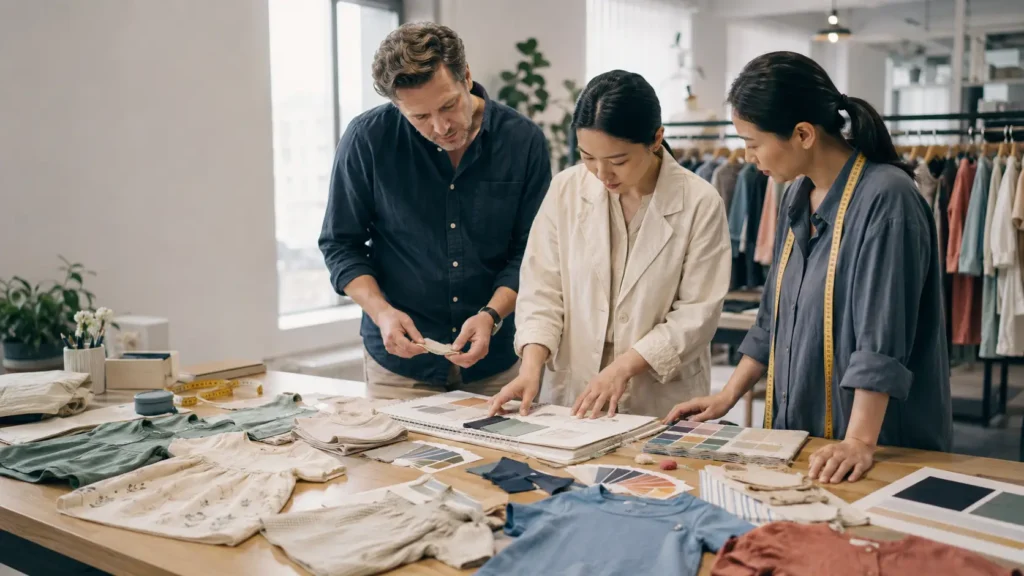
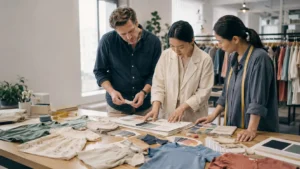
Overseas buyer reviewing kidswear samples in a Chinese development studio
What Makes a Chinese Children’s Clothing Manufacturer Suitable for Overseas Buyers?
A factory can be technically capable and still be a poor fit for an international buyer.
When you are managing production from another country, you cannot stand beside the cutting table every morning or walk down the sewing line whenever a question appears. Your supplier’s communication and production-control system become part of the product itself.
In practice, I look for seven things.
1. Relevant Product Experience
A factory that regularly makes jersey T-shirts may not be the right partner for a layered girls’ occasion dress. A babywear specialist may not be ideal for technical outerwear. A streetwear factory may understand heavyweight fleece extremely well but have little experience with infant sleep products.
The first question I ask is simple: what products do you make repeatedly?
You should ask to see recent samples that are structurally similar to your own designs. Do not stop at photographs. If possible, request a physical sample or live video showing the inside construction, trims, finishing, and fabric.
2. A Clear Development Process
Good bulk production starts before bulk production.
A reliable factory should be able to explain how it moves from your design brief to an approved sample. At HAPA, for example, our عملية تصنيع ملابس الأطفال الأصلية begins with product review, fabric and trim decisions, pattern and sample development, approval, and then production control.
That sequence matters because most expensive mistakes begin as small unresolved development decisions.
3. Communication That Is Technically Useful
Perfect English is not required. Precise communication is.
I would rather work with a merchandiser who asks five difficult questions than one who replies “yes, no problem” to everything.
Useful questions might include:
- Is the chest measurement half circumference or full circumference?
- Should the garment measurement be taken before or after washing?
- Does the artwork placement grade between sizes?
- Is the fabric weight specified before or after finishing?
- Is this intended to be children’s sleepwear in the target market?
These questions tell you that someone has actually read your specification.
4. Material Sourcing and Repeatability
Fabric is one of the biggest reasons two garments with the same design can feel completely different.
Two suppliers may both quote “100% cotton, 220 gsm,” yet one fabric can be compact, smooth, and stable while the other twists after washing or stretches at the neckline.
Ask the manufacturer how it controls:
- تركيبة الألياف
- بنية النسيج
- وزن
- تمارين التمدد والاستشفاء
- انكماش
- ثبات اللون
- Surface finish
- Dye lot consistency
- Reorder availability
A beautiful first sample made from a one-time market fabric is not enough if you expect repeat orders six months later.
5. Quality Control During Production, Not Only at the End
By the time a final inspection discovers a systematic measurement error, hundreds or thousands of garments may already be finished.
A stronger system checks the product earlier. Our guide to the عملية تصنيع ملابس الأطفال shows why fabric inspection, first-piece confirmation, in-line checks, measurement control, final inspection, and packing verification should connect rather than operate as isolated steps.
When you evaluate a supplier, ask who checks production, how often measurements are taken, and what happens when repeated defects appear.
6. Compliance Awareness
A garment can look excellent and still be unsuitable for your destination market.
For U.S. children’s products, the Consumer Product Safety Commission’s tracking-label guidance explains that children’s products generally need permanent identifying information that can help trace the manufacturer or private labeler, production location and date, and batch or other source information.
ال FTC’s apparel-labeling guidance also covers requirements affecting textile labeling, including fiber content, country of origin, responsible company identity, and care instructions.
For buyers selling into the EU, the European Commission’s إرشادات لائحة REACH is relevant because chemical restrictions can affect substances used in textiles, prints, coatings, and accessories.
Your factory does not replace your own compliance responsibility, but it should understand why you are asking for testing, traceability, and controlled materials.
7. Commercial Fit
A factory can be excellent and still be wrong for your business.
Compare:
- MOQ per style and color
- الحد الأدنى من الأقمشة
- Sample cost
- Development lead time
- Bulk lead time
- شروط الدفع
- Packaging capability
- Export support
- مرونة إعادة الطلب
- Maximum realistic capacity for your category
The most useful supplier is not necessarily the one with the lowest MOQ. It is the one whose production model fits the way your business buys.
Quick Comparison of 10 Manufacturers Worth Researching
| الشركة المصنعة | Apparent Strength | Buyer Profile to Investigate |
| ملابس هابا | Kidswear-focused OEM/ODM, detailed customization, decorative workmanship | Children’s brands, boutiques, importers, fashion-led collections |
| أطفال إم كي | Babywear, toddler apparel, nursery textiles | Baby brands and coordinated nursery collections |
| تي بي سي تيكستايل | Kidswear, babywear, outerwear, international production management | Quality-focused European and North American brands |
| ملابس هونغيو | Broad custom apparel including kidswear | Startups, casualwear, family collections |
| أباريفاي | Multi-category custom clothing and private label | Growing e-commerce and scalable casualwear brands |
| أزياء ألامبي | Fully customized private-label kidswear | Smaller and mid-sized fashion labels |
| ملابس AEL | Large multi-category custom apparel platform | Brands needing scale in casual or repeatable styles |
| MoonYao | Girls’ dresses, occasionwear, Guangzhou sourcing access | Boutique girlswear and occasion brands |
| ليزو للملابس | T-shirts, hoodies, tracksuits and casual basics | Streetwear and casual children’s labels |
| أوميا | Broad OEM/ODM apparel programs | Buyers evaluating larger multi-category manufacturing programs |
The table is a screening tool, not a certification of performance. When comparing Chinese Children’s Clothing Manufacturers for Overseas Buyers, company information can change, so verify current capabilities directly before ordering.
1. HAPA Garments – Best for Custom Kidswear and Detailed Product Development
Because this guide is published on HAPA Garments’ website, I want to be transparent: HAPA is both the publisher and one of the manufacturers discussed here.
We focus on children’s apparel rather than treating kidswear as a small extension of an adult clothing operation. That matters most when your collection involves fit-sensitive grading, child-appropriate trims, multiple decorative techniques, or complicated construction.
Our product-development work commonly involves:
- Girls’ dresses
- Children’s sets
- تيشيرتات وبلوزات
- هوديز وكنزات رياضية
- بنطلون وشورت
- السترات والملابس الخارجية
- ملابس النوم
- ملابس الأطفال الرضع والصغار
- تطريز
- Sequins and beadwork
- ملصقات وتغليف حسب الطلب
When I look at a detailed garment in our sample room, I rarely think of it as one product. I see a chain of decisions: fabric stability, pattern balance, seam type, decoration placement, trim security, pressing, grading, packaging, and how all of those details will behave once the order is multiplied across sizes and colors.
That is where a kidswear-focused development team can add value.
Who Should Consider HAPA?
HAPA is worth evaluating if you are an overseas brand developing original products from:
- A complete tech pack
- A physical reference sample
- Drawings and measurements
- An existing style that needs redesign
- A product concept that still needs technical development
If you want to evaluate workmanship before committing to bulk production, our custom product-sampling service is designed to let buyers review fit, materials, construction, decoration, and overall quality first.
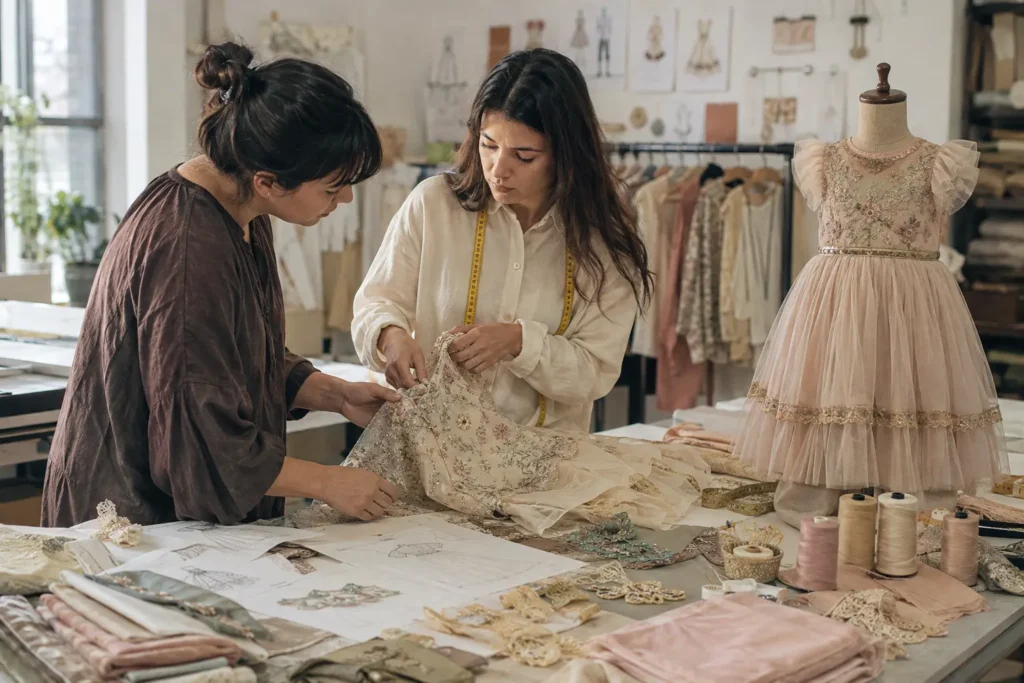
Custom girls’ dress development in a sample room
Where HAPA Is Less Likely to Be the Obvious Choice
If your only priority is buying ready-made stock at the lowest possible price, a pure wholesale supplier may be more efficient than a custom OEM factory.
Likewise, if you are ordering a highly technical category outside our normal kidswear range, the right specialist manufacturer may be a better fit. Good sourcing is partly about knowing when a factory’s strengths match the project – and when they do not.
2. MK Kids – Strong for Babywear and Nursery-Focused Collections
MK Kids publicly positions itself around baby and children’s apparel as well as nursery textile products. Its range includes categories such as rompers, pajamas, dresses, outerwear, swaddles, sleep sacks, blankets, bibs, and related soft goods.
That combination is useful if your brand is building a coordinated baby collection rather than sourcing clothing and nursery products from completely separate supply chains.
Why Overseas Baby Brands May Find It Interesting
A newborn line might include:
- بدلات الجسم
- Rompers
- منامة
- Sleep sacks
- Swaddles
- مرايل
- Blankets
When these products share color palettes, prints, fabric stories, and branding, working with a supplier that understands several adjacent categories can make development easier.
MK Kids also promotes materials such as cotton, organic cotton, bamboo viscose, and blends. For a baby brand, I would still verify each fabric by specification and test result rather than relying on marketing descriptions alone.
What I Would Ask Before Ordering
For babywear, I would ask specifically about:
- Snap attachment
- Neck-opening construction
- Seam comfort
- Fabric shrinkage
- ثبات اللون
- Small components
- Print chemistry
- Sleepwear classification
- ملصقات العناية
- معلومات التتبع
A babywear supplier should understand why these details matter before the conversation reaches bulk production.
Babywear sizing and development review
3. TPC Textile – Strong for Quality-Focused Kidswear and Outerwear
TPC Textile publicly describes a long-running China-based manufacturing operation serving fashion, sportswear, workwear, and kidswear customers, including buyers in Scandinavia, Europe, and North America.
Its kidswear materials emphasize baby clothing and children’s outerwear, with attention to functionality and comfort.
That makes TPC worth investigating if your product is more technical than a basic knit garment.
Product Types That May Fit
Consider TPC for products such as:
- Children’s jackets
- Functional outerwear
- Insulated garments
- Better-quality basics
- Sports-inspired kidswear
- Products using nominated fabrics
For a technical jacket, I would want to discuss zippers, lining, insulation, seam construction, water resistance, reflective elements, and testing. That requires a different production conversation from a simple cotton tee.
Buyer Profile
TPC may be particularly relevant if your organization already has structured specifications, quality expectations, and a clear sourcing process.
If you are producing heavily embellished occasion dresses, I would compare TPC with a fashion-specialist factory rather than assuming one manufacturing model is ideal for every category.
4. Hongyu Apparel – Useful for Startups and Mixed Adult/Kids Collections
Hongyu Apparel is a Dongguan-based custom apparel manufacturer whose public range includes men’s, women’s, and children’s clothing.
A broader category range can be useful when your brand crosses age groups.
Imagine a family-matching collection containing:
- Children’s hoodies
- Adult hoodies
- Kids’ joggers
- Adult sweatpants
- Matching family pajamas
A multi-category manufacturer may be able to coordinate materials and colors across the entire collection more efficiently than separate factories.
Where I Would Use Extra Due Diligence
For specialized children’s categories, ask who inside the organization handles kidswear technical decisions.
You should verify experience with:
- Children’s grading
- Babywear construction
- Small-part attachment
- ملابس النوم
- Target-market testing
- Child-specific fit
Broad capability is valuable, but it is not the same as category depth.
5. Appareify – Worth Evaluating for Scalable Custom Production
Appareify presents itself as a custom clothing manufacturer with a dedicated kidswear offering alongside other apparel categories. Its public materials emphasize private-label development and a broad material range.
For an online brand, the attraction is often scalability.
Your first order may be 300 pieces. If one style becomes a bestseller, your next order could be 3,000. A manufacturing partner that can grow with the program may save you from rebuilding the supply chain just as sales begin accelerating.
Product Types to Consider
Appareify may be worth comparing for:
- تيشيرتات
- هوديز
- ملابس أطفال كاجوال
- Organic-cotton-oriented basics
- مجموعات العلامات التجارية الخاصة
- E-commerce apparel
Capacity Claims Need Context
Whenever a manufacturer advertises a large monthly capacity, I ask a more useful question:
How much capacity is realistically available to my product category during my production window?
A factory group’s total capacity does not necessarily equal the capacity assigned to your specific order.
6. Alamby Fashion – Flexible Fully Customized Private Label
Alamby Fashion operates in southern China and publicly specializes in custom apparel for men, women, and children. Its kidswear materials emphasize fully customized products, branding, care labels, and packaging.
The company also publicly lists a relatively accessible MOQ for certain custom programs, which makes it interesting to smaller brands that need genuine customization without beginning at mass-retail volumes.
Where Alamby May Fit
I would include it in a shortlist for:
- Boys’ clothing
- Girls’ clothing
- ملابس أطفال
- أزياء العلامات التجارية الخاصة
- Custom T-shirts and hoodies
- Small and mid-sized overseas labels
Why Sourcing Location Matters
Alamby is based in Humen, Dongguan, an apparel manufacturing and trading cluster with access to fabrics and trims.
That can shorten sourcing time, but I would still ask whether the approved fabric is a stable production item or simply a market stock fabric. Fast sourcing is useful only when the material can be reproduced when you reorder.
7. AEL Apparel – Suitable for Scalable Casual Kidswear
AEL Apparel is another broad custom clothing operation with a children’s category rather than a children-only factory.
Its public positioning emphasizes international customers, product development, sourcing, and larger-scale apparel production.
That model can work well for repeatable garments where production efficiency is especially important.
Styles That May Suit This Model
- تيشيرتات
- هوديز
- قمصان رياضية
- Leggings
- أطقم ملابس كاجوال
- Sports-inspired pieces
If your order is highly specialized, ask which production facility will handle it and whether that specific team has experience with similar children’s garments.
ما الذي يجب التحقق منه
Ask about:
- Actual production location
- Subcontracting
- الفحص المباشر
- Size-control procedures
- Kidswear references
- Material testing
- Reorder capacity
The name on the quotation matters less than the production system behind the order.
8. MoonYao – Strong for Girls’ Dresses and Occasionwear
Guangzhou MoonYao publicly focuses heavily on girls’ dresses, flower-girl dresses, occasion dresses, and casual cotton dresses.
That specialization immediately makes the company easier to evaluate for boutique girlswear than a general apparel factory that produces everything from gymwear to denim.
Why Guangzhou Helps Fashion Development
MoonYao highlights its proximity to Guangzhou’s large textile sourcing market.
For a dress program, you may need to compare:
- تول
- Lace
- صقيل
- Cotton woven fabrics
- Linings
- Ribbons
- Invisible zippers
- Decorative trims
Being close to a dense fabric-and-trim market can make early sampling faster.
But I would still insist on confirming the bulk material source before approval. The exact swatch you find quickly today may not be available in the same quality six months from now.
Best Buyer Profile
MoonYao is worth researching for:
- Boutique girlswear
- Flower-girl dresses
- Occasion collections
- Fashion-led children’s brands
- Buyers needing a wide choice of decorative fabrics
9. Lezhou Garment – Practical for Hoodies, T-Shirts and Casual Basics
Lezhou Garment is based in Dongguan and publicly focuses on categories such as T-shirts, hoodies, sweatshirts, tracksuits, shorts, and pants for men, women, and kids.
That makes it a logical supplier to investigate for casual collections.
A factory that repeatedly works with jersey, French terry, fleece, rib, printing, and embroidery may be more efficient for a streetwear-style children’s line than a factory focused on woven dresses.
Product Types That May Fit Well
- Kids’ T-shirts
- هوديز
- قمصان رياضية
- بنطال رياضي
- بدلات رياضية
- سراويل
- Casual co-ords
What I Would Test in the Sample
For these garments, I would pay close attention to:
- وزن القماش
- انكماش
- Neckline recovery
- Rib quality
- Print or embroidery durability
- Pocket shape
- بناء غطاء المحرك
- Measurement stability after washing
Casual basics look simple, but poor material selection becomes obvious very quickly after wear and washing.
10. ODMYA – Worth Researching for Broader OEM/ODM Programs
ODMYA publicly promotes OEM and ODM children’s wear alongside broader garment manufacturing categories.
A larger multi-category manufacturer can be attractive if you are coordinating several apparel programs or expect to scale beyond a narrow kidswear collection.
Where This Model Can Work
- Multi-style retail programs
- Larger purchasing organizations
- Buyers sourcing several categories
- Private-label programs with repeat orders
What I Would Clarify First
Before moving forward, I would ask exactly which workshop and team will make your children’s order.
Large organizations often have different units with different expertise. You want to evaluate the actual production team, not only the total size of the company.
Which Manufacturer Type Matches Your Collection?
If you are comparing Chinese Children’s Clothing Manufacturers for Overseas Buyers, product specialization should narrow your list faster than almost anything else.
Complex Girlswear and Decorative Fashion
Start with factories that visibly work with dresses and detailed custom construction, such as HAPA and MoonYao. Alamby may also be worth comparing depending on the design and order size.
Babywear and Nursery Collections
MK Kids deserves attention because its public range combines children’s garments with nursery textiles. HAPA and TPC are also worth evaluating for baby and children’s apparel depending on the exact product.
Functional Outerwear
TPC is a natural comparison point because of its public focus on kidswear and outerwear. For any outerwear program, request evidence of experience with your intended materials and construction.
Hoodies, T-Shirts and Casualwear
Lezhou, Hongyu, AEL, Appareify, and HAPA can all be investigated, but the right choice will depend on fabric, customization, MOQ, and how much product-development support you require.
Private Label Collections
If you want custom labels, hangtags, packaging, and branding, compare factories that already offer these services. At HAPA, our تصنيع الملابس ذات العلامات التجارية الخاصة work connects branding with the approved garment specification rather than treating packaging as an afterthought.
How I Would Qualify a Manufacturer Before Paying a Deposit
A manufacturer list can help you start. It cannot make the decision for you. The strongest Chinese Children’s Clothing Manufacturers for Overseas Buyers still need to pass your own product-specific qualification process.
Here is the process I would use.
Step 1: Send the Same Real Inquiry to 3-5 Factories
Do not begin with “send catalog and best price.”
Send something the supplier can actually evaluate:
- Tech pack or clear sketches
- Reference photos or physical sample information
- نطاق المقاسات
- Quantity per color
- Fabric composition and target weight
- Print or embroidery requirements
- Destination country
- متطلبات الملصقات والتغليف
- Target delivery date
Using the same inquiry package makes quotations more comparable.
Step 2: Evaluate the Factory’s Questions
Price is useful. Questions are more revealing.
When our team reviews a new style, uncertainty is usually concentrated in a few technical areas: measurement method, fabric performance, construction, decoration, or branding. Those are the points we try to clarify before the sample is made.
If a supplier never asks anything about an incomplete tech pack, I would be cautious.
Step 3: Order a Custom Sample
A sample is one of the most effective filters available to you.
Do not judge it only from the front.
Turn it inside out. Measure it. Wash it if relevant. Examine:
- بدل الخياطة
- Stitch consistency
- التناظر
- تقليم الخيوط
- Print edges
- Embroidery backing
- السحابات
- Snap attachment
- موضع الملصق
- الضغط
- Measurement accuracy
The sample also lets you evaluate communication. Did the factory document changes? Did it follow the latest specification? Were substitutions approved first?
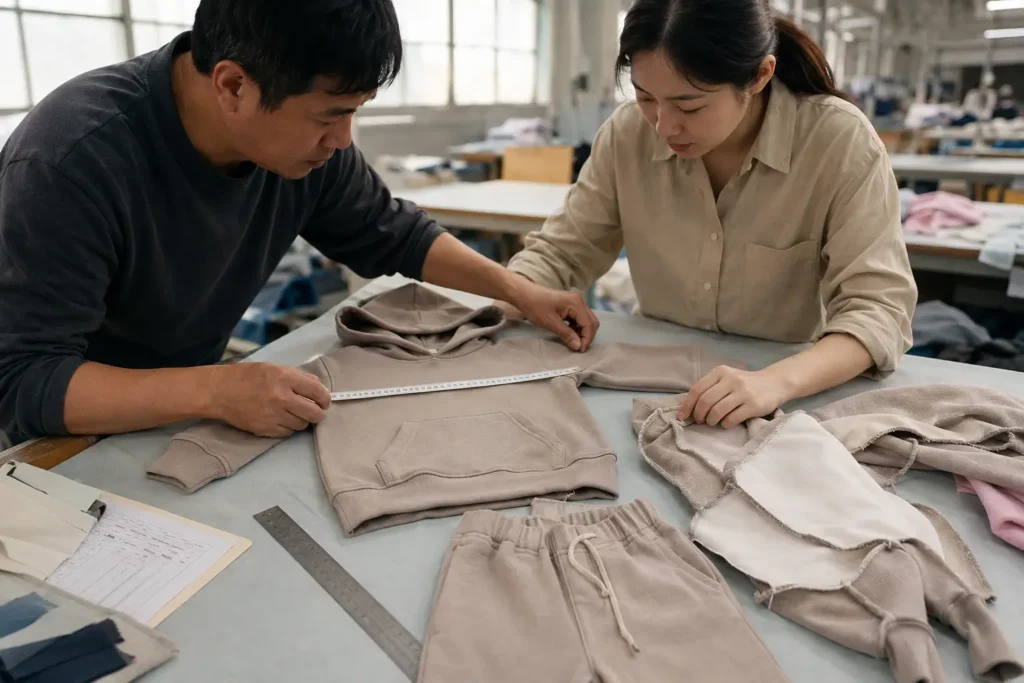
Children’s hoodie sample quality inspection
Step 4: Confirm the Source of Truth
Before bulk production, you and the factory should agree on what controls the order.
Usually that means some combination of:
- عينة ما قبل الإنتاج المعتمدة
- أحدث حزمة تقنية
- جدول القياسات
- Approved fabric and trim swatches
- ملفات العمل الفني
- ملفات التصنيف
- Packaging specification
If one document says 44 cm and another says 42 cm, someone has to resolve that conflict before cutting begins.
Step 5: Verify Production Location and Subcontracting
Ask directly:
- Where will cutting happen?
- Where will sewing happen?
- Is printing internal or external?
- Is embroidery internal or external?
- Who inspects outsourced processes?
- Can I visit or arrange a live video tour?
Outsourcing specialist processes is common in garment manufacturing. What matters is whether those processes are controlled.
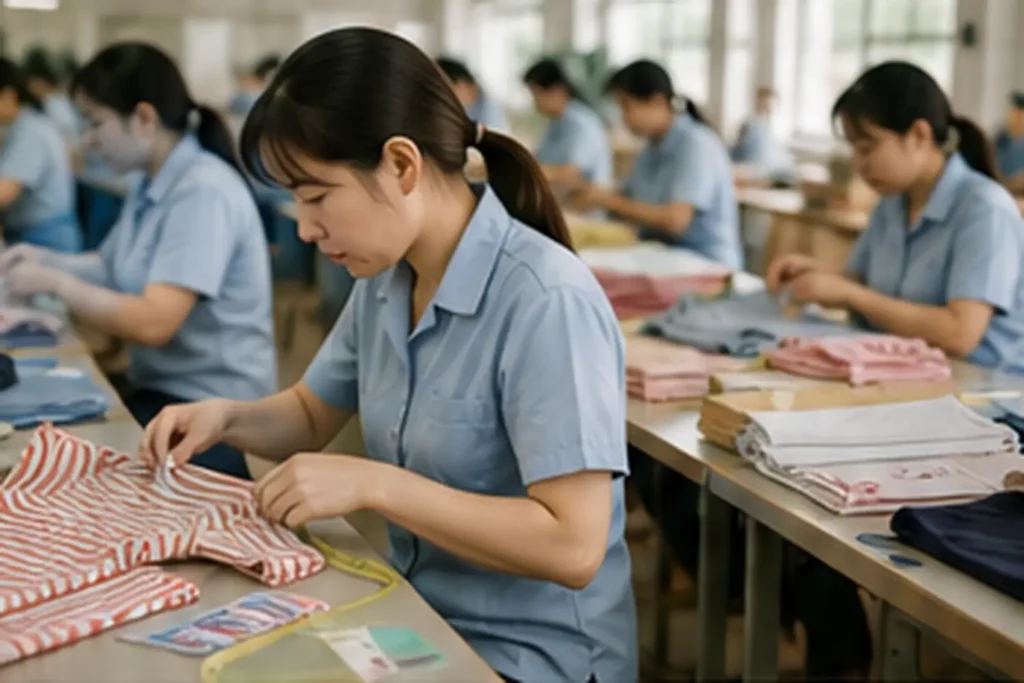
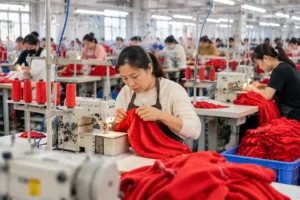
Children’s clothing production and in-line quality control
Step 6: Agree on Quality Standards in Writing
Terms such as “good quality” and “premium workmanship” are too vague for bulk production.
Define:
- Measurement tolerances
- Acceptable visual defects
- Stitch quality
- Print placement tolerance
- Embroidery appearance
- تباين الظل
- وضع الملصقات
- متطلبات التعبئة والتغليف
The factory cannot consistently inspect a standard that has never been defined.
Step 7: Plan Compliance Before Bulk Production
Do not wait until finished goods are packed to ask whether testing is required. Compliance planning is one of the clearest ways to separate experienced Chinese Children’s Clothing Manufacturers for Overseas Buyers from suppliers that focus only on sewing and price.
يتأكد:
- Target market
- تصنيف المنتج
- معايير الاختبار المطلوبة
- Which components need testing
- Laboratory
- Testing schedule
- Who pays
- What happens if something fails
This is especially important if you change fabric, coatings, decorations, trims, or other components after an earlier test.
Step 8: Use Third-Party Inspection When the Risk Justifies It
For a meaningful first order, an independent inspection can provide another layer of control.
At HAPA, we welcome buyer-appointed inspection agencies and third-party QC. You can learn more about our production transparency and facility approach on our HAPA factory and company page.
You do not need third-party inspection for every tiny development order, but the cost can be sensible when the shipment value or retail risk is significant.
What Overseas Buyers Often Get Wrong
After years around children’s apparel production, I see the same sourcing mistakes repeated because they look harmless at the beginning.
Choosing the Cheapest Sample
A cheap sample is irrelevant if the bulk order is inconsistent.
The supplier needs to show that the sample can become a controlled production standard, not simply a one-off garment made by the best sample machinist.
Approving a Fabric Without Testing Reorder Risk
A fabric can look perfect and still be commercially unsuitable if the supplier cannot reproduce it.
Ask whether the material is:
- Regular stock
- Custom production
- Mill-direct
- Market stock
- Subject to dyeing MOQ
Negotiating MOQ Without Understanding the Cause
The sewing factory may accept 100 pieces while the fabric mill requires much more fabric than that order consumes.
Instead of asking only “Can you lower MOQ?” ask:
Which component is creating the minimum?
Sometimes a factory can solve the problem by using stock fabric, combining colors, changing a trim, or choosing a different print technique.
Changing the Design After PP Approval
A small late change can affect pattern pieces, fabric consumption, testing, trims, production scheduling, and cost.
Freeze the design before bulk cutting whenever possible.
Treating Compliance as the Factory’s Responsibility Alone
The factory can support you with material records, testing coordination, and production information. The brand or importer still needs to understand its own market obligations.
That distinction is important.
A Practical Scorecard for Comparing Suppliers
When you reduce your shortlist to three or four Chinese Children’s Clothing Manufacturers for Overseas Buyers, score each supplier using the same criteria.
| منطقة | وزن | What I Would Evaluate |
| Product experience | 20% | Similar garments, materials, techniques, size ranges |
| جودة العينة | 20% | Measurements, construction, finishing, wash performance |
| تواصل | 15% | Technical clarity, speed, version control, problem-solving |
| Material sourcing | 10% | Fabric quality, repeatability, trims, mill transparency |
| ضبط الجودة | 10% | In-line checks, final inspection, corrective action |
| Compliance awareness | 10% | Testing, labeling, traceability, destination-market knowledge |
| Commercial fit | 10% | MOQ, price, payment terms, lead time, capacity |
| Logistics and packaging | 5% | Cartons, labels, shipping documentation, export coordination |
This prevents one attractive number – usually price – from dominating the entire decision.
OEM, ODM, Private Label or Wholesale?
Part of choosing the right manufacturer is understanding what service you actually need.
مصنّع المعدات الأصلية
You already control the product design and provide a tech pack, specification, measurements, artwork, or physical sample.
The factory develops and manufactures according to your requirements.
OEM is appropriate when product differentiation matters and you want more control.
التصميم والتصنيع الأصلي
You have a clear product direction but need more factory support with pattern, materials, construction, or details.
ODM can reduce development work if you are comfortable collaborating with the supplier on product decisions.
العلامة التجارية الخاصة
You want branded products with custom labels, colors, embroidery, prints, or packaging, but the core product direction may already exist.
This can help a brand launch faster.
بالجملة
You purchase ready-made goods.
Development time is lower, but exclusivity and customization are limited.
Comparing a wholesale quote with a fully customized OEM quote is not a fair comparison because they solve different problems.
Are Chinese Manufacturers Suitable for Startup Brands?
Yes, but you should approach the factory like a product-development partner, not an online shop.
A small brand does not need a perfect 40-page tech pack. It does need enough information to avoid guesswork, and the better Chinese Children’s Clothing Manufacturers for Overseas Buyers will usually help you identify what is still missing before sampling.
At minimum, prepare:
- Clear product images
- Target measurements or a reference sample
- Fabric direction
- كمية
- Color count
- Branding requirements
- Target market
- Delivery goal
When a startup sends us that information, we can have a much more productive conversation about whether the project should begin from OEM, ODM, or a private-label route.
The more clearly you explain the outcome, the less time both sides spend correcting assumptions.
Guangzhou, Dongguan or Eastern China: Does Location Matter?
It matters, but less than product fit.
قوانغتشو
Guangzhou is especially useful for fashion development because of its dense ecosystem of fabrics, trims, decoration suppliers, wholesale markets, and apparel businesses.
For a design-heavy collection, being close to sourcing markets can speed up early material matching.
Dongguan and Humen
Dongguan, including Humen, has a deep apparel-manufacturing base with factories specializing in casualwear, fashion, knit garments, and private label.
Jiangsu and Other Eastern-China Clusters
Eastern China has strong textile, knitting, outerwear, babywear, and export-manufacturing capabilities.
Location can influence access to specific supply chains, but I would still choose an excellent factory in the “wrong” city over an unsuitable factory that happens to be near a famous textile market.
Questions I Recommend Asking Every Shortlisted Factory
Before you pay a deposit, send these questions in writing:
1. What is your MOQ per style and per color?
2. Are there separate fabric or trim minimums?
3. What information do you need for an accurate quotation?
4. How long does sample development normally take for this style?
5. Where will cutting and sewing take place?
6. Which processes will be subcontracted?
7. Can I approve the actual bulk fabric before cutting?
8. Will I receive a pre-production sample?
9. How do you control measurements during production?
10. What happens when an in-line defect is found?
11. Can you support third-party inspection?
12. Which testing can you coordinate for my destination market?
13. Who is responsible for labels and tracking information?
14. How do you control fabric substitutions?
15. What is the realistic bulk lead time after approvals?
16. Can you reproduce the same fabric for a future reorder?
17. What are the payment terms?
18. What happens if production is delayed?
19. What packaging services are available?
20. What shipping terms can you support?
A serious supplier should be comfortable discussing these topics.
Red Flags I Would Take Seriously
One warning sign may have an innocent explanation. Several together deserve caution.
The Factory Says Yes to Everything
Experienced manufacturers know their limitations.
If a supplier can supposedly make every product, every material, every quantity, and every deadline without reviewing the specification, I would investigate further.
Bulk Materials Change Without Approval
Substitution can be necessary when a component becomes unavailable, but it should be communicated and approved.
The Production Address Is Unclear
Know who will actually make your goods.
The Quotation Is Incomplete
Check whether the quoted price includes:
- قماش
- الزخارف
- زخرفة
- الملصقات
- التغليف
- الاختبار
- شحن
Testing Questions Are Avoided
Children’s apparel deserves more careful discussion than “our fabric is safe.”
Banking Details Change Unexpectedly
Verify any payment-account change through an independent channel before transferring money.
الأسئلة الشائعة
Which are the best Chinese Children’s Clothing Manufacturers for Overseas Buyers?
There is no single best supplier for every product. HAPA Garments, MK Kids, TPC Textile, Hongyu Apparel, Appareify, Alamby Fashion, AEL Apparel, MoonYao, Lezhou Garment, and ODMYA are all manufacturers worth researching for different reasons. Your shortlist should be based on product category, order volume, customization, compliance needs, and target market.
Which factory is best for complex children’s fashion?
For detailed girlswear, embroidery, sequins, beadwork, and custom fashion development, I would begin by comparing kidswear-focused or dress-focused manufacturers such as HAPA and MoonYao, then evaluate sample quality rather than relying on website claims.
Which manufacturer is strongest for babywear?
MK Kids is particularly relevant because its public product range combines baby and children’s apparel with nursery textiles. HAPA and TPC also warrant consideration depending on the specific babywear product and market requirements.
Can Chinese factories work from a physical sample?
Yes. Many full-service OEM manufacturers can analyze a physical garment, reconstruct or adjust patterns, source equivalent materials, and create a new technical standard. You should explain exactly which parts of the sample should be copied and which should be changed.
Can I start with a small order?
Many manufacturers support smaller development programs, but practical minimums depend on the fabric, color, print, embroidery, trims, and packaging. Ask for the MOQ per style and per color, then ask whether the material supplier has a separate minimum.
Should I visit the factory before ordering?
For a significant first order or long-term program, a visit or third-party audit can be valuable. If you cannot travel, request a live video walkthrough showing the sample room, cutting area, sewing lines, QC stations, and packing area.
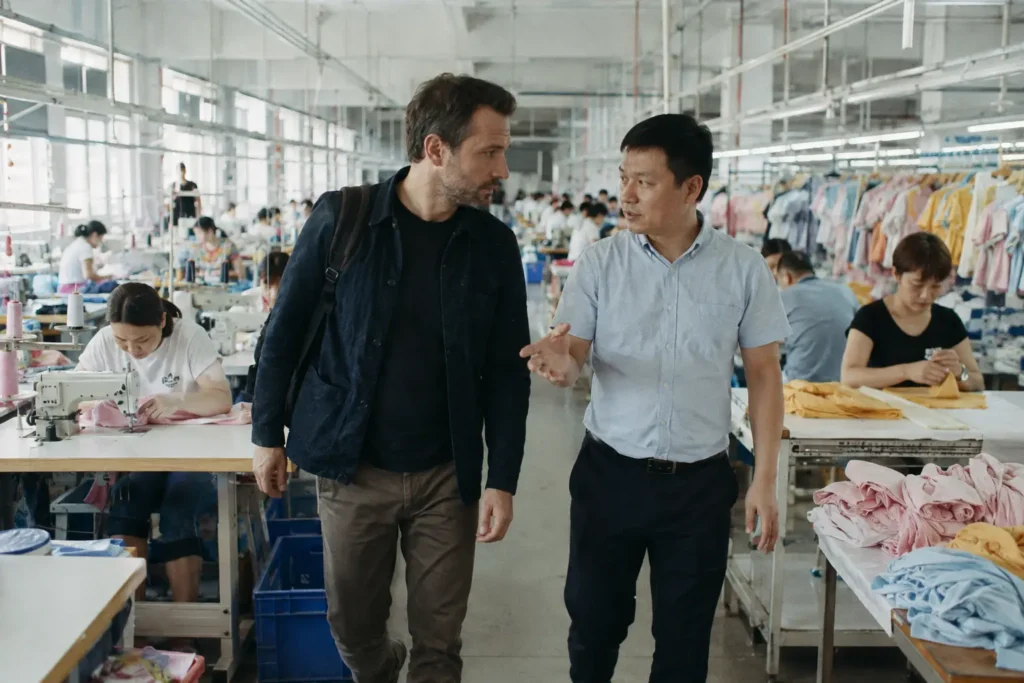
Overseas buyer touring a children’s clothing factory
How many factories should I compare?
I usually prefer three to five serious candidates. That is enough to compare technical capability and commercial terms without creating a sourcing process so large that you cannot communicate properly with any supplier.
Final Thoughts: The Right Factory Is the One That Fits Your Product
The search for Chinese Children’s Clothing Manufacturers for Overseas Buyers becomes much easier once you stop asking which company is “number one” and start asking which production system matches your collection.
If you make baby basics, you need soft-material experience and careful component control.
If you make technical jackets, functional construction matters.
If you make sequined dresses, decoration quality and sample-room skill become much more important.
If you sell basic hoodies at scale, fabric consistency and repeatable sewing may matter more than elaborate development capability.
From our side at HAPA, the most productive overseas projects usually begin with a buyer who explains the product clearly and is willing to make key decisions before production. You do not need to speak factory jargon. You do need to tell us what must be preserved, what can change, where the product will be sold, and what quality level you expect.
That gives the factory something much more useful than a request for “best price.”
When you compare manufacturers, look beyond the quote. Evaluate the sample, the questions they ask, the way they document changes, the materials they propose, the transparency of production, and the quality-control process.
A sourcing partner becomes valuable when it can do more than make one attractive sample. It should be able to turn that approved sample into a controlled, repeatable product across sizes, colors, and future orders.
That is the standard I would use to choose among Chinese Children’s Clothing Manufacturers for Overseas Buyers – and it is the standard I would want an overseas buyer to use when evaluating HAPA as well.